

Choosing the right custom bathroom mirror manufacturer involves much more than comparing unit prices. Hotel developers, contractors, retailers, and distributors need a supplier that can turn project requirements into a clear product specification. The manufacturer must also maintain that specification throughout bulk production.
Professional buyers usually face several practical questions. What can the manufacturer customize? Which materials and electrical components should buyers check? How should they evaluate samples? Which certifications apply to the destination market?
This guide explains the main points procurement teams should review when sourcing custom bathroom mirrors for commercial projects.
What Should You Confirm Before Looking for a Bathroom Mirror Supplier?
Define the basic project requirements before contacting manufacturers. A clear request for quotation helps suppliers recommend suitable models faster. It also reduces repeated revisions during the sampling stage.
Prepare information about the application, mirror shape, approximate dimensions, frame preference, lighting type, and electrical requirements. You should also include the installation method, quantity, destination market, packaging expectations, and delivery schedule.
A hotel guestroom project may prioritize visual consistency, hardwired installation, anti-fog functionality, adjustable lighting, and project-specific finishes.
A retail distributor may focus more on standardized models and private-label packaging. Carton dimensions, barcode requirements, and repeat-order consistency may also play an important role.
A complete initial specification also helps buyers compare each custom bathroom mirror manufacturer on an equal basis.
What Can Be Customized When Ordering Bathroom Mirrors?
Customization does not always require creating an entirely new product. Many commercial projects can start with an existing mirror structure or proven design. Buyers can then adjust selected specifications to suit the project.
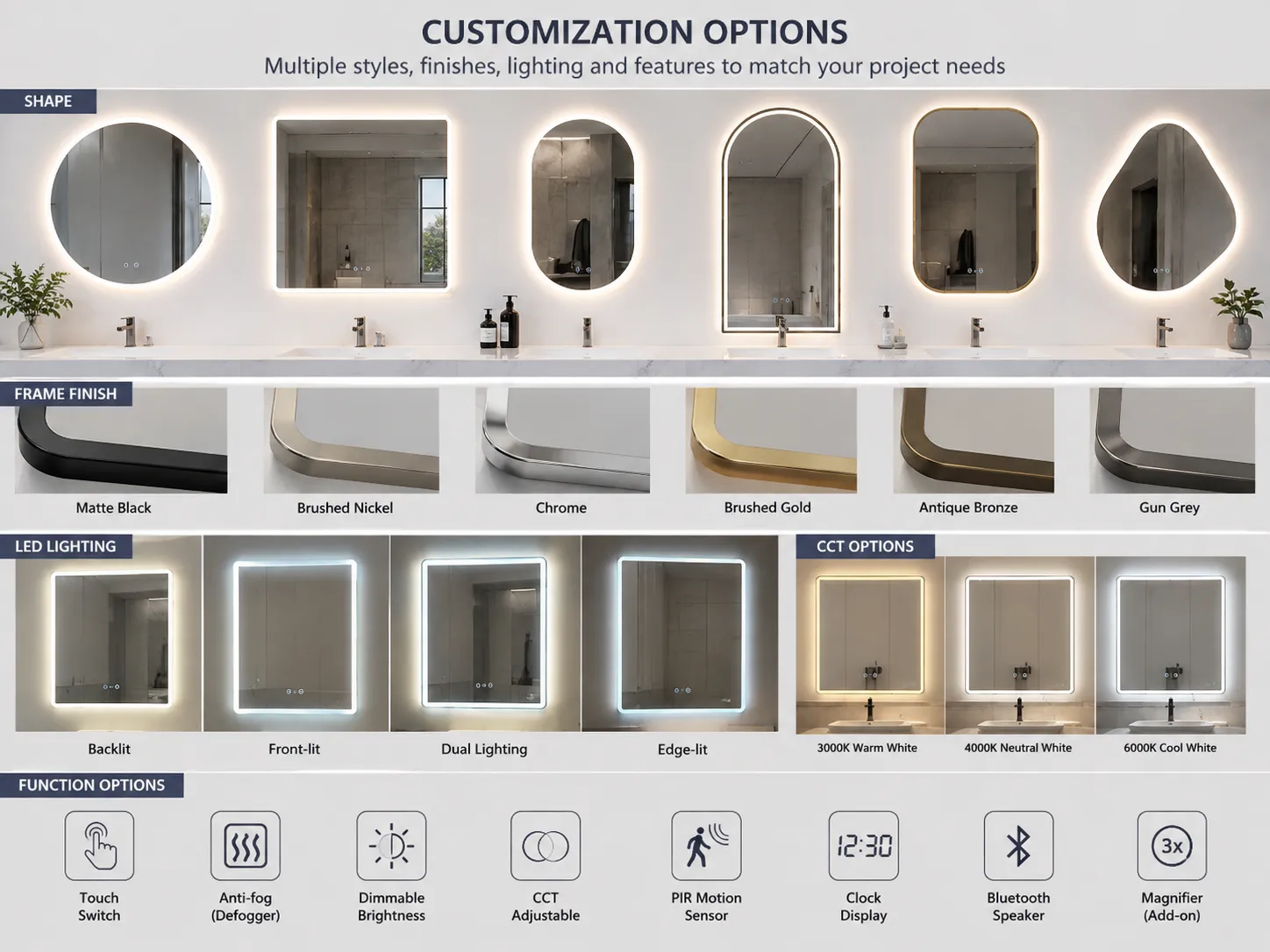
Options depend on the model and project requirements. They may include mirror shapes, frame finishes, lighting configurations, and color temperatures. Buyers can also discuss control systems, anti-fog functions, sensors, electrical specifications, mounting methods, and packaging.
Mirror Shape and Overall Design
Round, rectangular, square, oval, arched, and asymmetrical mirrors suit different design concepts. Hospitality and commercial buyers should coordinate the mirror shape with the vanity, lighting plan, wall dimensions, and interior design.
Buyers should also ask whether the requested shape uses an existing model. Some designs may require additional tooling, structural development, or engineering evaluation.
Frame Material and Finish
Framed bathroom mirrors may use aluminum or stainless steel, depending on the product structure and series. Common finishes include matte black, chrome, brushed nickel, gold tones, antique bronze, and gun grey.
Do not judge an important project finish from a digital rendering alone. Request a physical finish sample or an approved mirror sample when color consistency matters.
LED Lighting Configuration
LED mirrors can use backlit, front-lit, edge-lit, or dual-light structures. Each option creates a different visual effect. The lighting structure can also affect the frame, diffuser, mounting depth, and electrical layout.
Color temperature is another important specification. Common project options include warm, neutral, and cool white light. Some models can also support adjustable CCT and dimming.
Buyers should list the exact functions they need instead of simply requesting a “smart mirror.”
Possible options include touch control, anti-fog, dimming, CCT adjustment, and PIR motion sensing. Clocks, Bluetooth audio, and other functions may also be available on selected models. Always confirm these functions for the specific product and project.
How to Evaluate Mirror Quality and Electrical Components
A good-looking sample is only one part of supplier evaluation. Commercial buyers should also inspect the components behind the mirror. These components affect installation, service life, maintenance, and product consistency.
Mirror Glass
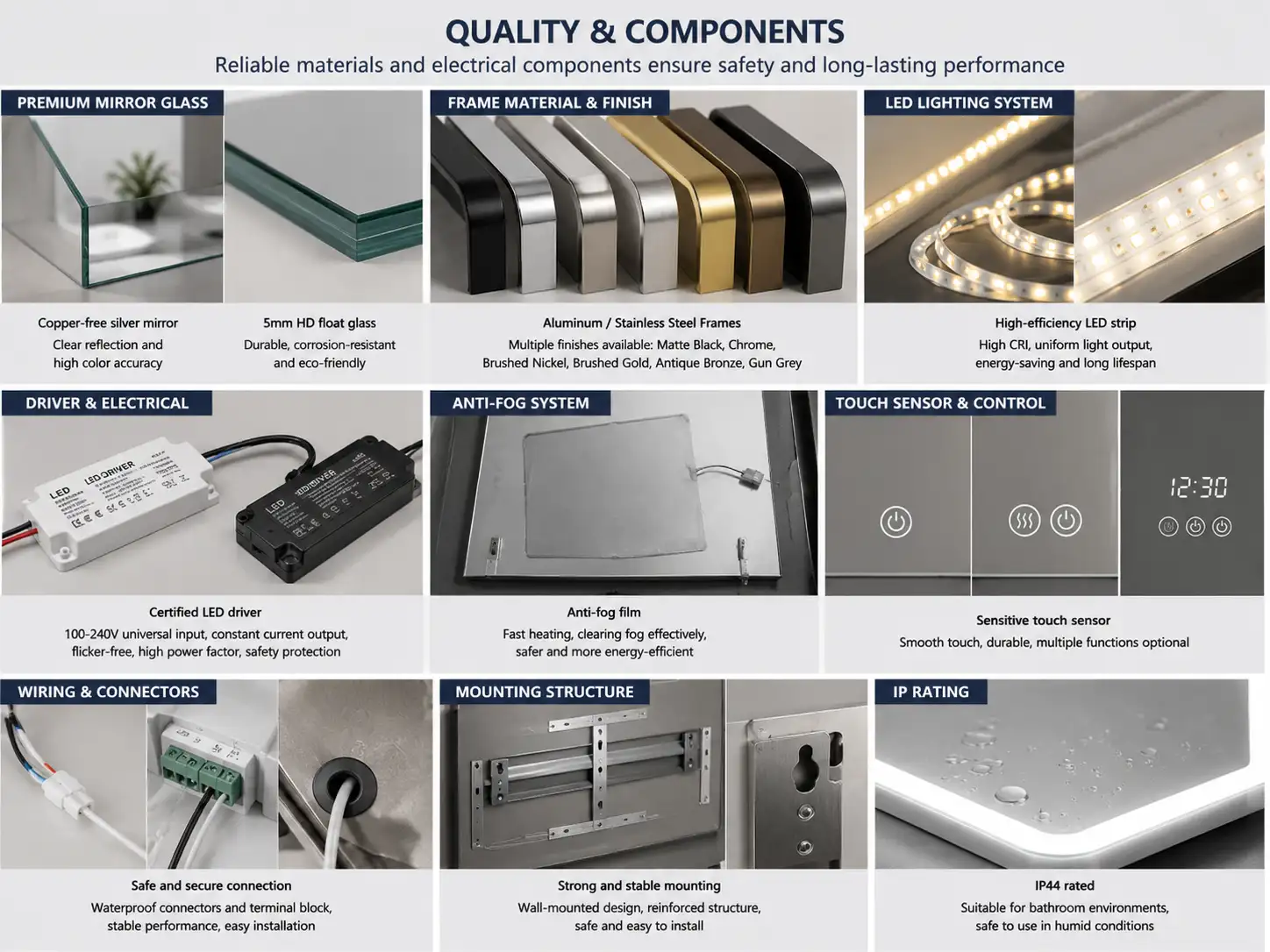
Inspect the mirror surface for distortion, dark spots, edge defects, scratches, and inconsistent reflection. Also check the processing quality around cut-outs or shaped edges.
Confirm the glass thickness and mirror construction for the selected product. Do not judge these specifications from appearance alone.
LED Strip and Light Uniformity
Check whether the LED lighting appears even around the illuminated area. Look for obvious dark zones, excessive hotspots, or noticeable color differences.
Consistency becomes especially important in multi-room projects. A good sample has little value if later production batches show different brightness or color temperatures.
LED Driver and Electrical System
Buyers should confirm the input voltage, driver specification, wiring method, and installation requirements. They should also check the electrical configuration required by the destination market.
Some NISSIYA LED bathroom mirror configurations use wide-range AC input with a low-voltage LED driver. Buyers should confirm the exact electrical structure for the selected model before ordering.
Anti-Fog System
If the project requires anti-fog functionality, confirm the control method and heating area. Buyers should also check whether the selected configuration includes the defogger.
The anti-fog pad normally heats a defined section of the mirror. It does not necessarily heat the entire glass surface.
Touch Controls and Optional Functions
Test touch switches for consistent response. Buyers should also test dimming, CCT adjustment, anti-fog, memory, and any other specified functions.
Commercial projects do not always need the longest feature list. A simpler control system may offer easier operation and maintenance.
Mounting Structure
Do not overlook the back structure during sourcing. Inspect the mounting brackets, frame strength, cable routing, electrical access, wall clearance, and installation orientation.
This step is especially important for hotel and apartment projects. Installers may need to mount dozens or hundreds of mirrors using the same procedure.
Which Certifications Should a Custom Bathroom Mirror Manufacturer Provide?
Certification requirements vary by destination market, mirror configuration, and project specification. One certification does not automatically satisfy every country or electrical requirement.
NISSIYA works with mirror products and configurations associated with requirements such as ETL, SAA, CE, RoHS and IP44. Buyers should confirm which requirements apply to the exact model and electrical configuration. They should also check the requirements of the destination market before placing an order.
Hotel groups, contractors, retailers, and local electrical consultants may have their own approval requirements.
Discuss certification early in the sourcing process. Do not wait until bulk production has already started.
Manufacturer or Trading Company: What Matters Most?
Buyers often ask whether they should work directly with a factory or use a trading company. A more useful question is whether the supplier can control the product specification and production process.
A capable manufacturer should discuss technical details directly and explain available product structures. It should also provide realistic customization boundaries and support sample development.
The supplier should maintain clear communication between sales, engineering, production, quality control, and packaging teams.
For a custom bathroom mirror manufacturer, identifying potential problems before production adds real value. Simply agreeing to every requested feature does not.
A professional supplier should explain when an existing model is suitable and when a modification is practical. It should also identify changes that may create unnecessary cost or technical risk.
Why Sample Approval Is Critical Before Bulk Production
Commercial buyers should treat the approved sample as more than a visual reference. It should become a physical benchmark for production.
Check the dimensions, shape, frame finish, mirror quality, LED color, and brightness during sample review. Test the control functions, anti-fog operation, wiring, and mounting structure. Buyers should also review labeling and packaging.
For framed products, inspect joints, corners, finish consistency, gaps, and alignment. For LED mirrors, test the product several times rather than switching it on only once.
Document any requested changes after sample inspection. Confirm those changes with the supplier before mass production begins.
How Does a Custom Bathroom Mirror Manufacturer Control Bulk Production?
Repeatability is one of the biggest differences between buying a single mirror and purchasing for a commercial project.
A project may require dozens or hundreds of units. Every unit should look and function consistently when installers place the mirrors in the same building or retail program.
Ask how the supplier controls incoming materials, frame finishes, LED components, and electrical assembly. Buyers should also understand the supplier's functional testing, appearance inspection, and final packing procedures.
For larger projects, agree on an approved sample and specification sheet. An inspection standard and pre-shipment quality review can provide additional control.
NISSIYA has more than 20 years of mirror manufacturing experience. The company supports OEM and ODM requirements for hospitality, commercial, retail, and distribution buyers.
The goal of project production goes beyond creating an acceptable first sample. A manufacturer must reproduce the approved specification consistently throughout the order.
Why Packaging Matters When Buying Bathroom Mirrors in Bulk
Mirrors are fragile products. Packaging becomes especially important when orders pass through warehouses, containers, ports, distribution centers, and final project sites.
A low unit price can quickly lose its advantage when weak packaging causes damage. Broken glass, damaged corners, scratched frames, and replacement shipments all increase the real project cost.
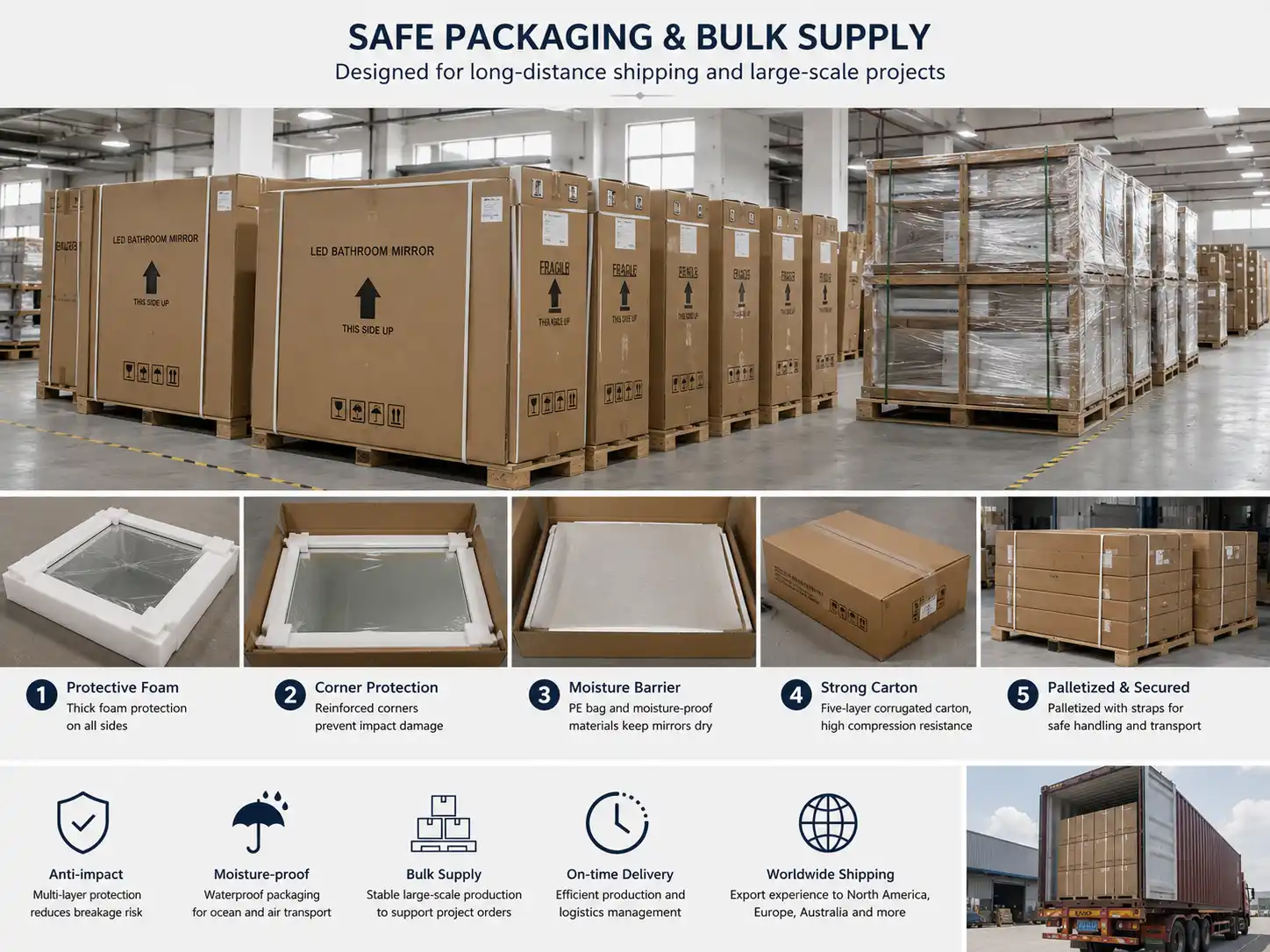
Packaging options depend on the mirror type, order size, and shipping method. Solutions may include protective foam, corner protection, surface protection, reinforced cartons, pallets, or wooden structures.
A hotel project may also need different packaging from a supermarket or e-commerce program.
Retail buyers may require private-label cartons, printed information, barcodes, manuals, or specific carton dimensions. Project buyers may focus more on job-site identification and safe bulk handling.
Discuss packaging during product development. Do not leave this decision until production is complete.
MOQ, Lead Time and Production Capacity
Buyers should evaluate MOQ together with the level of customization. Existing models may support more flexible quantities. Specialized frames, finishes, structures, or packaging may require a larger production quantity.
Break the lead time into separate stages. These may include specification confirmation, sample production, approval, material preparation, mass production, inspection, packing, and shipping.
Provide the target delivery date at the beginning of a time-sensitive project. The supplier can then evaluate whether the production schedule is realistic before finalizing the purchase order.
Hotel Projects and Retail Programs Require Different Sourcing Strategies
Not every commercial buyer needs the same mirror solution.
Hospitality projects often focus on interior coordination, electrical integration, durability, installation, and room-to-room consistency. Project approval procedures may also influence the final specification.
See examples of NISSIYA's approach to this market on the Hospitality LED Mirror Projects page.
Retailers and distributors often focus on existing product ranges and private labeling. Packaging efficiency, repeatability, logistics, and long-term product programs may carry more weight.
Buyers can also review NISSIYA's mirror solutions and bathroom mirror product collections before preparing an RFQ.
Bathroom Mirror RFQ Checklist for Buyers
Use this checklist before requesting a quotation. It helps ensure that the supplier receives the most important project information.
| RFQ Item | Information to Provide |
|---|---|
| Application | Hotel, apartment, commercial restroom, retail, distribution or other use |
| Mirror Type | LED mirror, framed mirror, backlit, front-lit, dual-light or non-lighted |
| Shape & Dimensions | Required shape and target dimensions |
| Frame | Material, finish and color preference |
| Lighting | Backlit, front-lit, dual-light, brightness and required CCT |
| Functions | Anti-fog, dimming, touch control, CCT, PIR or other required functions |
| Electrical | Voltage, hardwired or plug-in installation and destination market |
| Certification | Required certification or project compliance standard |
| Quantity | Sample quantity and estimated bulk order quantity |
| Packaging | Project packing, private label, retail carton or other requirements |
| Delivery | Destination country, required delivery window and shipping expectations |
Common Mistakes to Avoid When Sourcing Custom Bathroom Mirrors
Do not compare quotations only by unit price. First check whether the suppliers are quoting equivalent specifications. Two mirrors can look similar in photographs while using different frames, lighting systems, drivers, packaging, or finishing processes.
Another mistake is adding functions that the final application does not need. More features do not automatically create a better commercial product.
Every additional function adds another component to source, test, install, and maintain.
Do not leave certification, installation, packaging, or finish approval until the end of the project. These decisions can affect the product structure and should form part of the initial specification.
Finally, do not rely only on renderings or catalog photographs when appearance consistency matters. Physical samples provide a much stronger reference for commercial mirror approval.
How to Choose the Right Custom Bathroom Mirror Manufacturer for Your Project
The best supplier is not necessarily the company with the longest feature list or the lowest initial quotation.
A reliable custom bathroom mirror manufacturer should understand the intended application and clarify specifications. It should explain customization limits, support sample approval, and manage production consistency. The supplier should also prepare suitable packaging for the final delivery route.
B2B sourcing becomes easier when buyers discuss the project as one complete system. Product design, electrical requirements, certification, installation, quality control, packaging, and delivery all need to work together.
A detailed RFQ helps procurement teams make better supplier comparisons. Evaluating both the visible mirror and its internal components can also reduce avoidable risks before a commercial order begins.
Ready to Start Your Next Hospitality Project?
From initial design concepts to final product delivery, NISSIYA provides full-scale manufacturing support for hotels, resorts, and commercial developments worldwide. Let our engineering team help you translate your vision into reality with precision-engineered, commercially compliant mirror solutions.