
Yes—a well-designed LED bathroom mirror can provide enough light for everyday makeup and shaving. When assessing LED mirror brightness, check how evenly the light reaches your face and whether you can see fine details comfortably.
You should be able to see both cheeks, the eye area and your jawline without leaning over the basin or turning your head to find better light. For a hotel bathroom, this everyday experience matters more than how bright the mirror looks in a photograph.
How Bright Should an LED Mirror Be?
There is no single lumen figure that makes every LED mirror bright enough. The useful brightness depends on the mirror size, lighting direction, illuminated area, viewing distance, vanity depth and the other lights in the bathroom.
For makeup and shaving, the key question is not simply how many lumens the mirror produces, but how much usable light reaches the face. A mirror can have a strong total light output while still leaving shadows around the eyes, cheeks or jawline if most of the light is directed toward the wall instead of the user.
For project comparisons, review the mirror’s lumen specification together with lux measured at the normal face position. Keep the mounting height, viewing distance, dimming level, color setting and surrounding lighting conditions consistent when comparing samples.
In hotel bathrooms, the best LED mirror brightness is therefore the level that allows guests to see facial detail comfortably without leaning forward, experiencing distracting glare or relying on an unrealistic test setup.
Why can a mirror look bright while your face looks dark?
Start with the direction of the light.
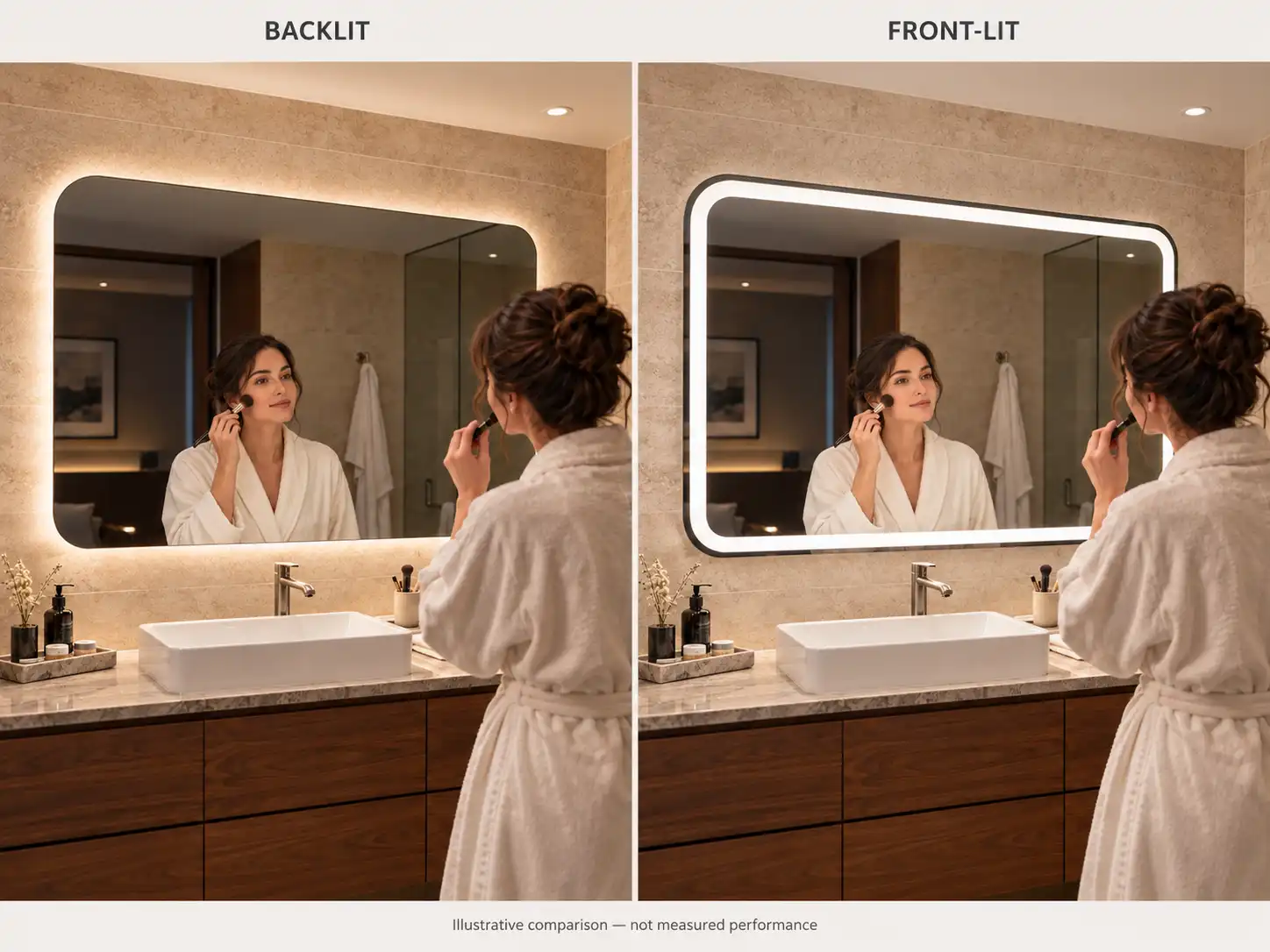
On a backlit mirror, the LEDs mainly illuminate the wall behind the glass. The halo can look striking while providing relatively little direct light to the face.
A front-lit mirror sends light toward the user through illuminated areas on the front. A dual-light mirror adds a rear glow to this frontal illumination. For makeup and shaving, pay particular attention to the light coming from the front.
The NISSIYA F-Series front-lit bathroom mirror is one example of this front-facing lighting arrangement.
The size and position of the illuminated areas also matter. A bright band above your head will light your face differently from illuminated sections extending down both sides. Check for shadows around the eyes and under the chin when comparing samples.
For the structural differences, see our backlit vs front-lit bathroom mirror guide.
A backlit mirror can still work well with suitable vanity lights. Judge the complete lighting arrangement at the position where guests will stand.
LED mirror brightness: watts, lumens and lux
To compare LED mirror brightness, first check what each figure measures. Watts, lumens and lux describe different things.
| Figure | What it tells you | What to check |
|---|---|---|
| Watts (W) | Electrical power consumption | Does the figure cover lighting alone, or also the defogger and other functions? |
| Lumens (lm) | Total visible light output | Is the figure for the finished mirror or just the LED light source? For dual-light models, does it combine front and rear output? |
| Lux (lx) | Light arriving at a surface | Where was it measured, at what distance, and with which other lights switched on? |
Watts measure power consumption. A higher total wattage may include a larger defogger rather than more lighting power. Lumens describe light output, but they do not tell you where the light lands. The Australian Government’s lighting guide explains the difference between power consumption and light output.
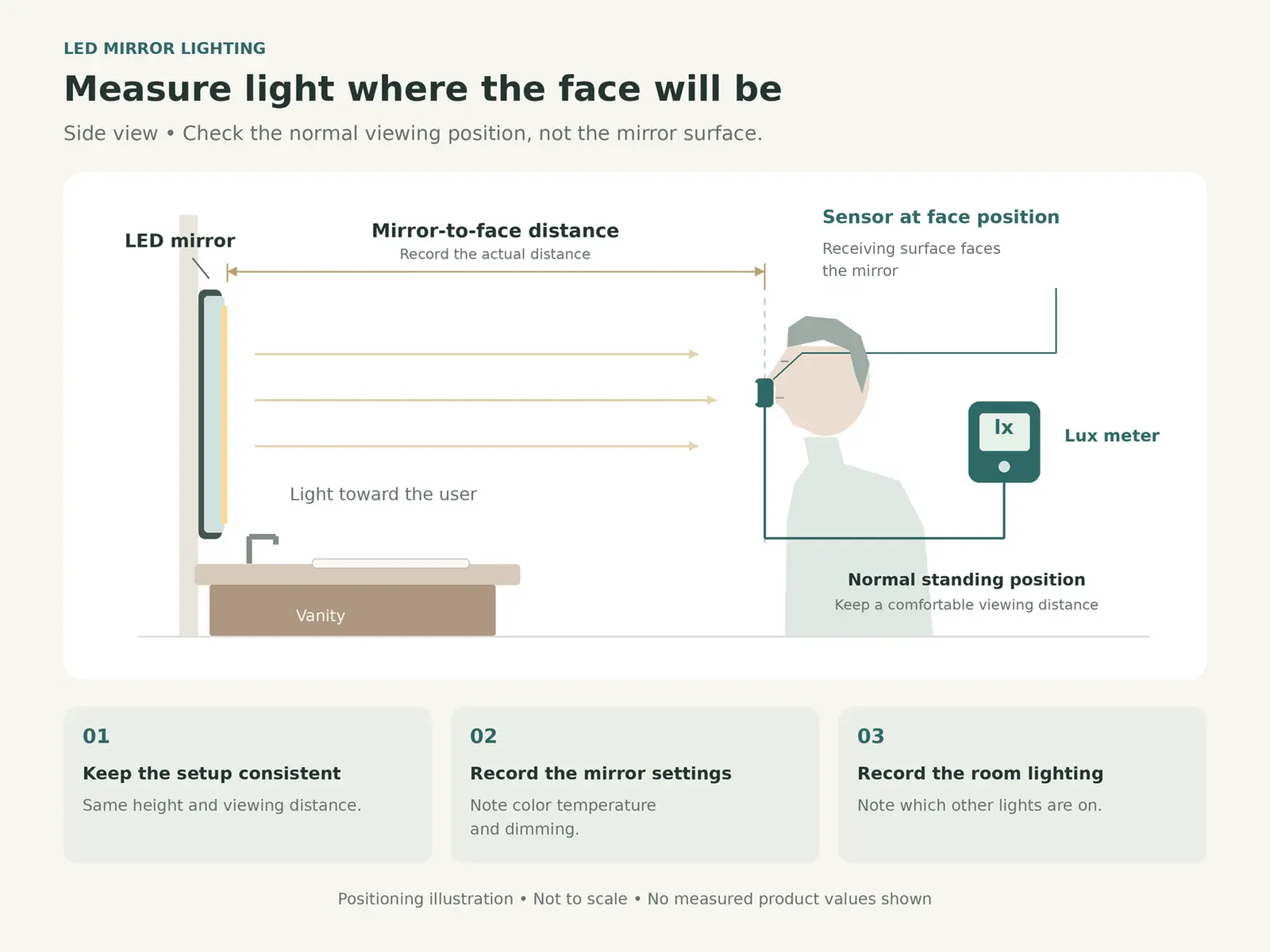
Lux readings help assess the light reaching the user. Place the illuminance meter’s sensor at the normal face position, with its receiving surface facing the mirror. Sensor position and orientation affect the result, as Konica Minolta’s measurement guide explains.
For example, a reading taken close to the illuminated strip does not show what a guest receives when standing behind the basin. A countertop reading also measures a different surface from the face.
Compare lux figures only when the measurement conditions match. If your project specifies a target, confirm the required position, sensor orientation and lighting arrangement before evaluating the sample.
Does cooler light make makeup easier?
LED mirror brightness does not tell you how accurately makeup colors will appear. Color temperature and color rendering need separate checks.
A 6000K setting looks cooler than 3000K. The higher Kelvin number does not mean more light reaches the face, and changing color temperature cannot correct an awkward lighting position.
Color rendering describes how faithfully colors appear compared with a reference light source. It matters when judging foundation, blush and skin tone. Poor color rendering can make makeup difficult to judge even when the face is well lit.
Check the declared color rendering index, or CRI, for the selected configuration, then try the sample’s color settings in person. The Australian Government’s lighting guide explains why color temperature and CRI describe different characteristics.
Our 3000K, 4500K and 6000K comparison covers the differences in color appearance.
How to test LED mirror brightness in a hotel bathroom
A sample lets you assess LED mirror brightness at the intended viewing position. Arrange a practical check in a mock-up bathroom or a setup that closely matches the finished room.
1. Recreate the normal viewing position
Have the sample safely installed at the proposed height and reproduce the vanity depth as closely as possible. Ask people of different heights to stand where guests would normally stand.
Can they see clearly while standing comfortably? If they have to lean far over the basin, record that limitation before approving the mirror and vanity combination.
2. Check facial detail and comfort
Check both cheeks, the eye area and the jawline. Try everyday tasks such as inspecting a foundation blend, viewing eyebrow detail or checking the beard line.
Note any dark patches or distracting glare. If the illuminated border is uncomfortable to look at while facial details remain unclear, review the lighting position and distribution before increasing the output.
3. Compare three lighting conditions
Exclude daylight or keep it consistent, then compare three settings: the mirror light alone, the other bathroom lights alone, and both together.
This shows what each source contributes. With a backlit model, check whether the separate vanity lights provide enough facial illumination. Make the final assessment using the combination guests will actually use.
4. Record a repeatable comparison
Record the model, mounting height, viewing distance, color setting, dimming level and other lights in use. Keep the lux meter’s sensor position and orientation consistent when comparing samples.
Can the mirror replace the other bathroom lights?
A mirror can provide enough light for shaving while leaving the shower, toilet or other areas poorly lit. Assess facial lighting and general bathroom lighting separately.
A front-lit mirror may supply the required grooming light while other fixtures illuminate the wider room. Alternatively, a backlit mirror can provide the desired appearance while separate vanity lights illuminate the face.
Before approving the sample, have someone use it at the planned vanity position. Can they judge a foundation blend or see the beard line clearly, without leaning forward or struggling with glare? Record that result alongside the lighting settings and measurements.
Ready to Start Your Next Hospitality Project?
From initial design concepts to final product delivery, NISSIYA provides full-scale manufacturing support for hotels, resorts, and commercial developments worldwide. Let our engineering team help you translate your vision into reality with precision-engineered, commercially compliant mirror solutions.