
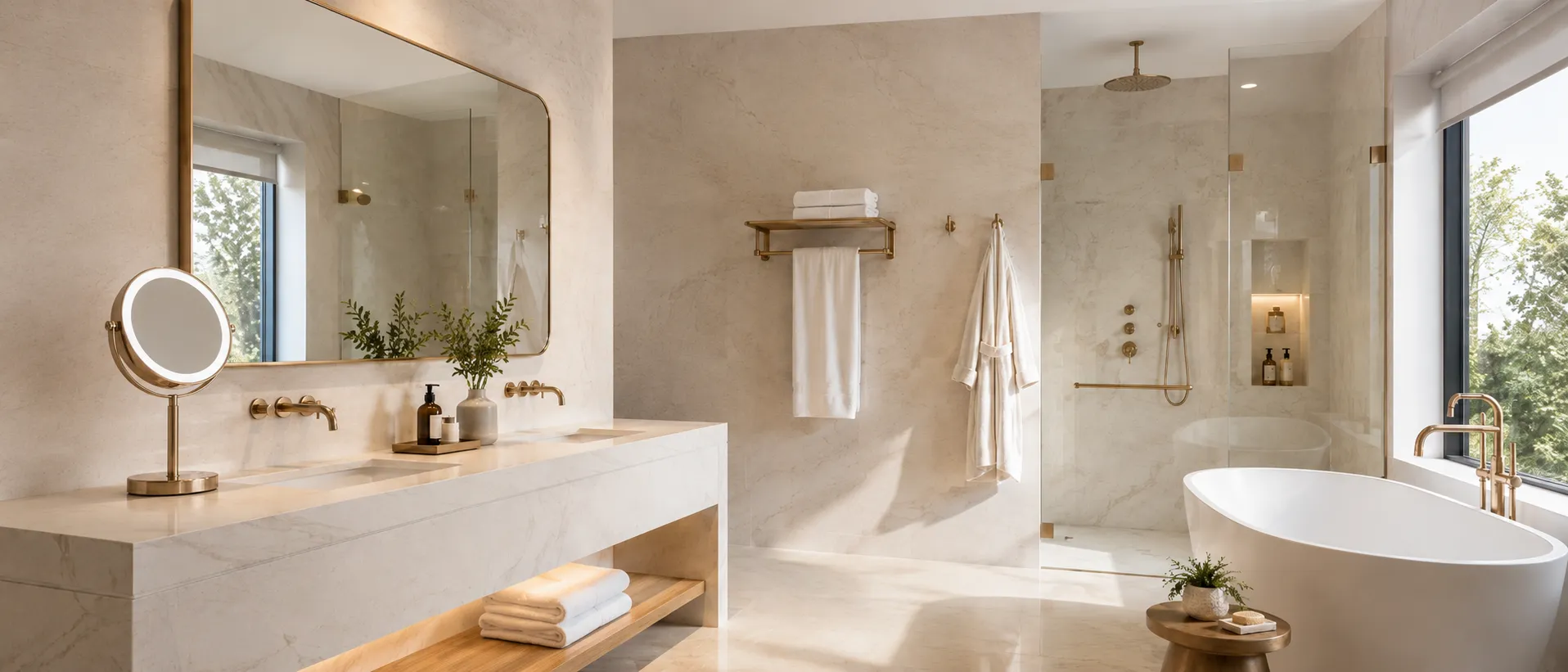
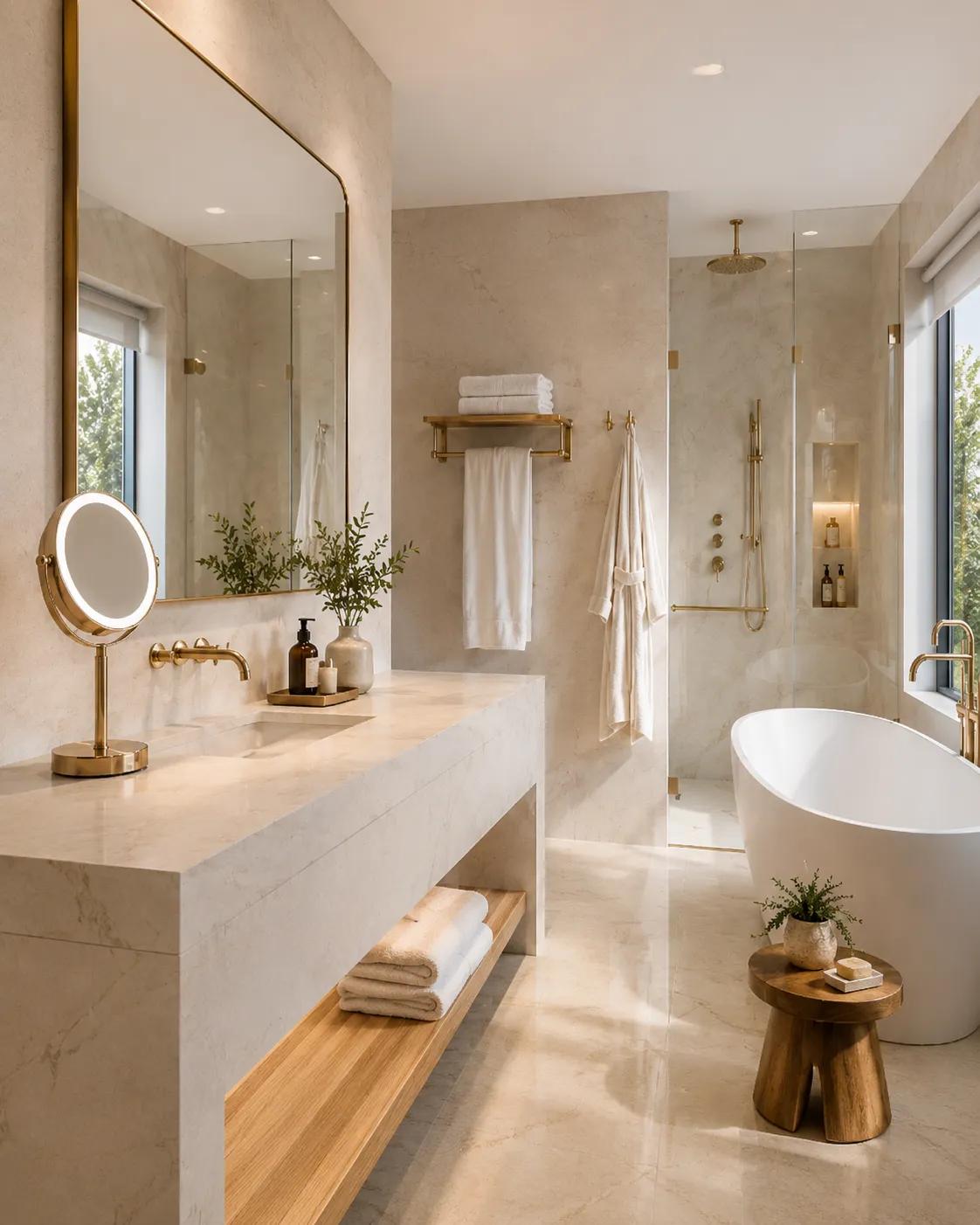
If your bathroom already has a large vanity mirror, you may wonder whether a makeup mirror for bathroom use is still necessary. After all, both show your reflection, but a main bathroom mirror and a makeup mirror serve different viewing needs.
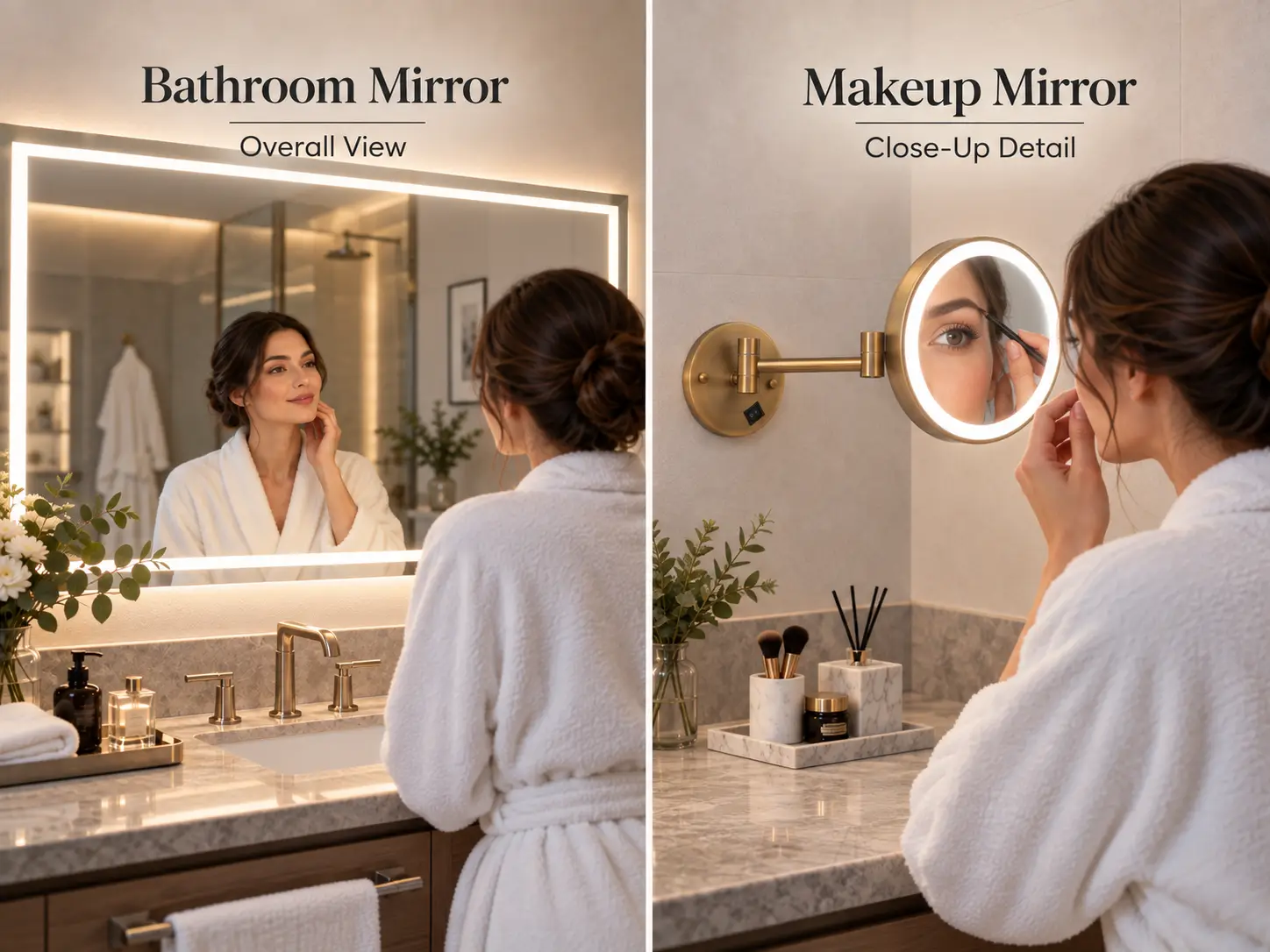
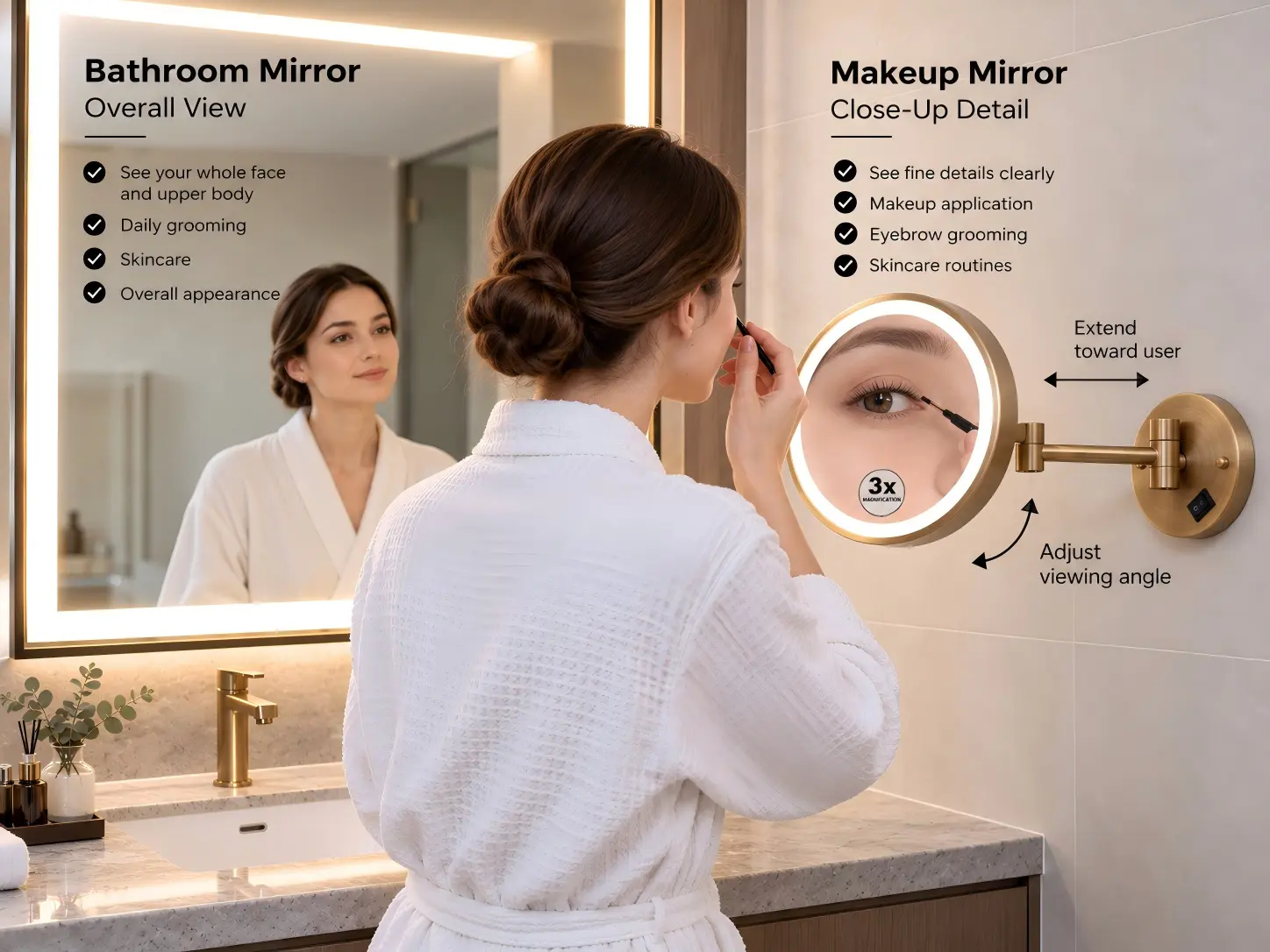
A bathroom mirror usually helps you see your overall face, hair and appearance. A lighted makeup mirror brings the viewing surface closer and can add magnification, adjustable positioning or dedicated facial lighting for smaller details.
Bathroom mirror vs makeup mirror: what is the difference?
The main difference comes from viewing distance and purpose rather than appearance.
Most bathrooms place the main mirror above the basin or vanity. Its large reflective area works well for washing, styling hair, checking clothing, shaving and general grooming. Many modern bathroom mirrors also offer LED lighting, anti-fog functions and adjustable color temperature.
A makeup mirror uses a much smaller viewing surface. You can mount one on an extendable wall arm or choose a countertop model. The smaller mirror lets you bring the reflection closer and, with magnification, inspect specific areas of the face in greater detail.
| Feature | Bathroom Mirror | Makeup Mirror |
|---|---|---|
| Main purpose | Shows the overall reflection for everyday bathroom use | Helps with close-up grooming and facial detail |
| Viewing area | Provides a large viewing area | Focuses on a smaller facial area |
| Viewing position | Usually stays above the vanity | Lets the user extend, tilt or rotate the mirror on many models |
| Magnification | Normally provides a 1X reflection | May offer 1X, 3X, 5X, 10X or other options depending on the model |
| Lighting | May use front, back or dual LED lighting | Comes in both lighted and non-lighted designs |
| Typical use | Supports washing, styling, grooming and checking overall appearance | Supports makeup, eyebrow work, shaving and close facial inspection |
When is your bathroom mirror already enough?
Not every bathroom needs a separate makeup mirror.
If the main mirror sits at a comfortable height, the vanity has a reasonable depth and the lighting reaches your face well, you can handle many everyday grooming tasks with the bathroom mirror alone.
You may not need an additional makeup mirror if:
- You rarely use magnification for makeup or grooming.
- You can see facial details comfortably from your normal standing position.
- The vanity lets you get close enough without leaning far over the basin.
- Your bathroom already gives your face enough light from the mirror or other fixtures.
- You prefer a simpler wall layout with fewer fixtures.
A well-designed LED bathroom mirror can also make a big difference. Good frontal illumination improves facial visibility and may reduce the need for stronger magnification.
When does a makeup mirror become useful?
A makeup mirror becomes useful when you keep moving your body toward the main mirror just to see smaller details.
For example, a deep vanity countertop can create a large gap between the user and a wall mirror. Someone applying eyeliner, checking eyebrow detail or inspecting a shaving area may lean across the basin to get a closer look.
A wall-mounted makeup mirror with an extension arm changes that situation. The user can pull the smaller mirror forward and bring the viewing surface to a comfortable position.
Close-up makeup application
Eye makeup, eyebrows and other small facial details become easier to inspect when you bring the mirror closer to your face. Magnification also enlarges the viewing area without requiring you to lean toward the wall.
Detailed shaving and grooming
A magnifying mirror also helps users inspect the chin, jawline and other small facial areas that may look unclear from a distant bathroom mirror.
Flexible viewing angles
Many wall-mounted makeup mirrors use adjustable arms and rotating mirror heads. These mechanisms let users change the mirror position instead of changing their posture to match a fixed mirror.
Does a lighted bathroom mirror make a makeup mirror unnecessary?
Not necessarily. Lighting and magnification solve different problems.
A good LED bathroom mirror can send useful light toward the face. A front-facing lighting design can provide enough illumination for makeup and shaving when the mirror and vanity layout work well together.
For broader guidance on bathroom and household lighting, the Australian Government's lighting guide explains the differences between light output, energy use and lighting design.
A makeup mirror offers another advantage that a large bathroom mirror usually cannot provide: a close-up or magnified reflection that the user can bring closer.
A bathroom can therefore have excellent lighting and still benefit from a separate magnifying mirror. On the other hand, a magnifying mirror cannot compensate for poor lighting if shadows still cover the face.
Think of the two mirrors as complementary tools. The main bathroom mirror handles the overall view, while the makeup mirror handles close-up detail.
Why do hotels often use both mirrors?
This difference matters even more in hotel bathrooms because many guests with different routines use the same space.
One guest may use the main bathroom mirror only for brushing teeth and checking overall appearance. Another may want a closer view for makeup. Someone else may use magnification for shaving or detailed grooming.
The main bathroom mirror gives guests the broad reflection they expect above a vanity. A smaller makeup mirror adds another viewing option without changing the role of the primary mirror.
Hotel designers and purchasing teams do not need to add a makeup mirror to every bathroom. Instead, they can evaluate the hotel positioning, vanity layout, available wall space, lighting plan and intended guest experience.
A deep countertop provides a good example. If guests must lean forward to see facial details, an extendable wall-mounted mirror can bring the reflection toward them and improve comfort.
Should you choose a lighted or standard makeup mirror?
Once a project decides to add a second mirror, the next question involves lighting.
Lighted makeup mirrors
A lighted makeup mirror adds its own light source around or near the smaller viewing surface. This extra light can help when the main bathroom lighting does not illuminate the close-up viewing position well enough.
NISSIYA offers existing models with different magnification levels, LED lighting arrangements, switches, finishes, arm structures and installation methods. Buyers can select the configuration that best matches the project requirements.
Standard makeup mirrors
A standard makeup mirror uses no integrated LED system. It works well when the bathroom already provides enough facial lighting and the user mainly needs magnification or adjustable positioning.
The simpler structure also removes the need to supply power directly to the mirror.
| Consideration | Lighted Makeup Mirror | Standard Makeup Mirror |
|---|---|---|
| Dedicated facial light | Adds its own local light source | Relies on existing bathroom lighting |
| Magnification | Offers different magnification options depending on the model | Offers different magnification options depending on the model |
| Electrical requirement | Uses power according to the chosen configuration | Generally requires no electrical connection |
| Best suited to | Bathrooms that need both close viewing and additional local lighting | Bathrooms that already have enough light but need close-up viewing |
What magnification should a bathroom makeup mirror have?
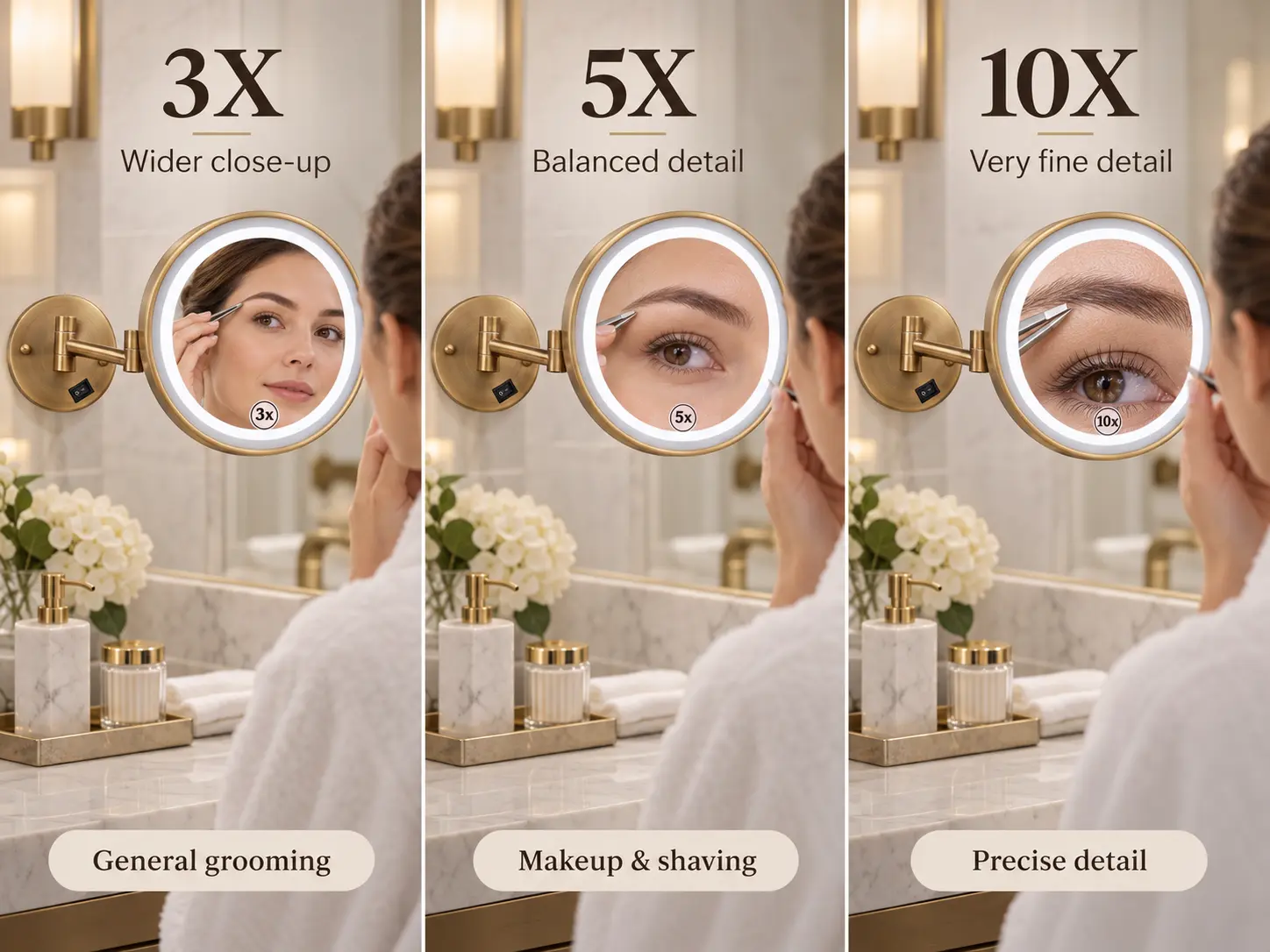
Higher magnification does not always give a better user experience. As magnification increases, the visible area becomes smaller and the user must position the mirror more precisely.
A 3X mirror gives a relatively wide close-up view and works well for general grooming. A 5X mirror shows more facial detail and suits tasks such as makeup, eyebrow work and shaving. A 10X mirror enlarges very small details but usually requires the user to bring the mirror closer and find a more precise viewing position.
Hotel projects need a mirror that works for many different guests rather than one person's individual routine. For that reason, designers should consider viewing comfort and ease of positioning alongside the magnification level.
For a more detailed comparison, see our makeup mirror magnification guide for hotels, which compares 3X, 5X and 10X viewing characteristics.
Where should a makeup mirror go in the bathroom?
Even a good makeup mirror can become inconvenient when the location does not suit the vanity layout.
For a wall-mounted model, review the actual vanity dimensions, wall space and normal standing position before choosing the mounting point.
Check the extension distance
Choose an arm length that brings the mirror close to the user's normal standing position. If the mirror remains too far away at full extension, stronger magnification will not solve the basic viewing-distance problem.
Check mounting height
Choose a height that works for guests of different heights. Before using the same mounting point across many hotel rooms, test the mirror with the actual vanity arrangement whenever possible.
Check surrounding clearance
Move the arm and mirror head through their normal range before approving the layout. Make sure they do not hit the main bathroom mirror, faucet, shelving, lighting fixtures or adjacent wall.
Check the resting position
Also check where the mirror sits when nobody uses it. In smaller bathrooms, the arm structure and folded depth can affect available space around the vanity.
Check power requirements for lighted models
If the makeup mirror includes integrated lighting, coordinate the electrical supply before completing the wall construction and finalizing the mounting location.
Do you need a makeup mirror for your bathroom?
The answer depends on what your main bathroom mirror cannot already do.
If users can stand comfortably, see facial details clearly and complete their normal grooming without leaning toward the mirror, a second mirror may add little practical benefit.
If users need a closer viewing position, magnification or an adjustable mirror angle, a separate makeup mirror can solve a different problem from the main bathroom mirror.
For hotel bathrooms, do not ask only whether two mirrors create a more luxurious appearance. Instead, ask whether the second mirror gives guests a useful viewing option that the main vanity mirror cannot provide.
When it does, the two mirrors work together naturally: the bathroom mirror provides the overall view, while the makeup mirror provides close-up detail.
Ready to Start Your Next Hospitality Project?
From initial design concepts to final product delivery, NISSIYA provides full-scale manufacturing support for hotels, resorts, and commercial developments worldwide. Let our engineering team help you translate your vision into reality with precision-engineered, commercially compliant mirror solutions.