


Choosing a wholesale bathroom mirror supplier requires more than comparing factory prices. Distributors, importers and retailers also need to consider product range, lighting structure, electrical functions, packaging efficiency, compliance support, after-sales service and the supplier's ability to maintain consistent specifications across repeat orders.
Bathroom mirror ranges have also become more diverse. Buyers now choose between backlit, front-lit, dual-light, framed, irregular and smart LED bathroom mirrors, often with anti-fog, dimming, adjustable color temperature, touch control and motion sensor options.
A strong wholesale program therefore starts with the right product strategy and the right supply partner. This guide explains the main factors B2B buyers should compare before adding bathroom mirrors to a retail, distribution or project portfolio.
How to Evaluate a Wholesale Bathroom Mirror Supplier
A reliable wholesale bathroom mirror supplier should support both product selection and the commercial process behind the order. This becomes especially important when a distributor wants to test several models first and increase quantities only after the market shows which products perform well.
Start by comparing the supplier's product depth, technical information, trial-order flexibility, packaging data and after-sales support. Clear information at the quotation stage helps buyers calculate landed cost more accurately and reduces surprises after production begins.
| Buying Factor | What Buyers Should Confirm |
|---|---|
| Product Range | Backlit, front-lit, dual-light, framed, irregular and smart mirror options |
| Trial MOQ | Minimum test quantity, regular MOQ and mixed-model possibilities |
| LED Functions | Anti-fog, dimming, CCT, touch control, motion sensor and driver specification |
| Packaging | Carton dimensions, internal protection, gross weight and CBM |
| Compliance | Applicable CE, RoHS, IP rating and destination-market requirements |
| After-Sales Support | Warranty handling and access to replacement drivers, switches and other components |
Build the Product Range Before Choosing Individual Models
Distributors often achieve a stronger assortment when they define several product positions before choosing individual SKUs. Selecting four or five mirrors with almost identical functions can create unnecessary inventory overlap without giving consumers a meaningful choice.
Instead, buyers can combine an entry-level backlit mirror, a mainstream anti-fog model, a framed LED mirror, a premium dual-light design and one or two distinctive shapes. This structure creates clear price levels and gives retailers more ways to serve different customer preferences.
NISSIYA offers a broad range of bathroom mirrors for distributors, retailers, contractors and project buyers. Buyers who want to review the wider NISSIYA product portfolio can also visit our mirror product collections .
Backlit vs Front-Lit vs Dual-Light Bathroom Mirrors
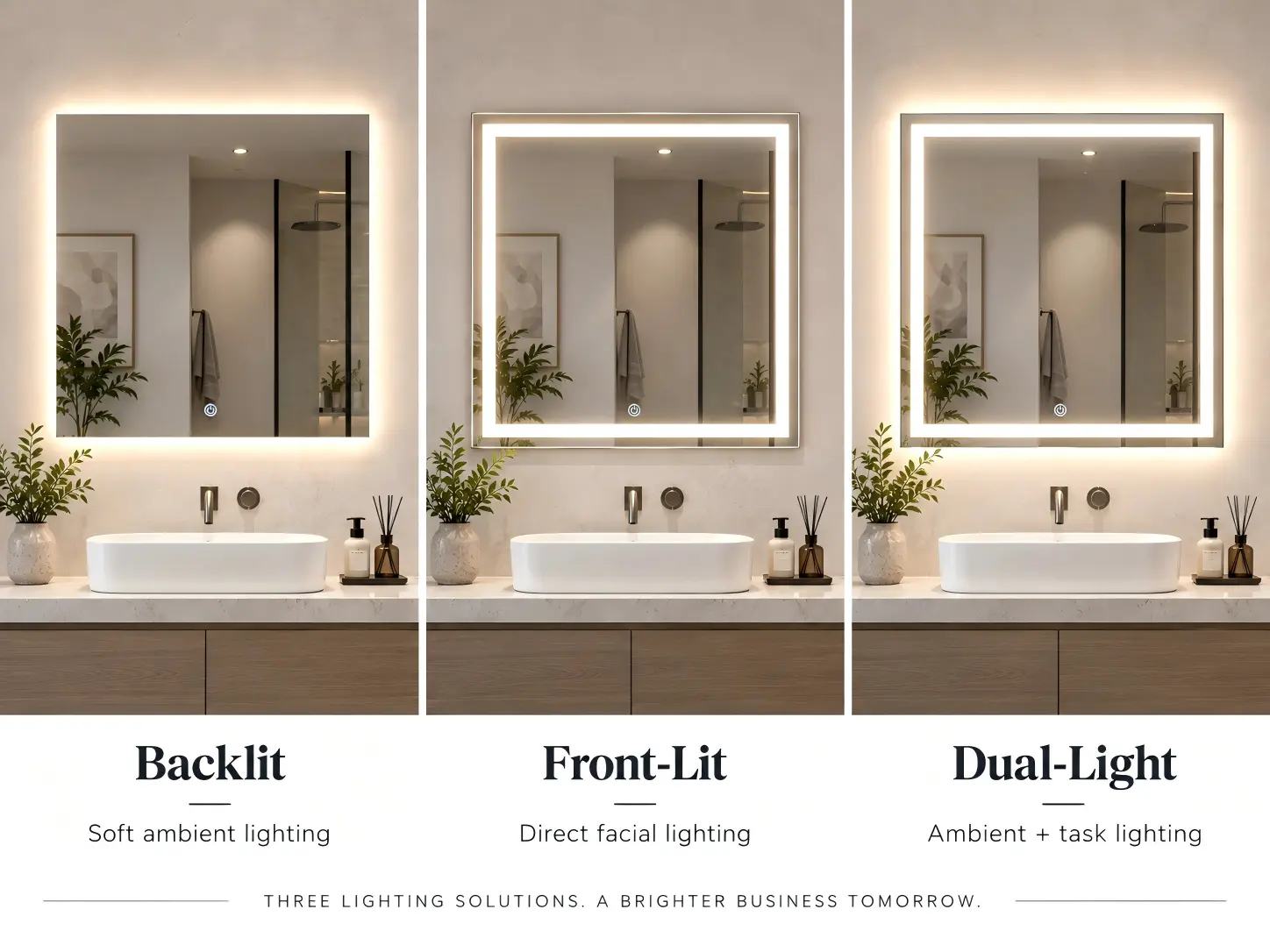
Lighting structure strongly influences the mirror's appearance, user experience and retail positioning. Buyers should decide how each lighting type fits into the planned product range before comparing individual models.
| Lighting Type | Main Characteristic | Typical Product Positioning |
|---|---|---|
| Backlit | Creates a soft halo around the rear of the mirror | Clean, modern designs for broad retail applications |
| Front-Lit | Directs more visible illumination toward the user | Task-oriented use and stronger facial illumination |
| Dual-Light | Combines front illumination with ambient rear lighting | Premium collections and design-focused retail ranges |
LED Functions That Matter to Wholesale Buyers
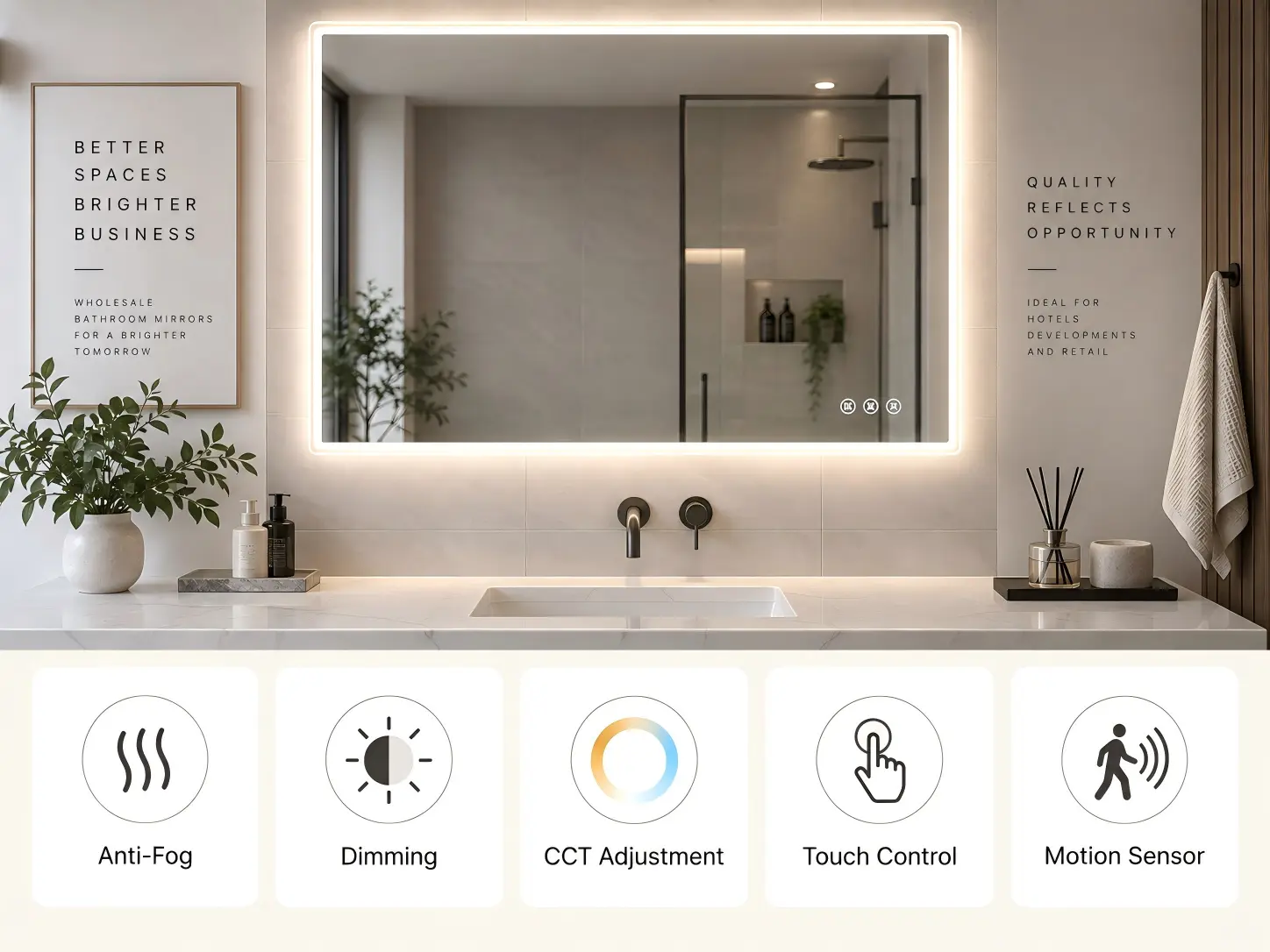
More functions do not automatically create a better product. A good wholesale bathroom mirror supplier should help buyers understand which functions add practical value and which options mainly increase cost or product complexity.
Anti-Fog for Everyday Bathroom Use
An integrated demister keeps a section of the mirror clear after hot showers. Consumers understand this benefit immediately, which makes anti-fog one of the easiest LED mirror functions for retailers to explain.
Dimming for Different Lighting Conditions
Adjustable brightness lets users adapt the light output to different times of day, bathroom sizes and personal preferences. Dimming also helps one mirror serve a broader range of residential applications.
CCT Adjustment for More Choice
Adjustable color temperature lets users move between warm, neutral and cool white lighting. This flexibility helps retailers match one product to several bathroom styles and consumer preferences.
Touch Control for a Clean Interface
Touch switches create a clean, familiar interface. Buyers should confirm which button controls lighting, dimming, CCT or demisting so the final retail description matches the actual product configuration.
Motion Sensors for Product Differentiation
Motion or proximity sensors add hands-free control and can help a premium model stand out. Buyers should confirm sensor type, activation distance and operating logic during product approval.
Compare Specifications Before Comparing Wholesale Prices
Two mirrors can look almost identical online while using very different components and materials. Glass thickness, frame construction, LED layout, driver specification, demister size, control system, surface finish and packaging all influence the final cost.
Buyers should therefore request quotations against the same specification. A lower quotation does not necessarily represent better value if it includes fewer functions, a different electrical system or a weaker packaging standard.
MOQ and Mixed-Model Trial Orders
New distributors often want to test several designs before committing significant inventory to one SKU. The trial quantity therefore matters almost as much as the long-term MOQ.
Ask whether the supplier allows different models or sizes in one shipment and whether private-label packaging changes the minimum quantity. Mixed-model orders can help importers test different lighting structures, shapes and price points without overstocking one unproven model.
After the first selling period, buyers can increase quantities for the strongest models and reduce or replace slower-moving designs. NISSIYA's mirror solutions page gives buyers a broader view of how different mirror programs can serve distribution and project applications.
EXW vs FOB for Bathroom Mirror Wholesale Orders
EXW prices show the basic factory product cost, which makes them useful for initial supplier comparisons. FOB quotations add local export and handling costs before international transport begins.
These local charges can create a high cost per unit when buyers ship only a small LCL trial quantity. As a result, buyers should compare FOB quotations together with total shipment CBM, order composition and the number of models in the shipment.
A mixed order can spread fixed local charges across more products and provide a more realistic view of landed cost than a very small single-model shipment.
Why Carton Size and CBM Affect Wholesale Profitability
Bathroom mirrors use considerably more shipping volume than many compact bathroom accessories. Therefore, distributors should compare carton efficiency alongside the factory price.
A mirror that costs a few dollars less at the factory may not create a better landed margin if its carton occupies significantly more space. Packaging also needs enough protection to reduce breakage, so suppliers must balance shipping efficiency with product safety.
| Cost Factor | Why It Matters |
|---|---|
| EXW Price | Shows the core factory product cost |
| Carton CBM | Determines how much container or LCL space each mirror requires |
| Gross Weight | Influences handling and some transport calculations |
| Packaging Protection | Helps reduce breakage during storage and transportation |
| Damage Rate | Directly affects replacements, customer service and real landed margin |
Packaging and Breakage Risk
Good mirror packaging protects the glass, corners, frame and electrical components throughout factory handling, warehousing and international transport.
Buyers should ask for carton dimensions, gross weight, internal protection details and packaging test information where relevant. E-commerce sellers may place even greater importance on packaging because individual parcels often experience more handling than palletized project shipments.
Strong packaging does not simply prevent visible breakage. It also helps reduce replacement shipments, customer complaints and the hidden after-sales cost of a wholesale program.

Compliance and Electrical Requirements for LED Bathroom Mirrors
Importers should check the rules that apply in the destination market before placing an electrical mirror order. For European sales, buyers may need to review CE-related requirements, RoHS, electrical safety, electromagnetic compatibility and the product's applicable IP rating.
The European Commission CE marking guidance explains the general responsibilities of manufacturers, importers and distributors when products fall under applicable EU harmonisation legislation.
Buyers can also review the European Commission's RoHS Directive information for the EU rules that restrict certain hazardous substances in electrical and electronic equipment.
Buyers should also compare the ordered configuration with the technical documentation supplied for that product family. If a mirror includes Bluetooth, Wi-Fi or another radio function, the buyer should review the additional requirements that apply to radio equipment in the destination market.
After-Sales Support: Drivers, Touch Switches and Replacement Parts
Good after-sales planning starts before the first bulk order. LED drivers, touch switches, sensors and other electrical components can fail over time, so buyers should understand how the supplier handles replacements.
Ask the supplier to identify important electrical parts clearly and explain the warranty process. Buyers should also confirm whether they can purchase compatible replacement drivers or switches later if a market continues selling the same mirror for several years.
This approach helps distributors solve individual service cases without replacing an entire mirror unnecessarily.
Approve a Sample Before Bulk Production
Samples give buyers a practical way to check the product before committing to a larger order. During sample approval, inspect the mirror finish, lighting effect, touch controls, CCT settings, demister function, frame construction, mounting hardware and packaging.
Buyers should also keep a clear record of the approved specification. When repeat orders grow, that reference helps the supplier maintain the same functions, finish and construction instead of gradually changing the product from one production batch to another.
Buyers working on hotel or commercial projects can also review NISSIYA's hospitality LED mirror projects to see how specification consistency matters in larger project applications.
Wholesale Bathroom Mirror Supplier Checklist
Before choosing a wholesale bathroom mirror supplier, buyers can use the following checklist to compare both product quality and commercial support.
- Is the trial MOQ practical for your market test?
- Can you consolidate different sizes or models in one shipment?
- Does the supplier provide carton dimensions, GW and CBM?
- Does the quotation clearly define all LED and control functions?
- What compliance documents support the selected configuration?
- What production lead time should you expect?
- How does the supplier handle warranty claims?
- Can you obtain replacement drivers, switches or sensors?
- Does the supplier support private-label packaging?
- Can the factory repeat the approved specification consistently on future orders?
Match Bathroom Mirror Products to Different Sales Channels
Retailers, e-commerce sellers, distributors and project buyers do not always need the same mirror assortment. Matching the product strategy to the sales channel helps buyers control inventory and communicate clearer benefits.
| Sales Channel | Useful Product Direction |
|---|---|
| Bathroom Retailers | Mainstream dimensions, anti-fog, CCT and easy-to-explain functions |
| Home Improvement Stores | Reliable core models with clear specifications and broad consumer appeal |
| E-Commerce Sellers | Distinctive designs, strong packaging and clear feature differentiation |
| Distributors & Wholesalers | Entry, mainstream and premium products across multiple sizes and shapes |
| Hospitality & Projects | Specification consistency, repeatability and project-focused configurations |
Why Buyers Work with NISSIYA for Wholesale Bathroom Mirrors
NISSIYA focuses on bathroom mirrors, LED bathroom mirrors and makeup mirrors for B2B buyers. Our manufacturing experience supports distributors, retailers, contractors and hospitality projects across international markets.
Buyers can select from backlit, front-lit, dual-light, framed, irregular and smart bathroom mirror designs. Depending on the model, NISSIYA can also discuss functions, finishes, branding and packaging requirements for OEM and ODM programs.
When buyers compare NISSIYA with another wholesale bathroom mirror supplier, they should look beyond the initial unit price. Product specification, packaging efficiency, technical support and repeat-order consistency all contribute to the long-term value of a supply program.
Buyers who want to review NISSIYA's broader product offering can also download or request information through our product catalogs .
Frequently Asked Questions About Bathroom Mirror Wholesale Sourcing
How should I compare a wholesale bathroom mirror supplier?
Compare the exact product specification, MOQ, carton dimensions, CBM, lighting configuration, electrical functions, compliance support, production lead time, warranty handling and replacement-part policy. A useful supplier comparison should cover both product cost and long-term supply support.
Can distributors mix different bathroom mirror models in one order?
Some suppliers allow mixed-model trial shipments. This approach can help distributors test several shapes, lighting types and price levels before increasing quantities for the strongest sellers. Buyers should confirm the minimum quantity for each selected model before ordering.
Which LED bathroom mirror functions offer the clearest retail value?
Anti-fog, dimming, adjustable CCT and touch control provide benefits that consumers can understand quickly. Motion sensors can add further differentiation to selected premium models.
Why should wholesale buyers calculate carton CBM?
Bathroom mirrors occupy substantial shipping volume. Carton CBM helps importers estimate freight efficiency and compare landed margin more accurately instead of focusing only on the factory unit price.
Should buyers request EXW or FOB bathroom mirror prices?
EXW helps buyers compare core factory prices, while FOB includes local export-related costs. Small LCL shipments can make the FOB cost per unit look unusually high, so buyers should also consider total order quantity and shipment CBM.
Can wholesale bathroom mirrors use private-label packaging?
Many B2B programs use private-label cartons, logos or other branding elements. Packaging options and minimum quantities depend on the selected model, packaging design and order volume, so buyers should define these requirements before bulk production.
Final Thoughts on Choosing a Bathroom Mirror Supply Partner
Choosing a wholesale bathroom mirror supplier means balancing product design, pricing, logistics, compliance, packaging and long-term support. The lowest factory price alone rarely tells buyers which supplier will create the strongest landed margin or the most reliable repeat-order program.
A well-planned wholesale range combines different lighting structures, practical LED functions, controlled packaging volume and clear commercial specifications. By comparing these factors before placing a bulk order, distributors can reduce inventory risk and build a more sustainable bathroom mirror assortment.
From initial design concepts to final product delivery, NISSIYA provides full-scale manufacturing support for hotels, resorts, and commercial developments worldwide. Let our engineering team help you translate your vision into reality with precision-engineered, commercially compliant mirror solutions.