
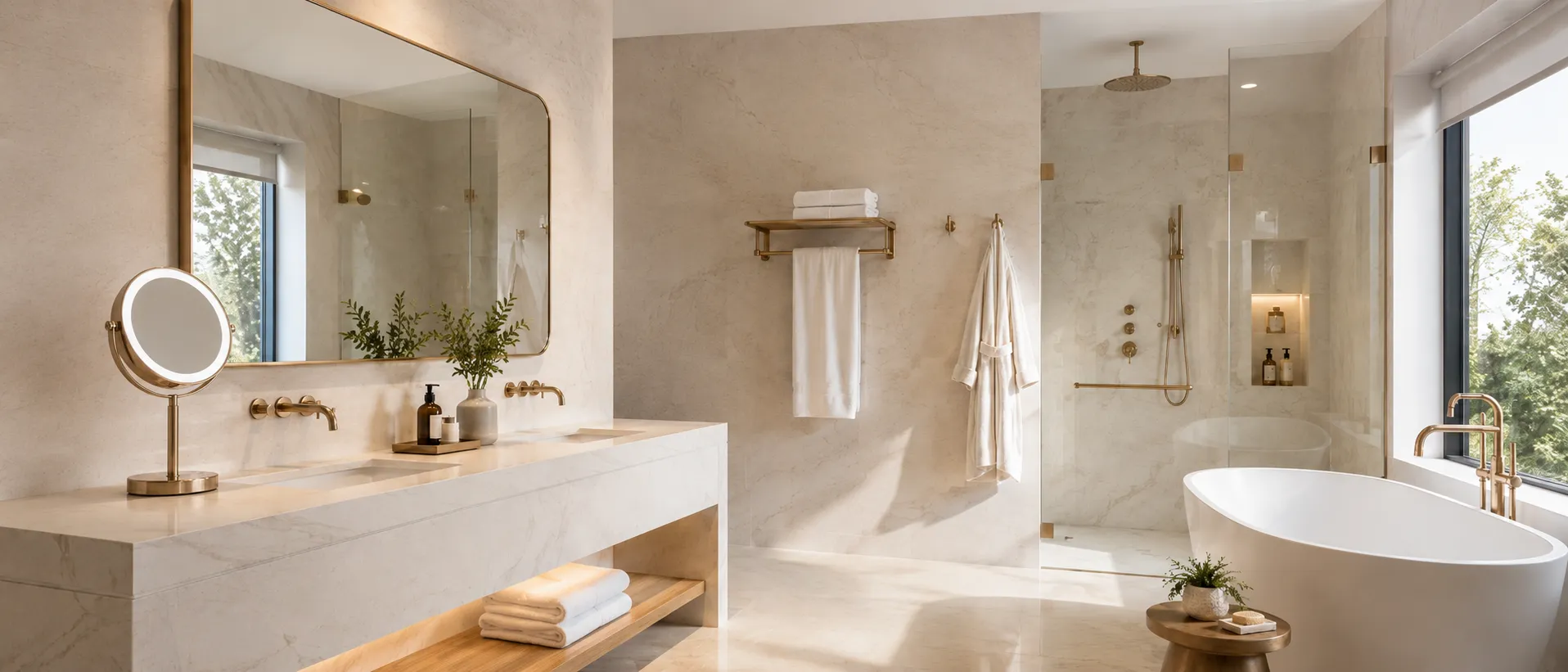
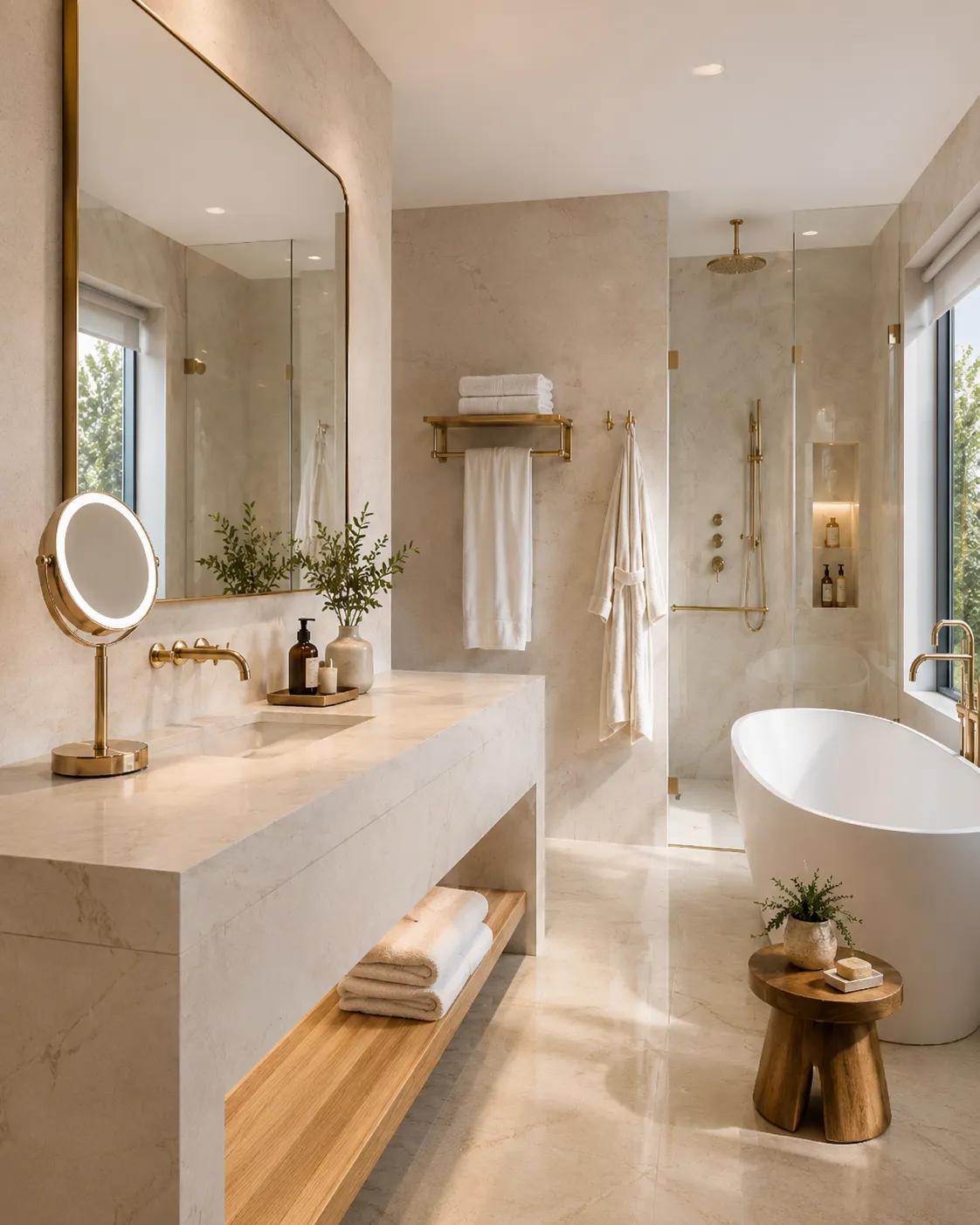
A makeup mirror for glasses wearers should make close-up grooming more comfortable, not force someone to lean into a bathroom mirror. If you remove your glasses to apply eyeliner or mascara, you may discover a frustrating problem: the mirror needs to be close, but your makeup brush also needs room to move.
That problem is familiar to many nearsighted makeup users. A bright mirror alone may not solve it, and stronger magnification does not always produce a clearer reflection. Viewing distance, lighting, arm reach and mirror position have to work together.
This guide shares seven practical ways to improve the setup. It also explains how hotels can choose a wall-mounted magnifying mirror that serves a wider range of guests without promising that one magnification fits every person's vision.
Quick answer: Start with a mirror that you can position near your face without blocking your hand. Test the actual viewing distance, use even facial lighting and leave space for a brush. A movable wall-mounted arm or an adjustable tabletop mirror may be more useful than simply selecting the highest magnification number.
Why a Makeup Mirror for Glasses Wearers Needs the Right Distance
Many people with nearsightedness can see objects nearby more easily than objects farther away. However, the comfortable distance varies with the individual, whether corrective lenses are being worn and other vision factors. A magnifying mirror is a grooming aid, not a replacement for prescribed glasses or contact lenses.
When glasses come off, the user may move close to the mirror to find a workable image. Eyeliner brushes, mascara wands and fingers then occupy the same narrow space between the face and the glass. Sometimes the tool hits the mirror before the user can complete the movement.
In a Reddit discussion about doing makeup without glasses , people described exactly this challenge. Several mentioned magnifying mirrors, short brushes and bringing a mirror closer instead of leaning farther across a counter. These experiences are individual reports, not clinical evidence about which magnification is best.
For background on nearsightedness and corrected vision, see the National Eye Institute's explanation of myopia . Mirror selection should still be based on a practical trial rather than a glasses prescription number alone.
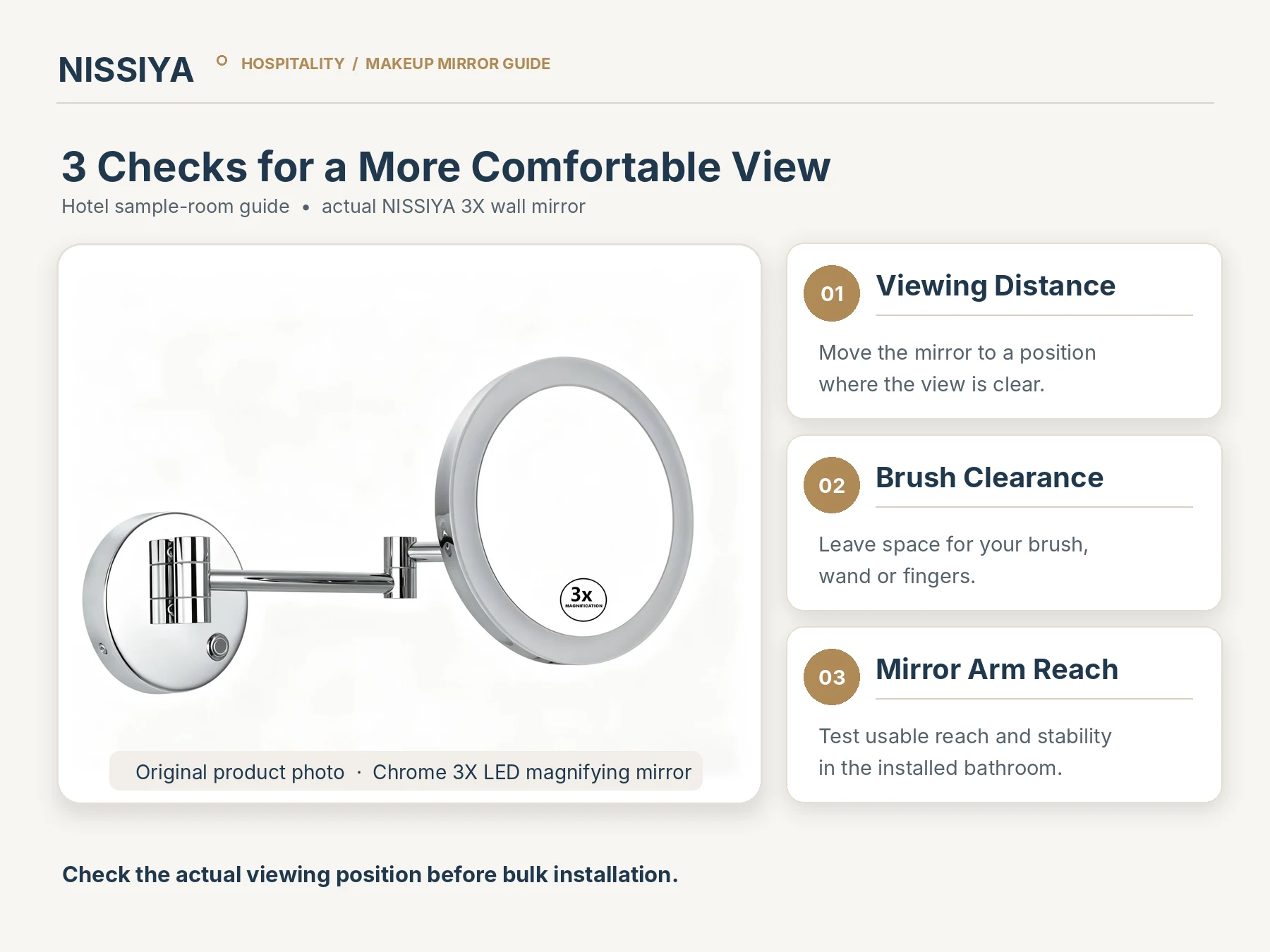
The illustration highlights three details to check together. First, move the mirror to a position where the reflection looks clear. Next, leave enough room for a brush or mascara wand. Finally, confirm that the adjustable arm can reach and hold that position in the installed bathroom.
There is no single viewing-distance number that suits every guest or every magnifying mirror. The useful position depends on the optical design, the individual user and the available working space.
7 Practical Makeup Mirror Tips for Glasses Wearers
1. Bring the Mirror Toward You Instead of Leaning Forward
A fixed bathroom vanity mirror may be too far away when you remove your glasses. Leaning over a sink also changes posture and can make delicate hand movements awkward. A mirror with an adjustable arm lets you move the viewing surface toward a more useful position.
For example, the NISSIYA 8-inch wall-mounted magnifying mirror combines a 3X lighted surface with a folding double swing arm. The arm provides positioning flexibility, but the final working distance must be tested with the actual product and bathroom layout.
Before choosing a makeup mirror for glasses wearers, check that the arm can reach a comfortable position without touching the faucet, wall mirror or nearby fittings. A longer advertised extension is useful only if the mirror remains stable where someone actually needs it.
2. Leave Enough Room for the Brush, Wand or Fingers
Getting closer can improve the view for some users, but extreme proximity can leave no space for makeup tools. Try adjusting the mirror angle and moving it slightly to one side. This can create a usable path for the hand while keeping the area being worked on visible.
Short-handled makeup brushes may also help when the mirror must be close. One Reddit conversation about wearing glasses during makeup includes people who prefer travel-size brushes and close-up mirrors. Their suggestions are practical options to test rather than rules that work for everybody.
For eye makeup, make small movements and avoid pressing a brush or sharp tool against the mirror surface. If an arrangement feels cramped or unsafe, change the angle or use a different viewing method instead of forcing the brush through the gap.
3. Test Magnification at a Comfortable Distance
Magnification makes details appear larger, but it also changes how much of the face can be seen at once. In general, stronger magnification requires more careful positioning and may be less comfortable for broad makeup application.
A 3X mirror can be useful for a wider close-up view. Meanwhile, a 5X design may help someone inspect smaller facial details. A 10X mirror concentrates on a still smaller area and usually requires particularly precise positioning. None of these levels is guaranteed to correct blurry vision caused by an individual refractive error.
Rather than choose a model only from its label, compare the actual reflection with and without glasses at the distance you expect to use. Our hotel makeup mirror magnification guide covers 3X, 5X and 10X in more detail; this article focuses on the practical working setup.
4. Use a Normal View for the Final Makeup Check
Close-up magnification can help with eyeliner, brows or other detailed tasks. Yet the enlarged view may make it difficult to judge whether both sides of the face look balanced. A normal 1X reflection remains useful for checking the overall result.
A double-sided mirror can combine these two jobs. For instance, the NISSIYA HERITAGE-V is a non-illuminated wall-mounted design with a standard 1X side and a 5X side. Its reversible head allows users to switch views without installing a second small mirror.
Another option is to apply detailed makeup using the magnifying surface, then return to the main bathroom mirror while wearing glasses. This simple wide-view check can help users assess blending and symmetry rather than concentrating only on one eyelid.
5. Improve the Lighting Around the Face
Low or uneven lighting makes fine details harder to inspect, regardless of magnification. A bright overhead bathroom light can still cast shadows around the eyes and nose. Look for a setup that gives the face useful, comfortable illumination from the front.
Integrated LED makeup mirrors can support facial lighting where the selected model includes it. However, LED brightness, glare, color appearance and light uniformity depend on the complete design. More light does not automatically mean better visibility, especially if the illumination is uncomfortable.
During a trial, bring your hand and makeup brush into the normal working position. Check whether shadows hide the eyebrow or eyelid. Also verify that the main bathroom lighting remains comfortable when the makeup mirror's LEDs are switched on.
6. Position the Mirror Near Your Natural Eye Level
A mirror mounted too high, too low or too far to the side can create an uncomfortable viewing angle. Some guests may prefer to stand; others may sit at a dressing counter. The most useful position depends on the user and the available room layout.
With a movable arm, users can usually adjust the mirror head angle after installation. Nevertheless, that flexibility cannot always compensate for a poorly chosen wall location. Hotel designers should consider standing and seated use where relevant to the room design.
Plan mirror position, vanity clearance and wall fixing together. NISSIYA's mirror installation guides provide model-specific references for selected mounting systems; they should not be treated as universal installation heights.
7. Test the Complete Routine, Not Just One Reflection
A suitable mirror should remain useful from the start of the makeup routine to the final check. Test looking at the full face, moving closer for detail, applying a product with a brush and folding the mirror away afterward.
Some people may need to put their glasses back on between steps. Others may prefer contact lenses or a different makeup technique. No fixed rule based on prescription strength can determine which magnification will feel comfortable.
For a hotel or distributor, a practical sample test is more informative than choosing a makeup mirror for glasses wearers by its product photograph alone. Ask several intended users to try the approved sample under realistic conditions before confirming a larger purchase.
How to Choose a Makeup Mirror for Glasses Wearers
Mirror type matters because moving the glass closer to the face often solves a different problem from increasing magnification. The table below compares common configurations without treating any one design as a universal answer.
| Mirror Configuration | Potential Advantage | What to Check |
|---|---|---|
| Single-sided 3X wall mirror | A dedicated close-up viewing surface with a foldable arm on suitable models | Arm reach, working distance, light placement and stability |
| Double-sided 1X/5X wall mirror | Regular and magnified viewing in one rotating head | Rotation clearance, viewing distance and available bathroom lighting |
| Double-sided 1X/3X lighted wall mirror | Two viewing options plus integrated lighting | LED performance, arm access and ease of turning the head |
| Adjustable tabletop mirror | Flexible placement without a permanent wall mount | Stable base, countertop depth, mirror height and available space |
| High-magnification detail mirror | Concentrated view for selected precise tasks | Whether the user can actually focus at the required short distance |
For a double-sided lighted option, the NISSIYA ELITE wall-mounted mirror offers standard 1X and 3X viewing in its listed configuration. Hotels can also evaluate the FLEX-T20 tabletop mirror , which lists a 1X/5X double-sided design.
These are examples of existing NISSIYA configurations, not interchangeable specifications. Power supply, lighting functions, finishes, mirror dimensions and available magnification should be confirmed for the exact model and purchase order.
Why a Stronger Magnifying Mirror May Still Look Blurry
When a reflection appears blurry, increasing magnification is not always the solution. First check the distance between the face and the glass. Magnifying makeup mirrors have a useful viewing range that depends on their optical construction, and stronger magnification often narrows that comfortable range.
Next, inspect the mirror surface for smudges, condensation or packaging film. Uneven illumination may also make a reflection harder to interpret. The actual product should be assessed in normal bathroom conditions rather than against a magnification label alone.
Vision needs differ between people who are nearsighted, farsighted or affected by astigmatism or age-related focusing changes. A magnifying makeup mirror cannot be assumed to replace corrective lenses. If someone cannot obtain a clear view with the chosen mirror or experiences new visual symptoms, professional eye-care advice is appropriate.
Important distinction: A mirror's 3X, 5X or 10X label describes its optical magnification, not a matching eyeglass prescription. Do not select a magnification number from a person's prescription without testing the actual viewing experience.
What Reddit Users Reveal About Makeup Without Glasses
Several recurring themes appear in the discussions reviewed for this article: people want a mirror close enough to see, a hand position that does not block the view, adequate lighting and a way to check the whole face after detail work.
In the makeup-and-glasses discussion , commenters described close viewing, magnifying mirrors and short tools. Another discussion about eyeliner and glasses focused on the lack of room for a brush when the face must be close to the mirror.
Such posts are useful for discovering questions, but they should not be interpreted as tests of specific products. They also do not establish that the highest magnification is the right choice for everyone.
For NISSIYA, the product lesson is practical: viewing distance, adjustment range, mirror size and clear lighting deserve attention alongside magnification. Those details can make a small wall-mounted mirror easier to use in a real hotel bathroom.
Makeup Mirror for Glasses Wearers: Hotel Buyer Checklist
Hotels serve guests with different heights, routines and visual needs. A project specification should therefore prioritize straightforward operation and adaptable positioning rather than promising that one mirror will meet every guest's eyesight requirements.
| Sample-Room Check | What the Buyer Should Test | Why It Matters |
|---|---|---|
| Mirror Reach | Can the mirror be brought closer without leaning over the basin? | Helps users establish a workable viewing position |
| Brush Clearance | Is there room to use a normal makeup brush or smaller tool? | Prevents the hand or wand from hitting the mirror |
| Viewing Distance | Is the reflection useful at several realistic positions? | Checks the actual user experience, not only the magnification label |
| Mirror Sides | Can guests switch easily between normal and magnified viewing when specified? | Supports both overall and detail checks |
| Lighting | Are the face and eye area clearly illuminated without uncomfortable glare? | Helps make small details visible |
| Arm Stability | Does the mirror stay in the selected position? | Reduces guest frustration and maintenance calls |
| Mounting and Clearance | Does the arm clear faucets, walls and other fixtures? | Supports safe, usable room layouts |
| Cleaning and Service | Are mirror surfaces, switches and accessible joints easy to maintain? | Supports consistent operation across many rooms |
When selecting a makeup mirror for glasses wearers in a hotel setting, distinguish user convenience from an accessibility claim. A suitable magnifying mirror may improve one guest's experience without meeting every guest's particular vision needs. Required accessible features must be evaluated against applicable project requirements separately.
Three Questions to Ask Before Approving the Sample
- Can the user reach a clear position? Test the mirror standing or seated as appropriate for the room, with the arm at a realistic extension.
- Is there space to work? Try an eyeliner brush or mascara wand while the mirror is at the required viewing distance.
- Can the user check the final result? Confirm that the room has a useful normal-view mirror or that the selected makeup mirror provides a 1X side.
These checks also help hospitality buyers compare a single-sided lighted mirror with a double-sided non-lighted design. The better choice depends on the bathroom lighting, room layout, guest expectations and the approved sample.
Common Mistakes When Buying a Makeup Mirror for Glasses Wearers
The first mistake is assuming that 10X is automatically better than 3X or 5X. Strong magnification may make small details easier to inspect, but a narrow viewing range or short working distance can make everyday application difficult for some people.
Another problem is choosing the mirror solely by its outer diameter. The usable viewing surface, reach and angle matter during real makeup tasks. A compact design that moves into a good position may work better than a larger fixed mirror across the vanity.
Finally, buyers sometimes overlook the normal reflection. Even when the magnified view is helpful for precise work, users may still want a 1X mirror or their prescription glasses to check balance and blending. For hotel rooms, the main vanity mirror and the makeup mirror should complement each other.
Frequently Asked Questions
What makeup mirror is best for someone who wears glasses?
Look for a mirror that can be positioned comfortably close to the face, provides suitable lighting and leaves space for makeup tools. A wall-mounted adjustable arm or movable tabletop design may help. Test the actual magnification rather than choosing it from a glasses prescription.
Can a magnifying makeup mirror replace prescription glasses?
No. A magnifying mirror can help some people inspect details at close range, but it does not correct vision in the same way as prescribed glasses or contact lenses. Individual results vary with vision needs and viewing distance.
Is 5X or 10X better for doing makeup without glasses?
Neither is universally better. A 5X mirror may provide a more comfortable view for some people, while 10X may help with selected close-up tasks. Stronger magnification generally requires more precise positioning, so try both if possible.
Why does the makeup brush hit my mirror?
The working distance may be too short for the brush or wand. Try moving the mirror slightly, adjusting its angle or using a shorter-handled tool while maintaining a safe, clear viewing position.
Are double-sided mirrors helpful for glasses wearers?
They can be. A 1X side supports a normal overall view, while a 3X or 5X side offers more detail. The usefulness depends on the person's vision, mirror construction and the ability to reach the right distance.
Should hotels choose wall-mounted or tabletop makeup mirrors?
Wall-mounted models keep the countertop clear and can bring the mirror toward the guest when equipped with a suitable arm. Tabletop models offer flexible placement. Hotels should compare clearance, stability, lighting and maintenance in a sample room.
Does an LED makeup mirror help people who wear glasses?
Good lighting can make facial details easier to see, especially when a bathroom has uneven illumination. However, LEDs do not correct refractive errors, and bright or poorly directed lighting may cause glare. Evaluate the actual light quality.
What should hotel buyers check before bulk ordering magnifying mirrors?
Review mirror reach, viewing distance, brush clearance, light quality, arm stability, normal-view options, wall mounting and service access. Approve the actual model and configuration in a representative guestroom before bulk installation.
Final Advice: Choose Viewing Comfort, Not Just Magnification
A makeup mirror for glasses wearers should make everyday tasks easier, but the best result comes from combining several details. Positioning the glass at a usable distance, preserving room for a brush and providing comfortable lighting are often as important as the magnification label.
NISSIYA offers wall-mounted and tabletop makeup mirrors with different existing structures, magnification choices and lighting configurations for hotel, distributor and OEM projects. Buyers should confirm the exact model, test its intended working position and review the room layout before approving an order.
For guests, the most practical mirror is the one they can use comfortably. For hotels, it is the one that serves a broad range of routines while fitting the design, installation and maintenance requirements of the property.
Ready to Start Your Next Hospitality Project?
From initial design concepts to final product delivery, NISSIYA provides full-scale manufacturing support for hotels, resorts, and commercial developments worldwide. Let our engineering team help you translate your vision into reality with precision-engineered, commercially compliant mirror solutions.