


Black edge corrosion is a common long-term issue in bathroom mirrors, especially in hotels, resorts, serviced apartments and other commercial properties where mirrors are repeatedly exposed to humidity, condensation and frequent cleaning.
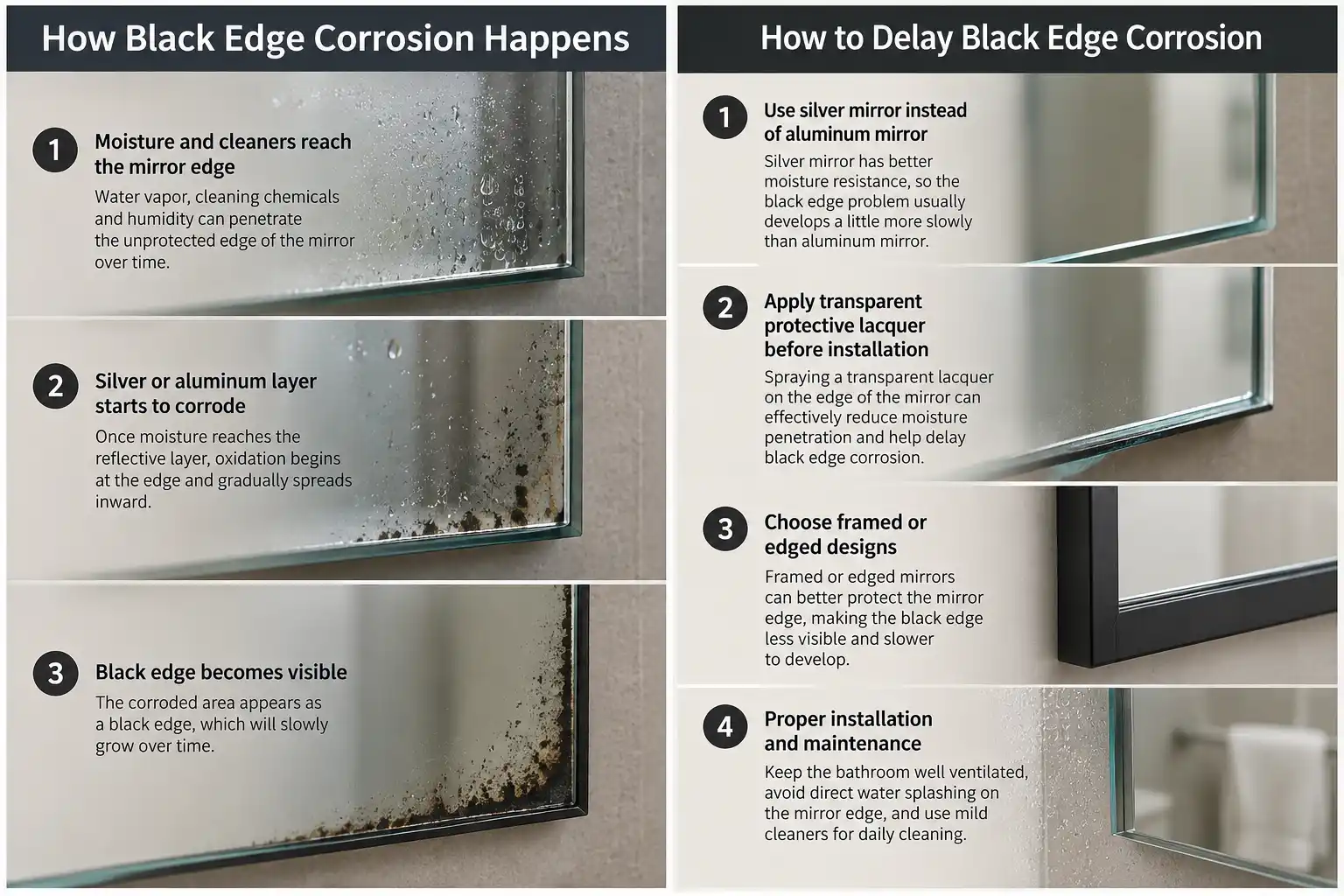
Once dark discoloration begins to appear around the perimeter, it usually indicates deterioration of the reflective coating near the edge of the mirror.
For hotel projects, the realistic objective is not to find a mirror that can never corrode. The goal is to select the right mirror, protect vulnerable edges and control installation and maintenance conditions so that mirror black edge corrosion develops as slowly and as inconspicuously as practical.
Black edge corrosion cannot be completely eliminated in every bathroom environment. Based on our manufacturing experience, silver mirrors generally develop visible edge deterioration more slowly than aluminum mirrors. Applying a compatible clear protective lacquer around vulnerable mirror edges before installation can further delay moisture and chemical penetration.
Framed or edge-covered mirror designs can also make early perimeter discoloration less visible, although they do not guarantee that corrosion will never occur.
What Causes Black Edge Corrosion on Bathroom Mirrors?
A bathroom mirror is more than a sheet of glass. The reflected image depends on a metallic reflective coating and protective backing behind the glass.
Over time, moisture, cleaning chemicals and contaminants can reach vulnerable areas around the perimeter, drilled holes, cutouts or damaged backing layers. As the reflective coating deteriorates, dark discoloration becomes visible through the front of the glass.
The bottom edge often shows deterioration first because water and cleaning solution naturally flow downward and may remain along the lower perimeter.
| Risk Factor | How It Affects the Mirror | Hotel Project Concern |
|---|---|---|
| High Humidity | Keeps vulnerable mirror edges exposed to moisture for longer periods. | Guest bathrooms may experience repeated steam cycles every day. |
| Condensation | Water repeatedly forms on the glass and can reach the perimeter. | Poor ventilation can slow drying after showers. |
| Direct Cleaner Spray | Cleaning liquid can run down the glass and collect around the bottom edge. | Daily housekeeping creates repeated chemical exposure. |
| Damaged Edges | Chips or backing damage can make moisture penetration easier. | Cutting, drilling and polishing quality become important on bulk orders. |
| Trapped Moisture | Frames or mounting channels can hold water against the perimeter. | Poorly detailed framed and recessed installations can increase exposure. |
| Incompatible Adhesive | Certain installation chemicals may attack or weaken mirror backing. | Installers should use products confirmed to be compatible with mirrors. |
Silver Mirror vs Aluminum Mirror: Which Develops Black Edge More Slowly?
One of the first material choices in mirror manufacturing is the reflective coating system.
Based on our production experience, silver mirrors generally show somewhat better resistance to visible edge deterioration than aluminum mirrors . However, this difference should not be described as a permanent solution.
Silver mirrors can still develop black edges. Under comparable bathroom conditions, the deterioration may simply take longer to become visible.
| Comparison | Silver Mirror | Aluminum Mirror |
|---|---|---|
| Reflective System | Uses a silver-based reflective coating. | Uses an aluminum-based reflective coating. |
| Image Quality | Generally provides high reflectivity and clear optical appearance. | Suitable for many standard mirror applications. |
| Black Edge Performance | In our experience, visible deterioration generally develops somewhat more slowly. | May show visible edge deterioration sooner under harsh bathroom conditions. |
| Corrosion-Proof? | No. | No. |
| Edge Protection Recommended? | Yes. | Yes. |
Practical takeaway: choosing a quality silver mirror can help delay visible edge deterioration, but material selection alone cannot eliminate mirror black edge corrosion.
Why Clear Protective Lacquer Can Delay Black Edge Corrosion
One of the most practical measures for slowing early edge deterioration is applying a compatible clear protective lacquer before installation.
The purpose of the lacquer is not to repair the reflective coating. It creates an additional barrier around vulnerable edge areas and can reduce direct exposure to moisture, condensation and cleaning chemicals.
Based on our experience, this additional protection can effectively delay the appearance of black edge corrosion when it is applied correctly and is compatible with the mirror backing.
Protect Exposed Mirror Edges
The outside perimeter is one of the most obvious paths for moisture and cleaning chemicals to reach vulnerable coating layers.
Give Extra Attention to the Lower Edge
Water and cleaning solution naturally move downward, making the lower perimeter particularly vulnerable to prolonged exposure.
Protect Holes and Fabricated Areas
Switch holes, sensor cutouts, drilled holes and irregular fabricated areas can expose additional edges that require attention.
Use the Correct Protective Coating
The lacquer or edge coating should be compatible with the mirror backing, adhesive, silicone and surrounding frame materials.
Important: not every transparent paint or lacquer is suitable for mirrors. An incompatible chemical system can damage the backing instead of protecting it.
Can Edge Protection Completely Stop Mirror Corrosion?
No. Edge protection should be understood as a way to delay moisture and chemical penetration, not as a permanent guarantee.
Bathroom mirrors continue to experience changing humidity, temperature, condensation and cleaning conditions throughout their service life. Protective coatings can age, installation joints may change and chemicals can eventually reach vulnerable areas.
A more accurate engineering statement is: edge protection can improve corrosion resistance and delay the development of visible black edges, but it cannot make a mirror permanently corrosion-proof.
Why Framed Mirrors Often Show Less Visible Black Edge
Framed and edge-covered mirrors offer an important practical advantage for hotel projects.
They do not necessarily stop corrosion, but the frame can cover part of the perimeter. As a result, minor early deterioration may remain hidden from normal viewing.
1. Less Direct Edge Exposure
Depending on the construction, a frame can reduce direct contact between exposed mirror edges and cleaning liquid or bathroom moisture.
2. Lower Visual Exposure
Even if slight deterioration begins behind the frame, the affected area may not be visible from the front.
For hotels, this can be important because the visual condition of the guest bathroom is often more important than whether microscopic deterioration has started behind a covered perimeter.
However: a poorly designed frame can also trap water. If condensation or cleaning liquid enters the bottom channel and cannot dry, the frame can keep moisture against the mirror for longer.
Frameless vs Framed Mirrors for Hotel Projects
| Mirror Design | Black Edge Consideration |
|---|---|
| Frameless Mirror | The entire perimeter remains visible, so even minor edge deterioration can become noticeable. |
| Thin Metal Frame | Covers part of the perimeter and may reduce the visual impact of early discoloration. |
| Fully Edge-Covered Frame | Provides greater visual concealment of early perimeter deterioration. |
| Recessed Mirror | Can hide the mirror edge but requires careful detailing to avoid trapped moisture. |
| Frameless LED Mirror | Offers a clean architectural appearance but requires careful perimeter protection because exposed edges remain visible. |
This does not mean every hotel should use framed mirrors. Frameless LED mirrors remain popular because of their clean, contemporary appearance.
The choice is partly a trade-off between design preference, edge visibility and long-term maintenance.
Mirror Edge Processing Also Matters
Mirror fabrication can create additional vulnerable areas. After cutting, grinding, polishing or drilling, the perimeter and fabricated areas should be inspected carefully.
| Inspection Point | What to Check |
|---|---|
| Polished Edges | Check for excessive chipping, shelling and inconsistent finishing. |
| Corners | Look for impact damage or exposed backing near corner areas. |
| Drilled Holes | Inspect for cracks, chips and damage around the drilled perimeter. |
| Switch Cutouts | Make sure fabrication has not caused unnecessary damage to surrounding backing. |
| Sensor Cutouts | Treat these fabricated edges with the same attention as the outside perimeter. |
Buyers who want to understand how cutting, polishing, drilling and assembly fit into the wider production process can also review our guide to the bathroom mirror manufacturing process .
Installation Can Be Just as Important as Mirror Quality
A good mirror can still develop premature edge deterioration if the installation keeps moisture or aggressive chemicals in contact with vulnerable areas. Factory inspection is therefore only one part of long-term product performance. Buyers interested in the wider testing process can also review how LED mirror quality control is carried out before shipment.
| Installation Factor | Recommended Approach |
|---|---|
| Adhesive | Use a mirror-compatible adhesive or suitable non-corrosive neutral-cure system. |
| Bottom Channels | Avoid details that allow water or cleaning liquid to remain permanently against the lower edge. |
| Frame Design | Cover vulnerable edges where appropriate without creating a sealed moisture trap. |
| Wall Cavity | Avoid installation conditions that keep the rear of the mirror continuously damp. |
| Ventilation | Better bathroom ventilation helps reduce the time moisture remains around the mirror. |
Housekeeping Practices Can Affect Mirror Service Life
Mirror material receives most of the attention during procurement, but housekeeping begins affecting the mirror immediately after a hotel opens.
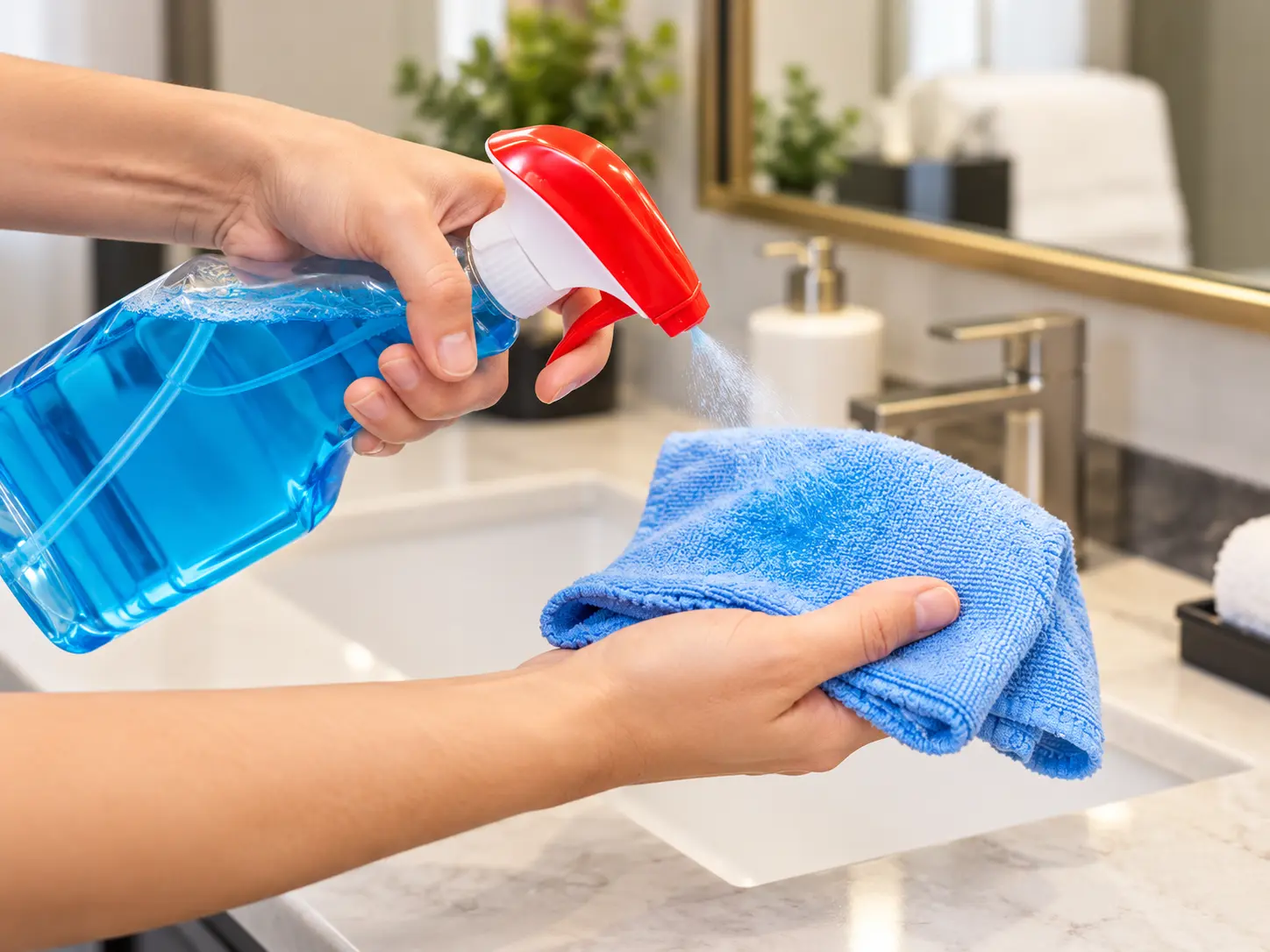
One of the most common risk factors is spraying cleaning liquid directly onto the glass. The liquid runs downward and repeatedly collects around the lower perimeter.
| Housekeeping Practice | Recommended Method |
|---|---|
| Applying Cleaner | Spray cleaner onto a microfiber cloth rather than saturating the mirror directly. |
| Cleaning Edges | Avoid unnecessarily soaking exposed edges and frame channels. |
| Bottom Edge | Remove remaining water and cleaning solution after cleaning. |
| Cleaner Selection | Follow the mirror supplier's cleaning guidance and avoid unnecessarily aggressive chemicals. |
| Abrasive Cleaning | Avoid abrasive pads and powders that may damage glass or surrounding finishes. |
Simple rule: keep water and cleaning chemicals away from exposed mirror edges as much as reasonably possible.
What Actually Helps Delay Mirror Black Edge Corrosion?
| Measure | Practical Effect |
|---|---|
| Use Quality Silver Mirror | Can delay visible edge deterioration compared with aluminum mirror in our manufacturing experience. |
| Apply Compatible Clear Protective Lacquer | Adds another barrier against moisture and cleaning chemicals and can effectively delay corrosion. |
| Protect Fabricated Edges | Reduces unnecessary exposure around holes, cutouts and shaped edges. |
| Use Framed or Edge-Covered Designs | Can reduce direct exposure and make early black-edge discoloration less visible. |
| Use Compatible Adhesive | Helps avoid chemical attack caused by unsuitable installation materials. |
| Avoid Trapped Moisture | Reduces prolonged water contact around the mirror perimeter. |
| Avoid Direct Cleaner Spray | Reduces repeated chemical pooling along the lower edge. |
| Dry the Bottom Edge | Reduces the amount of time moisture remains against vulnerable areas. |
| Improve Bathroom Ventilation | Helps the mirror and surrounding bathroom dry more quickly. |
No single measure can guarantee that black edge corrosion will never occur. The greatest benefit comes from combining several protective measures rather than relying on one material claim.
What Hotel Buyers Should Put in the Mirror RFQ
Instead of simply writing “corrosion-resistant mirror,” hotel developers and procurement teams can define the construction and protection requirements more clearly.
| RFQ Item | Recommended Requirement |
|---|---|
| Mirror Type | Quality silver mirror suitable for bathroom applications. |
| Glass Thickness | Specify according to mirror size, mounting method, frame construction and project requirements. |
| Edge Finish | Clean processed edges without major chips, shelling or visible backing damage. |
| Protective Treatment | Compatible clear protective lacquer or another approved edge-protection treatment before installation where required. |
| Cutouts and Holes | Inspect fabricated areas for cracks, chipping and coating damage. |
| Frame Design | Where a frame is used, avoid details that permanently trap water against the perimeter. |
| Installation Adhesive | Mirror-compatible, non-corrosive adhesive or sealant. |
| Sample Approval | Approve edge finish, backing condition, frame detail and installation method before mass production. |
| Maintenance Guidance | Supplier to provide recommended cleaning and care instructions. |
Buyers preparing tender documents can also use our hotel bathroom mirror specification checklist to review dimensions, installation, electrical requirements and other project-level considerations beyond edge corrosion.
Supplier capability should also be evaluated before approving bulk production. Our guide to choosing a hotel bathroom mirror supplier covers the broader manufacturing, project-support and procurement questions hospitality buyers should review.
Hotel Mirror Black Edge Corrosion FAQs
Can black edge corrosion be completely prevented?
No. There is no realistic mirror construction that guarantees black edge corrosion will never occur under every bathroom condition. The practical objective is to delay the process by reducing moisture and chemical exposure and protecting vulnerable edges.
Is silver mirror better than aluminum mirror for black edge resistance?
Based on our manufacturing experience, silver mirrors generally develop visible edge deterioration somewhat more slowly than aluminum mirrors. However, silver mirror can still corrode and should still receive appropriate edge protection.
Does copper-free mirror completely solve the black edge problem?
No. No single coating technology completely eliminates the risk. Mirror quality, fabrication, edge protection, installation, bathroom conditions and maintenance all affect long-term performance.
Does applying clear lacquer to mirror edges help?
In our experience, applying a compatible clear protective lacquer before installation can create an additional barrier around vulnerable edges and effectively delay moisture and chemical penetration. Compatibility with the mirror backing and installation materials should always be confirmed.
Are framed mirrors better for black edge problems?
A frame does not guarantee that corrosion will not occur. However, it can reduce direct exposure of some perimeter areas and make early edge deterioration less visible. The frame should also be designed so that water is not trapped against the glass.
Why does the bottom of a mirror often turn black first?
Water, condensation and cleaning liquid naturally move downward. If liquid repeatedly remains along the bottom edge, that area receives more long-term moisture and chemical exposure.
Should hotel housekeepers spray cleaner directly onto mirrors?
It is generally better to apply cleaner to a microfiber cloth. This reduces the amount of liquid flowing down the glass and collecting around exposed mirror edges or frame channels.
Can a mirror manufacturer guarantee there will never be black edges?
A responsible manufacturer should not make that guarantee. Actual service life depends on mirror construction, humidity, installation, ventilation, cleaning chemicals and maintenance.
Treat Black Edge Corrosion as a Durability Management Issue
Black edge corrosion should not be treated as a problem that can be permanently eliminated simply by selecting one special type of mirror.
For hotel and commercial bathroom projects, a more practical strategy is to combine better mirror material, controlled edge processing, compatible protective lacquer, suitable installation materials, intelligent frame design and proper housekeeping.
Silver mirror can generally delay visible deterioration compared with aluminum mirror based on our manufacturing experience, but it is still not immune to corrosion. Applying a compatible clear protective lacquer around vulnerable edges before installation provides an additional barrier and can further delay the appearance of black edges.
Framed or edge-covered mirrors can also offer a useful visual advantage because early perimeter deterioration is less noticeable.
For hotel developers, contractors and procurement teams, the realistic engineering objective is not to specify a mirror that can never corrode. It is to make corrosion develop as slowly and remain as visually unobtrusive as practical.
For projects involving guest rooms, public bathrooms or large-volume custom mirror requirements, you can also explore NISSIYA's hospitality mirror project solutions for information about customization, production and project support.
From initial design concepts to final product delivery, NISSIYA provides full-scale manufacturing support for hotels, resorts, and commercial developments worldwide. Let our engineering team help you translate your vision into reality with precision-engineered, commercially compliant mirror solutions.