


Electrical configuration is one of the most important details to confirm when sourcing an LED bathroom mirror for a hotel, apartment, residential development, or commercial project. Buyers often focus first on mirror size, lighting style, frame finish, and anti-fog functions. However, the electrical system also affects installation, safety, product compatibility, and long-term performance.
Understanding LED bathroom mirror electrical requirements before requesting a quotation helps manufacturers prepare the correct configuration for the destination market. Buyers should confirm input voltage, LED driver output, connection method, control method, anti-fog requirements, IP rating, certification needs, and installation conditions before approving production.
This guide explains the main electrical specifications that project buyers should check before ordering LED bathroom mirrors in bulk.
What Are the Main LED Bathroom Mirror Electrical Requirements?
The electrical requirements of an LED bathroom mirror depend on the mirror design, destination market, lighting system, control functions, and installation method. There is no single electrical configuration that applies to every mirror or every project.
For most commercial sourcing projects, buyers should confirm the following information first:
- Destination country or market
- Required input voltage and frequency
- LED driver output voltage
- Hardwired or plug-in connection
- Touch control, wall-switch control, PIR, or other control method
- Anti-fog function
- Product IP rating
- Required electrical certifications
- Installation orientation and wall conditions
A clear electrical specification allows the factory to match the mirror configuration to the project instead of making assumptions after production has started.
Input Voltage: What Should Project Buyers Specify?
Input voltage is the first electrical detail a buyer should confirm. Different markets use different building power supplies, so the destination country should always appear in the RFQ.
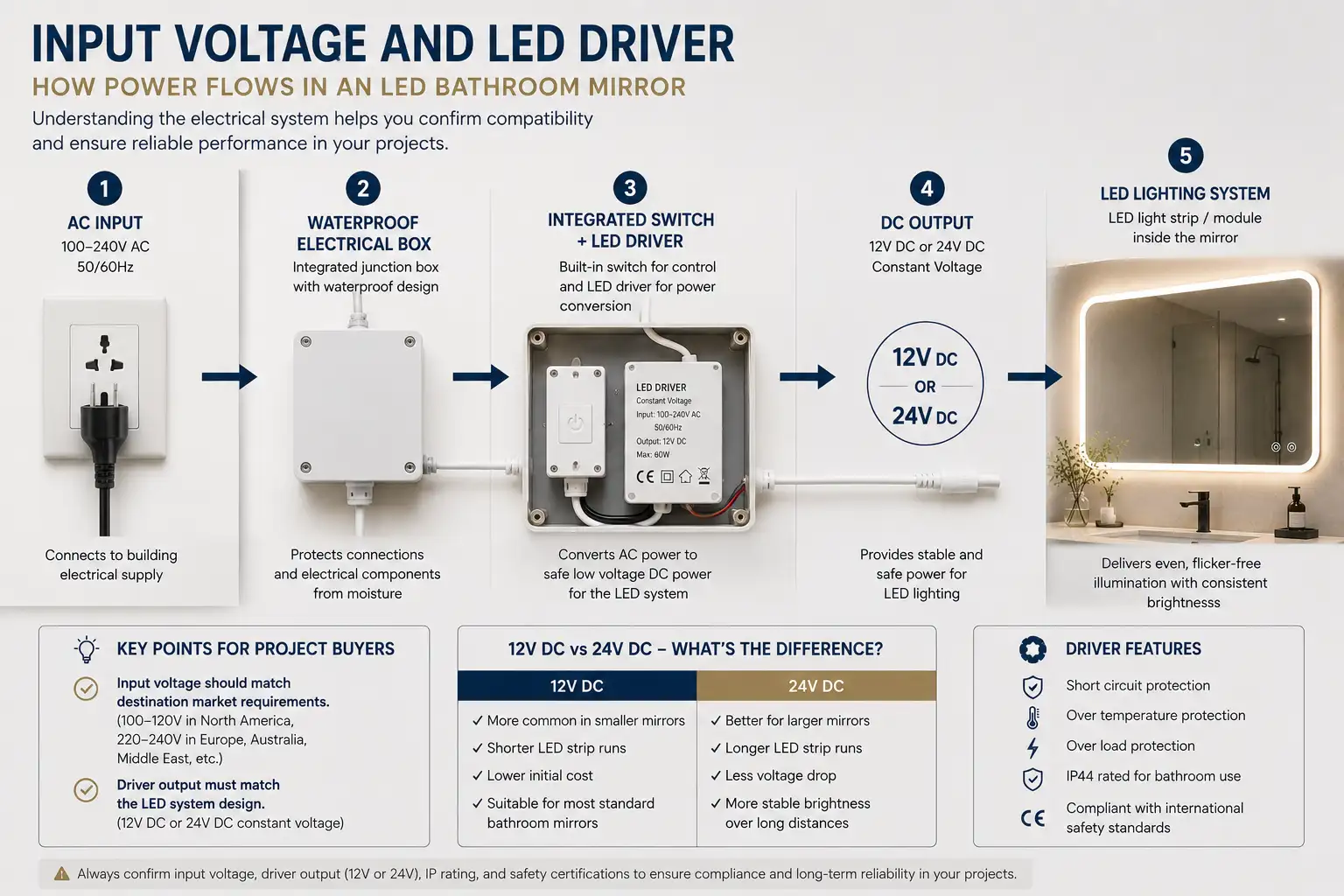
Many LED bathroom mirror configurations can be designed for a wide input range such as 100–240V AC, 50/60Hz. However, the exact specification still needs to be confirmed for the selected model and project.
The buyer should provide the destination market even when a wide-range power supply is available. This information also helps the manufacturer check plug type, wiring method, certification requirements, control components, and other electrical details.
What Does the LED Driver Do in a Bathroom Mirror?
The LED driver is an important part of the mirror's electrical system. It converts incoming AC power into the low-voltage DC power required by the LED lighting system.
Depending on the mirror design, the LED system may use a 12V or 24V constant-voltage driver. The driver output must match the LED strip or LED module used in the mirror. Buyers should not treat the driver as an interchangeable component without checking the complete electrical design.
Driver quality also matters in commercial projects. A reliable driver helps maintain stable light output and supports the expected service life of the lighting system.
12V vs 24V LED Mirror Systems
Both 12V and 24V systems can be used in LED bathroom mirrors. The correct choice depends on the mirror dimensions, LED strip design, power consumption, wiring length, and internal electrical configuration.
A 24V system can be useful for some larger mirror designs or longer LED runs because it can help reduce voltage drop. However, this does not mean that 24V is always better than 12V. A properly designed 12V system can also provide stable performance.
For project buyers, the more important question is whether the driver output matches the LED system design.
Hardwired vs Plug-In LED Bathroom Mirrors
Connection method is another major part of LED bathroom mirror electrical requirements. Two common configurations are hardwired and plug-in.
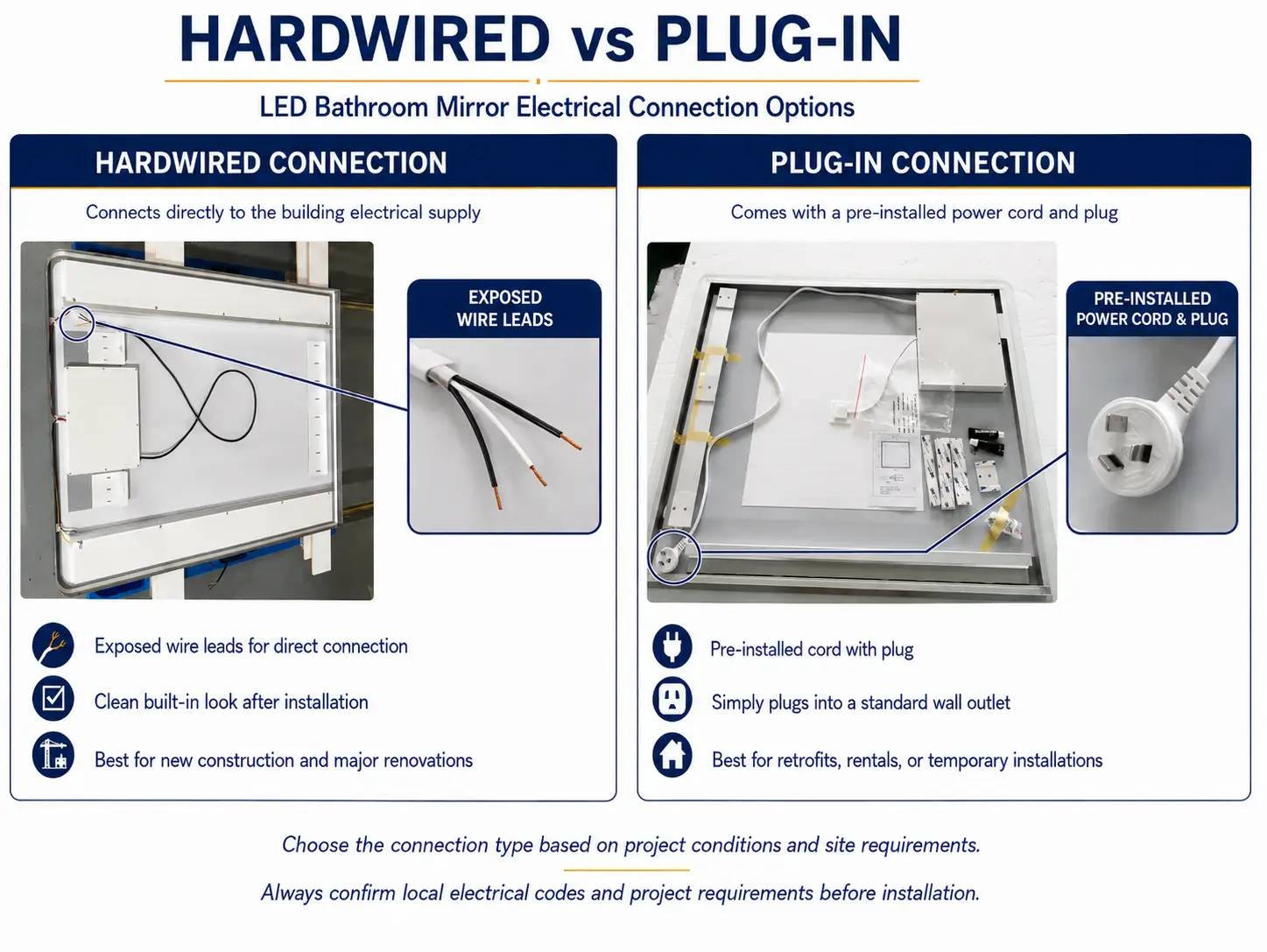
A hardwired LED bathroom mirror has exposed wire leads that connect directly to the building electrical supply. After installation, the electrical connection normally remains concealed behind the mirror or within the wall connection area.
A plug-in LED bathroom mirror includes a pre-installed power cord and plug extending from the mirror's electrical box. The plug connects to an appropriate wall outlet.
When Is Hardwired Connection More Suitable?
Hardwired installation is commonly considered for new construction, hotel projects, apartment developments, and permanent commercial installations. It creates a cleaner finished appearance because the power cable does not remain visible after installation.
The exact wiring arrangement must follow the project's electrical drawings and local electrical requirements. A qualified electrician should handle permanent electrical connections where required.
When Is Plug-In Connection More Suitable?
Plug-in installation can be useful for retrofit projects, existing buildings, showrooms, or locations where a suitable outlet is already available.
Plug type and outlet compatibility should be confirmed before production. Buyers should also check whether a plug-in configuration is permitted in the intended bathroom installation location under local requirements.
Wall Switch, Touch Control, or PIR: Which Control Method Should You Choose?
Control method should be decided before production because it affects both the electrical system and the user experience.
Common options may include:
- Touch switch
- Wall-switch control
- Touch control with anti-fog
- Dimming and color-temperature control
- PIR motion sensor on selected models
Hotel projects often need a clear control strategy. For example, the project may require the mirror light to operate from a room wall switch rather than an independent touch switch. This requirement should be included in the project specification before samples are approved.
How Does the Anti-Fog Function Affect Electrical Specifications?
An anti-fog pad is an additional electrical component installed on the back of the mirror. When activated, it warms part of the mirror surface and helps reduce condensation after hot showers.
The anti-fog pad adds electrical load to the system. For this reason, buyers should not evaluate mirror power requirements based only on the LED lighting wattage.
The factory should consider the LED lighting, anti-fog pad, control components, and other optional functions when determining the complete electrical configuration.
Anti-fog size and position can also vary by mirror model. The electrical box should remain properly positioned and should not interfere with the anti-fog area or other components.
What Does IP44 Mean for an LED Bathroom Mirror?
For NISSIYA LED bathroom mirror products, the product IP rating should be stated as IP44 where applicable to the selected model.
IP44 indicates protection against certain solid objects and water splashes. It does not mean that the mirror can be installed in any bathroom location without considering local electrical rules.
The installation zone, wiring method, local electrical code, and project requirements must still be reviewed by the contractor or qualified electrician.
Which Certifications Should Buyers Confirm?
Certification requirements vary by country, project, product model, and electrical configuration. Buyers should provide the destination market at the beginning of the sourcing process.
Depending on the selected model and market, relevant compliance documentation may include ETL, CE, SAA, RoHS, or other destination-specific requirements.
A certification used for one market should not automatically be treated as sufficient for another market. Importers, contractors, and project buyers should confirm the required standard before placing the order.
This becomes especially important when a project includes customized drivers, control systems, plugs, anti-fog systems, or electrical components.
Why Electrical Component Consistency Matters in Bulk Orders
A sample mirror may perform correctly, but commercial buyers also need consistency across the complete production batch.
For a 100-piece, 300-piece, or larger order, buyers should confirm that the approved electrical configuration remains consistent during bulk production. This includes:
- LED driver specification
- Input and output voltage
- LED strip configuration
- Wiring method
- Touch switch or control components
- Anti-fog pad
- Electrical box arrangement
- Plug type when applicable
Changing one component can affect other parts of the electrical system. For this reason, commercial mirror sourcing should include sample approval and a clear specification sheet before mass production.
What Should Buyers Confirm Before Ordering?
A practical checklist makes LED bathroom mirror electrical requirements easier to communicate between the buyer, manufacturer, contractor, and project team.
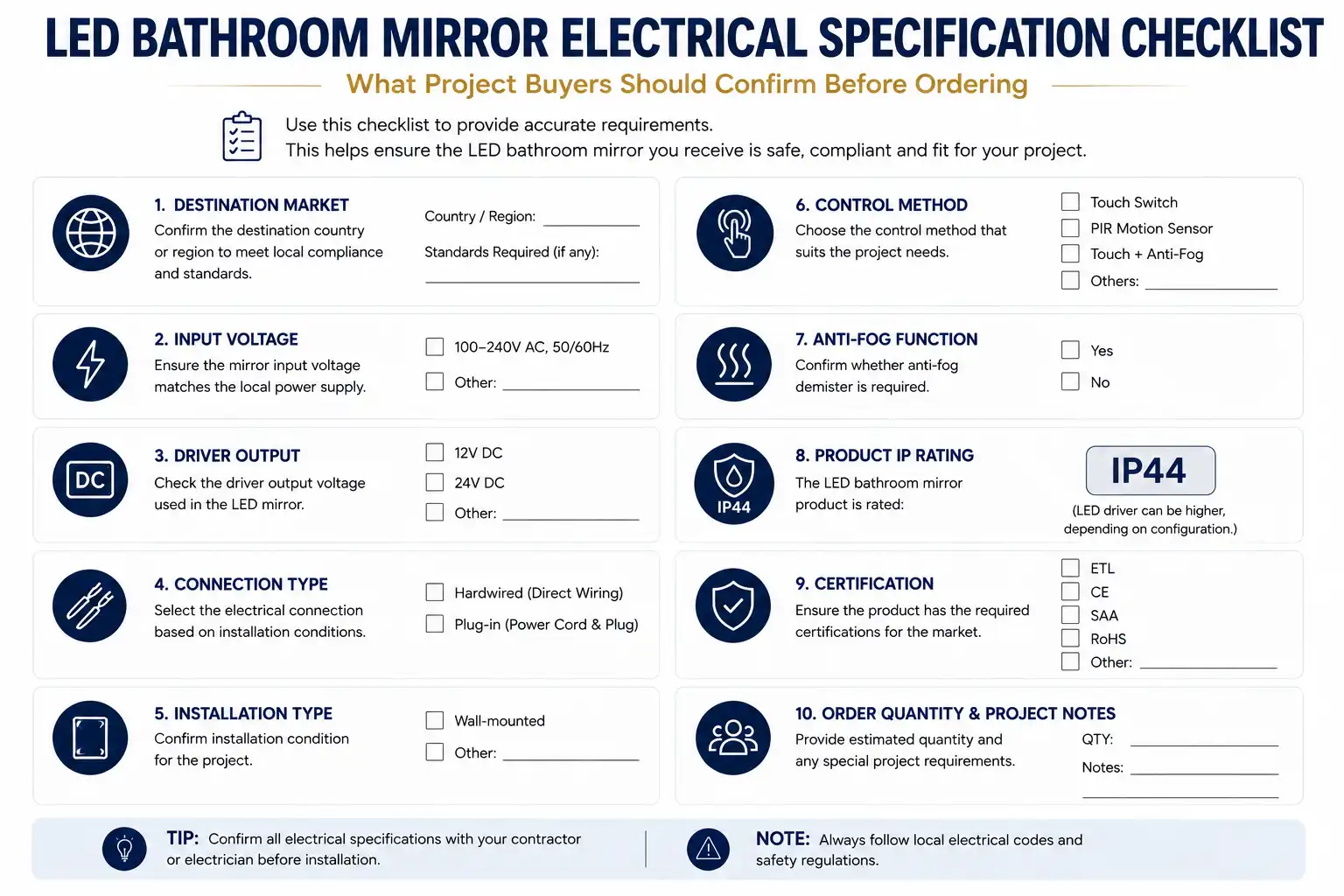
LED Bathroom Mirror Electrical Specification Checklist
| Specification | What the Buyer Should Confirm |
|---|---|
| Destination Market | Country or region where the mirrors will be installed |
| Input Voltage | Required AC input voltage and frequency for the project |
| Driver Output | 12V DC or 24V DC depending on the mirror design |
| Connection Type | Hardwired or plug-in |
| Control Method | Touch switch, wall switch, PIR, dimming, CCT, or other required control |
| Anti-Fog | Confirm whether the project requires an anti-fog pad |
| Product IP Rating | IP44 for the applicable LED bathroom mirror product |
| Certification | Required compliance according to destination market and selected model |
| Installation | Wall conditions, orientation, wiring access, and installation requirements |
| Order Quantity | Estimated project quantity and delivery schedule |
Common Electrical Specification Mistakes to Avoid
Ordering Without Confirming the Destination Market
The destination market affects voltage, plug type, compliance requirements, and installation expectations. Providing this information early helps prevent unnecessary revisions.
Assuming Every LED Mirror Uses the Same Driver
Different mirrors can use different LED strips, power levels, and driver outputs. Buyers should approve the complete electrical configuration instead of specifying only the mirror size.
Confusing Driver Protection Rating With Product IP Rating
A driver may have a higher protection rating than the finished mirror. The rating of one internal component should not be used to describe the protection level of the complete product.
Changing Electrical Functions After Sample Approval
Adding anti-fog, changing touch controls, changing voltage, or switching from hardwired to plug-in can affect wiring and component selection. Make these decisions before bulk production whenever possible.
Electrical Requirements for Hotel and Commercial Mirror Projects
Hotel and commercial projects usually need more coordination than individual retail purchases. The mirror specification may need to align with architectural drawings, electrical plans, room controls, installation methods, and local compliance requirements.
For hospitality developments, buyers can review NISSIYA's hospitality LED mirror project solutions to understand how mirror specifications can be coordinated for larger projects.
Buyers who are still comparing shapes, finishes, lighting designs, and product configurations can also review the NISSIYA mirror product range and commercial mirror solutions.
If the project is still at the supplier-selection stage, the custom bathroom mirror manufacturer guide explains how to evaluate customization capability, quality control, certifications, packaging, and bulk production support.
Final Checklist for LED Bathroom Mirror Electrical Requirements
The electrical system should be confirmed at the same time as mirror dimensions, lighting design, frame finish, and functional features. Waiting until production begins can cause unnecessary changes to drivers, wiring, controls, anti-fog systems, and packaging.
Before approving an order, confirm the destination market, input voltage, driver output, connection method, control method, anti-fog requirement, IP44 product rating, certification requirements, and installation conditions.
Clear LED bathroom mirror electrical requirements help the manufacturer prepare the correct sample and maintain consistent specifications during bulk production. They also help contractors and project buyers reduce installation conflicts when the mirrors arrive on site.
Ready to Start Your Next Hospitality Project?
From initial design concepts to final product delivery, NISSIYA provides full-scale manufacturing support for hotels, resorts, and commercial developments worldwide. Let our engineering team help you translate your vision into reality with precision-engineered, commercially compliant mirror solutions.