
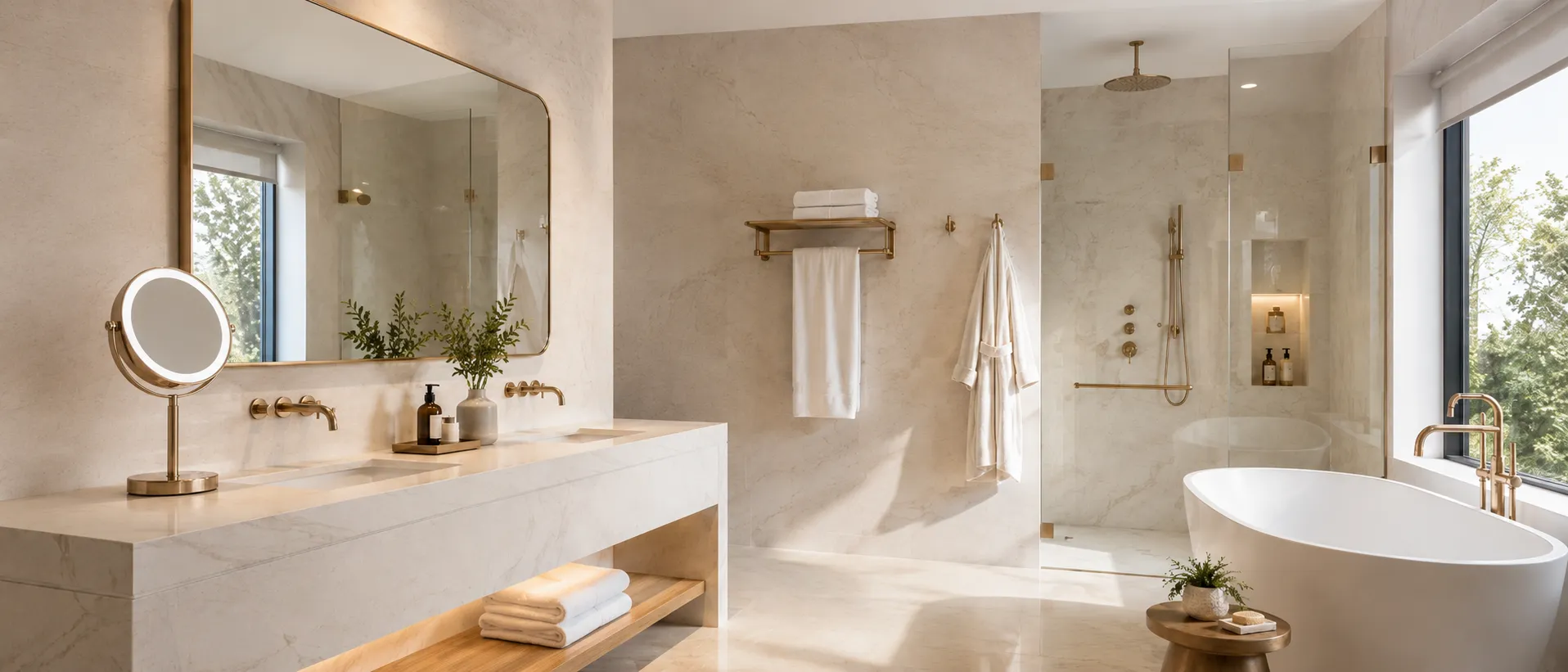

The bathroom mirror manufacturing process involves much more than cutting mirror glass and adding a frame or LED strip. For OEM buyers, hotel procurement teams, distributors and contractors, every production stage can affect appearance, electrical reliability, installation consistency and transport performance.
A successful bulk order starts with a clear specification and ends with consistent production, functional testing, quality inspection and suitable packaging. Buyers who understand these stages can evaluate a bathroom mirror manufacturer more effectively and identify potential problems before shipment.
What Does the Bathroom Mirror Manufacturing Process Include?
The exact production flow depends on the mirror type. A framed non-lighted bathroom mirror requires a different process from a backlit, front-lit or smart LED bathroom mirror. However, a professional bathroom mirror manufacturing process normally follows the same basic sequence from specification approval through final packing.
OEM buyers should view these steps as one connected process. A mirror may look attractive in a catalog but still create problems if the supplier overlooks its electrical system, mounting structure or packaging.
Start with an Approved Product Specification
A good production process does not start with glass cutting. It starts with a specification that both the buyer and manufacturer clearly understand.
Before production begins, buyers should confirm the mirror dimensions, shape, lighting structure, frame design, surface finish, control functions, anti-fog requirement, electrical configuration, installation method and packaging expectations.
For LED bathroom mirrors, buyers should also consider the destination market because voltage, connection methods and compliance requirements may vary between projects.
Mirror Glass Cutting and Edge Processing
After specification approval, the factory cuts and processes the mirror glass according to the confirmed dimensions and shape.
Depending on the product, workers may cut straight or curved profiles, process edges, prepare openings or complete other model-specific machining. Irregular, oval, round and framed mirrors may require different production methods.
Buyers should check visible edge quality, dimensional consistency and surface condition. Scratches, edge damage, distortion or poorly processed openings can affect both appearance and later assembly.
For bulk hotel or retail orders, production consistency matters more than one attractive sample. Mirrors installed side by side or across multiple rooms should follow the same dimensions and visual standard.
Frame and Rear Structure Preparation
Buyers often focus on the front of a bathroom mirror, but the rear structure also plays an important role in mounting, wiring and future maintenance.
Depending on the model, the factory may use an aluminum structure, stainless steel frame, mounting rail, brackets or another support system. Buyers should review how the structure supports the mirror and how installers can reach the electrical components.
Buyers should also check cable routing, mounting points, wall clearance and installation orientation before they approve the product.
When installers fit dozens or hundreds of mirrors, a consistent rear structure can simplify installation and reduce unexpected changes on site.
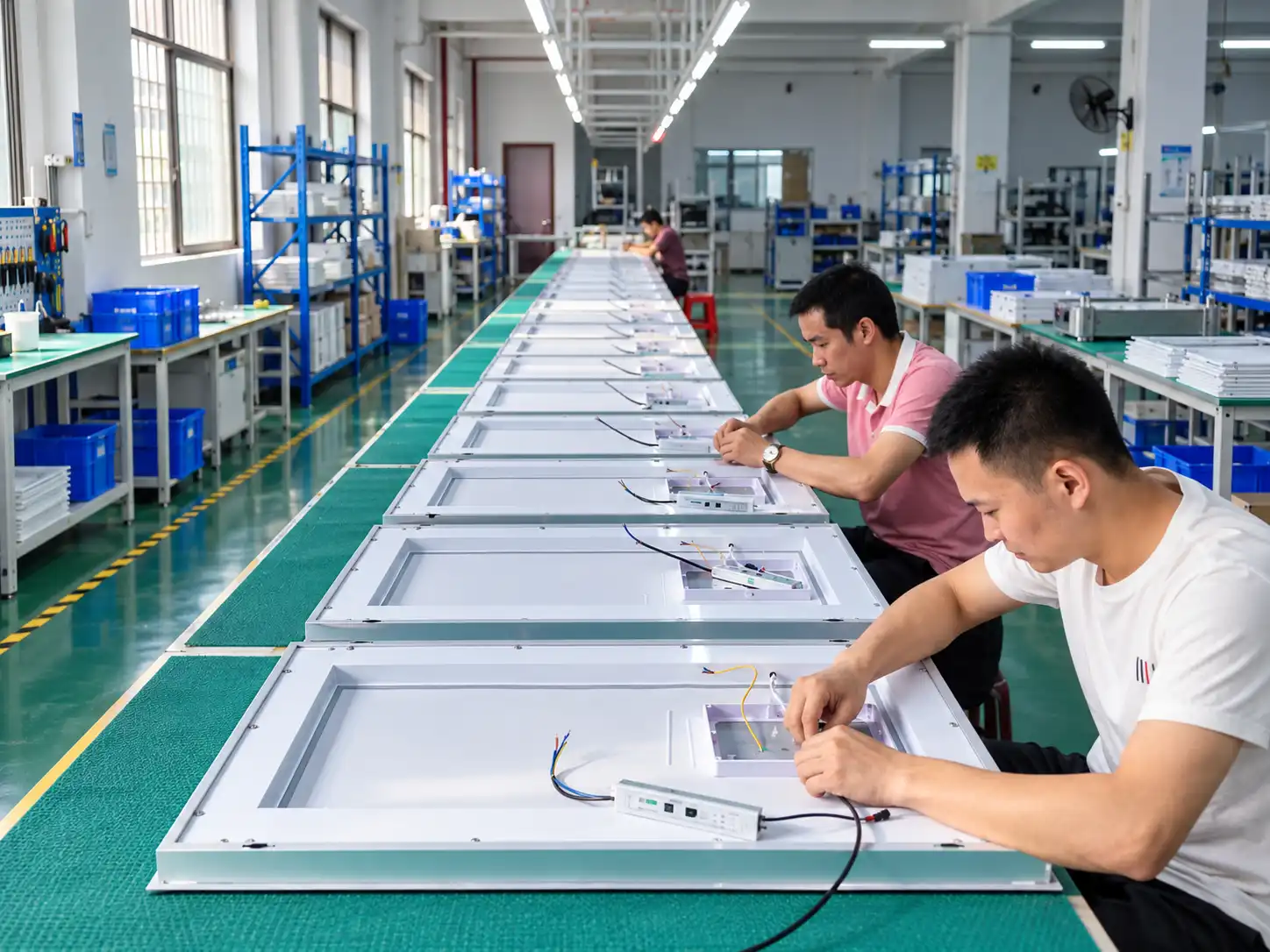
LED and Electrical Component Assembly
For LED bathroom mirrors, electrical assembly forms one of the most important stages of the bathroom mirror manufacturing process.
Depending on the selected configuration, workers may install LED lighting, an LED driver, wiring, touch controls, a PIR motion sensor, dimming controls, adjustable color-temperature functions and an anti-fog system.
Buyers should confirm the input voltage, driver output, wiring method and required control functions for the exact model.
Service access also deserves attention. A practical rear structure allows technicians to reach a driver or controller more easily if the product needs maintenance in the future.
Can technicians access the LED driver for service or replacement?
Does the control system respond consistently after repeated operation?
Do the lighting and anti-fog functions use independent or combined controls?
Does the electrical configuration match the destination market and the approved product specification?
Lighting and Functional Testing
Functional testing forms another important part of the bathroom mirror manufacturing process. After assembly, the factory should test every function that the buyer approved for the selected model.
For an LED bathroom mirror, workers may check light output, dimming response, color-temperature switching, touch controls, motion sensing and anti-fog operation.
Buyers should look beyond a simple on-or-off test. They should also check consistency across the production batch.
For example, noticeably different color temperatures can become obvious when a hotel installs multiple mirrors along the same corridor, across similar rooms or in matching vanity areas.
Buyers should also listen for abnormal electrical noise. A driver or controller should operate without creating an unexpected sound during normal use.
Control logic matters as well. Some buyers prefer independent lighting and anti-fog controls, while other projects use a wall switch or sensor. The approved sample should demonstrate the exact operation that the buyer expects from mass production.
Appearance and Assembly Inspection
Electrical performance represents only one part of quality control. The factory must also check whether the finished mirror matches the visual standard that the buyer approved.
Inspectors should review the mirror surface, frame finish, gaps, joints, alignment, buttons, visible hardware and overall cleanliness.
Framed mirrors require particular attention to finish consistency. Matte black, brushed metal, gold, bronze and other finishes can look different under different lighting conditions, so buyers should confirm a physical sample instead of relying only on digital images.
For repeat retail orders, the supplier should also maintain a consistent appearance between production batches when the buyer continues selling the same model.
Aging Test Before Packing
A factory should not move LED bathroom mirrors directly from final assembly into cartons without first observing their operation.
An aging test gives the production team time to identify unstable electrical components, abnormal lighting behavior or other issues before shipment.
Each product may require a different testing method or duration, so buyers should ask the supplier how it tests the selected model instead of assuming that every mirror follows the same procedure.
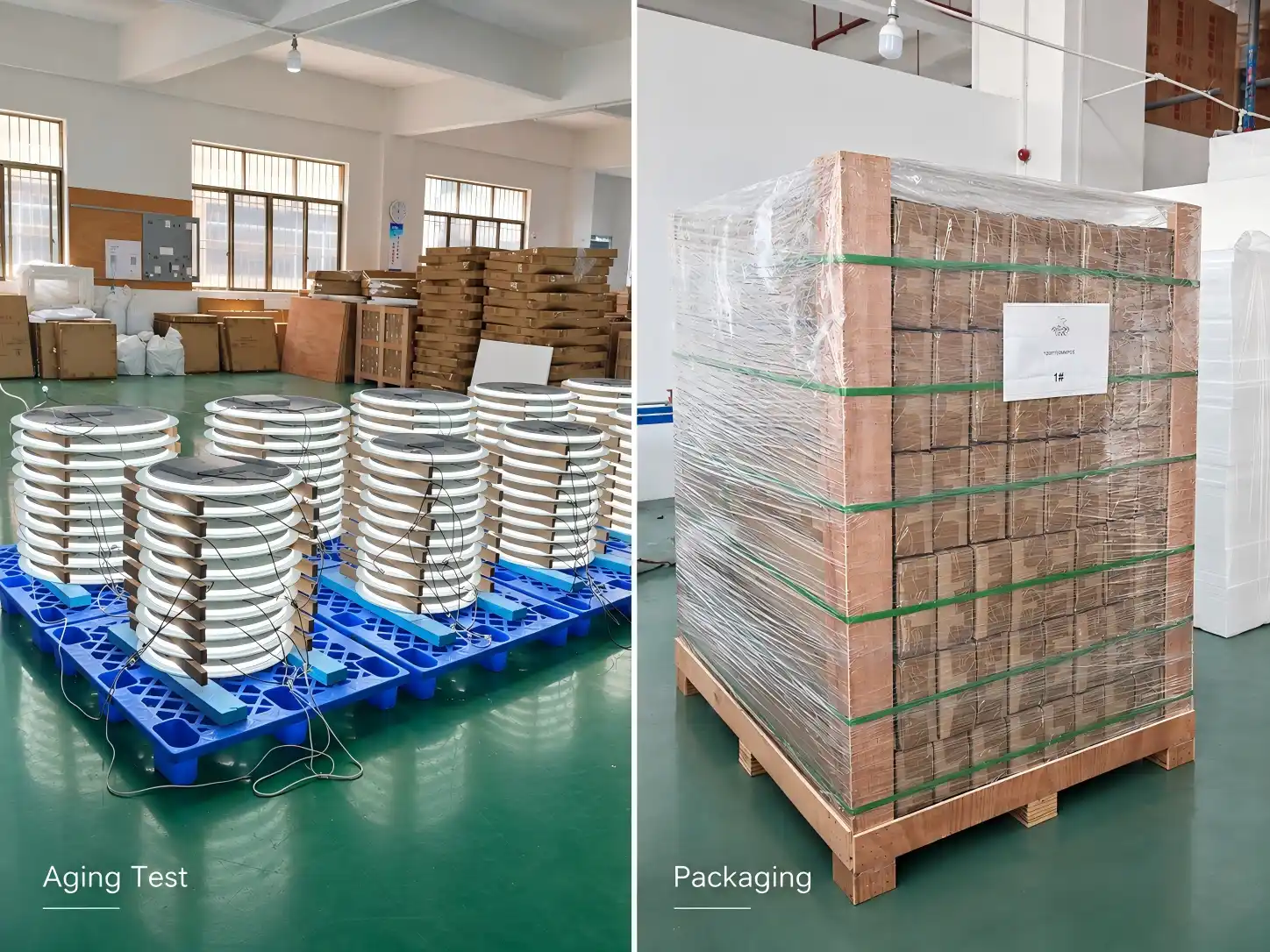
Packaging Is Part of the Manufacturing Process
Suppliers should include packaging in production planning rather than treat it as a final afterthought. Bathroom mirrors may pass through warehouses, containers, ports, distribution centers and job sites before installers mount them on a wall.
A mirror can leave the factory in excellent condition and still arrive damaged if the packaging does not suit the shipping route.
Buyers should confirm the packaging structure, protective materials, carton dimensions and handling requirements before the factory completes bulk production.
Retail and distribution programs may also need private-label cartons, barcodes, manuals or specific packaging dimensions that support warehouse and freight efficiency.
For more detail, buyers can review NISSIYA's mirror packaging solutions for project and international delivery considerations.
Quality Control During the Bathroom Mirror Manufacturing Process
A supplier should maintain quality control throughout the bathroom mirror manufacturing process instead of relying only on one final inspection. Each production stage gives the factory another opportunity to compare the product with the approved specification.
| Production Stage | Buyer Check |
|---|---|
| Specification Approval | Dimensions, functions, finish, electrical system, installation and packaging |
| Mirror Processing | Glass quality, dimensions, edges, holes and special shapes |
| Rear Structure | Mounting points, frame strength, wiring access and wall clearance |
| Electrical Assembly | Driver, wiring, controls, anti-fog and destination-market configuration |
| Functional Testing | Lighting, dimming, CCT, touch, sensor, anti-fog and abnormal noise |
| Final Inspection | Surface, frame finish, alignment, gaps, cleanliness and hardware |
| Packaging | Protection, carton size, labeling and delivery requirements |
Why the Approved Sample Should Become the Production Benchmark
A commercial bathroom mirror sample should confirm much more than the general appearance.
Buyers should use the sample to approve dimensions, finish, light color, brightness, functions, mounting structure, wiring and packaging expectations.
If a buyer requests changes after reviewing the first sample, both sides should record those changes before mass production begins.
The factory can then use the approved sample as an important benchmark for bulk quality control and future repeat orders.
Buyers who still need to evaluate supplier capability can also review the custom bathroom mirror manufacturer guide for supplier selection, sample approval and OEM sourcing considerations.
Hotel Projects and Retail Programs Need Different Production Priorities
Consistency and Installation
Hotel buyers often focus on room-to-room consistency, electrical coordination, mounting structure, approved finishes, replacement planning and packaging by room type or project phase.
Repeatability and Logistics
Retail buyers often focus on stable existing models, carton dimensions, product labeling, private-label packaging, low transport damage and consistent specifications across repeat orders.
Buyers can also explore NISSIYA's bathroom mirror manufacturer collection for mirror structures developed for hospitality, commercial and distribution requirements.
Questions to Ask a Bathroom Mirror Manufacturer Before Bulk Production
1. Which specifications will the factory include on the production sheet?
2. Which functions and electrical components apply to this exact model?
3. How does the factory check lighting and functional consistency?
4. Can technicians access the LED driver or controller for future maintenance?
5. How does the factory test the mirror after assembly?
6. Which appearance defects does the inspection team check before packing?
7. Which compliance documents apply to the exact product configuration?
8. Which packaging structure will the factory use for the planned shipping route?
9. How will the factory match future repeat orders to the approved specification?
A Good Manufacturing Process Is About Repeatability
The goal of a professional bathroom mirror manufacturing process goes beyond producing one attractive sample. OEM and project buyers need the factory to reproduce the approved product consistently throughout the full order.
Mirror processing, structural preparation, electrical assembly, functional testing, appearance inspection, aging tests and packaging all contribute to the final result.
Buyers who understand these stages can ask better questions, review samples more carefully and compare manufacturers on more than unit price alone.
For commercial mirror sourcing, a reliable process starts with a clear specification, follows that specification throughout production and finishes with quality control and packaging that match the destination market and delivery route.
Ready to Start Your Next Hospitality Project?
From initial design concepts to final product delivery, NISSIYA provides full-scale manufacturing support for hotels, resorts, and commercial developments worldwide. Let our engineering team help you translate your vision into reality with precision-engineered, commercially compliant mirror solutions.