
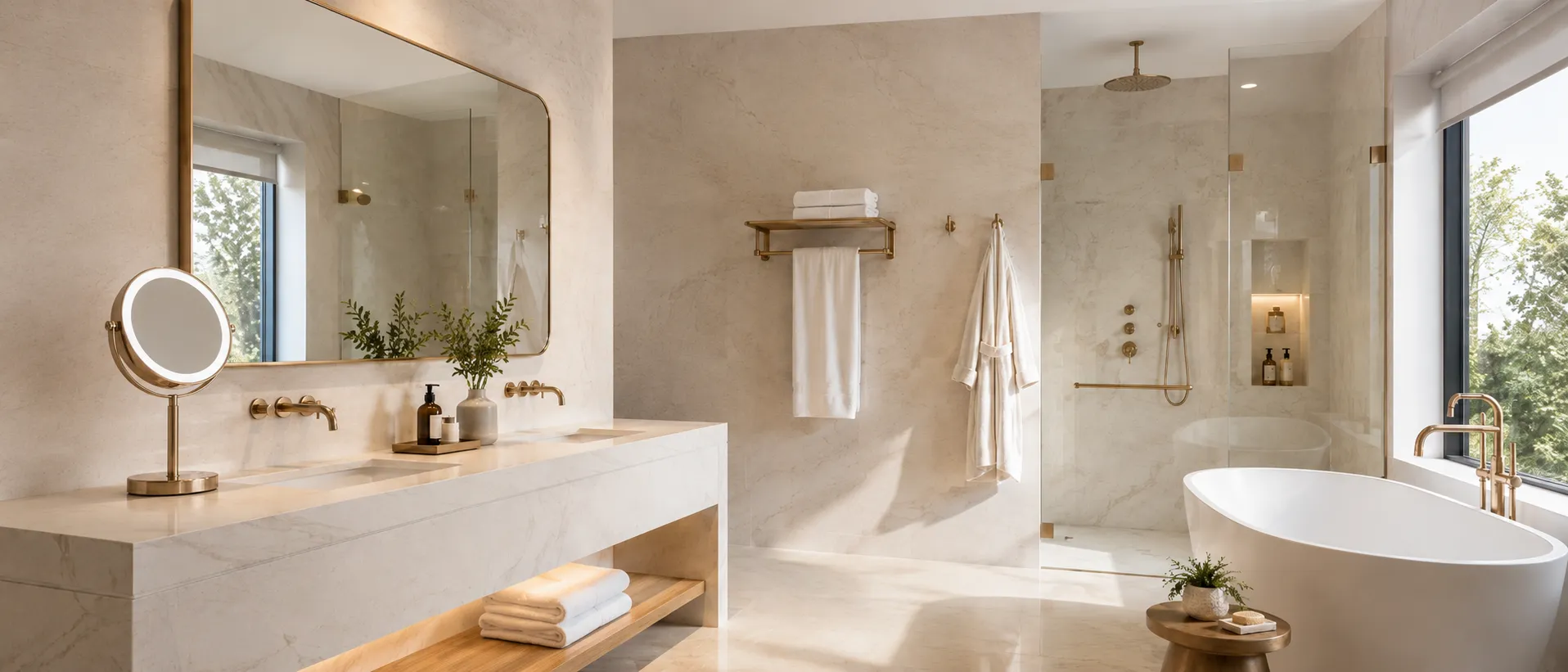
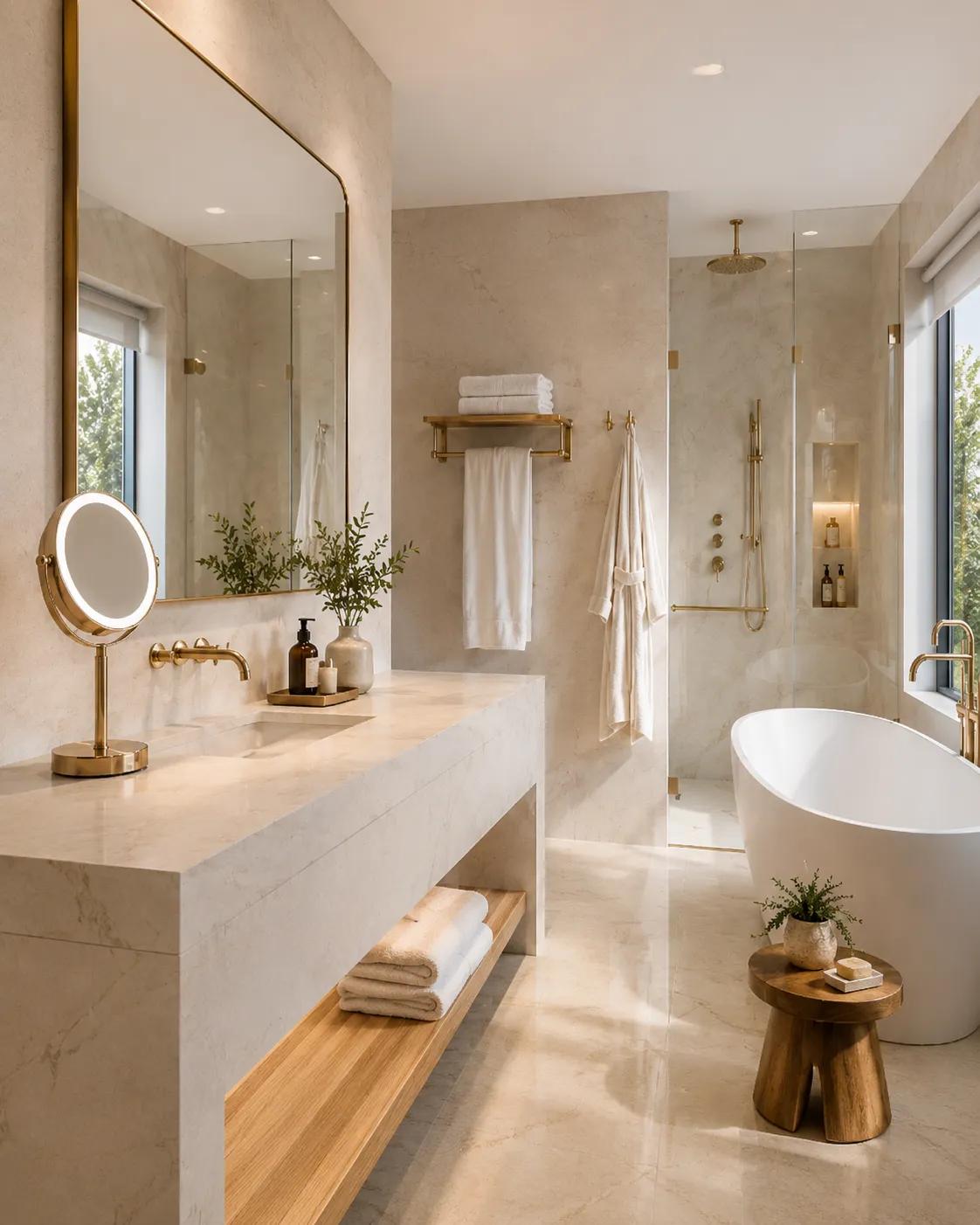
Choosing between a round vs rectangular mirror may look like a simple bathroom design decision. In practice, mirror shape also affects usable reflection, vanity proportions, lighting placement and everyday viewing comfort.
A round bathroom mirror can soften a room filled with straight architectural lines and create a strong decorative focal point. A rectangular mirror, however, usually provides more continuous reflective space and gives designers more flexibility when working with wide vanities, double basins and integrated LED lighting.
NISSIYA is a bathroom mirror manufacturer supplying LED and non-lighted mirrors for hospitality, residential and commercial projects. In this guide, we compare round and rectangular bathroom mirrors from both a design and practical project perspective.
Round vs Rectangular Mirror: Which Shape Fits the Bathroom Best?
Choose a round bathroom mirror when you want a softer visual effect, especially above a single vanity or in a bathroom dominated by straight lines. Choose a rectangular bathroom mirror when usable reflective area, wider vanity coverage or flexible width-to-height proportions matter more. Neither shape works best in every bathroom. The right choice depends on layout, mirror dimensions, lighting and intended users.
Why Is Bathroom Mirror Shape Harder to Choose Than It Looks?
Bathroom buyers often compare mirrors visually first. However, practical problems usually appear after installation rather than during product selection.
A mirror may look attractive in a product photograph but feel too small above the vanity, sit awkwardly below a lighting fixture or provide less useful reflection than expected. In other cases, the mirror itself is large enough, but its proportions do not work well with the available wall space.
Therefore, buyers should not ask only, “Do I prefer round or rectangular?” Instead, they should consider:
- How much usable reflection does the bathroom need?
- How wide is the vanity?
- Will one person or several people use the mirror?
- Where are the lights, outlets and wall cabinets?
- Will the mirror include integrated LED lighting?
- Does the room need softer curves or stronger architectural lines?
When Does a Round Bathroom Mirror Work Best?
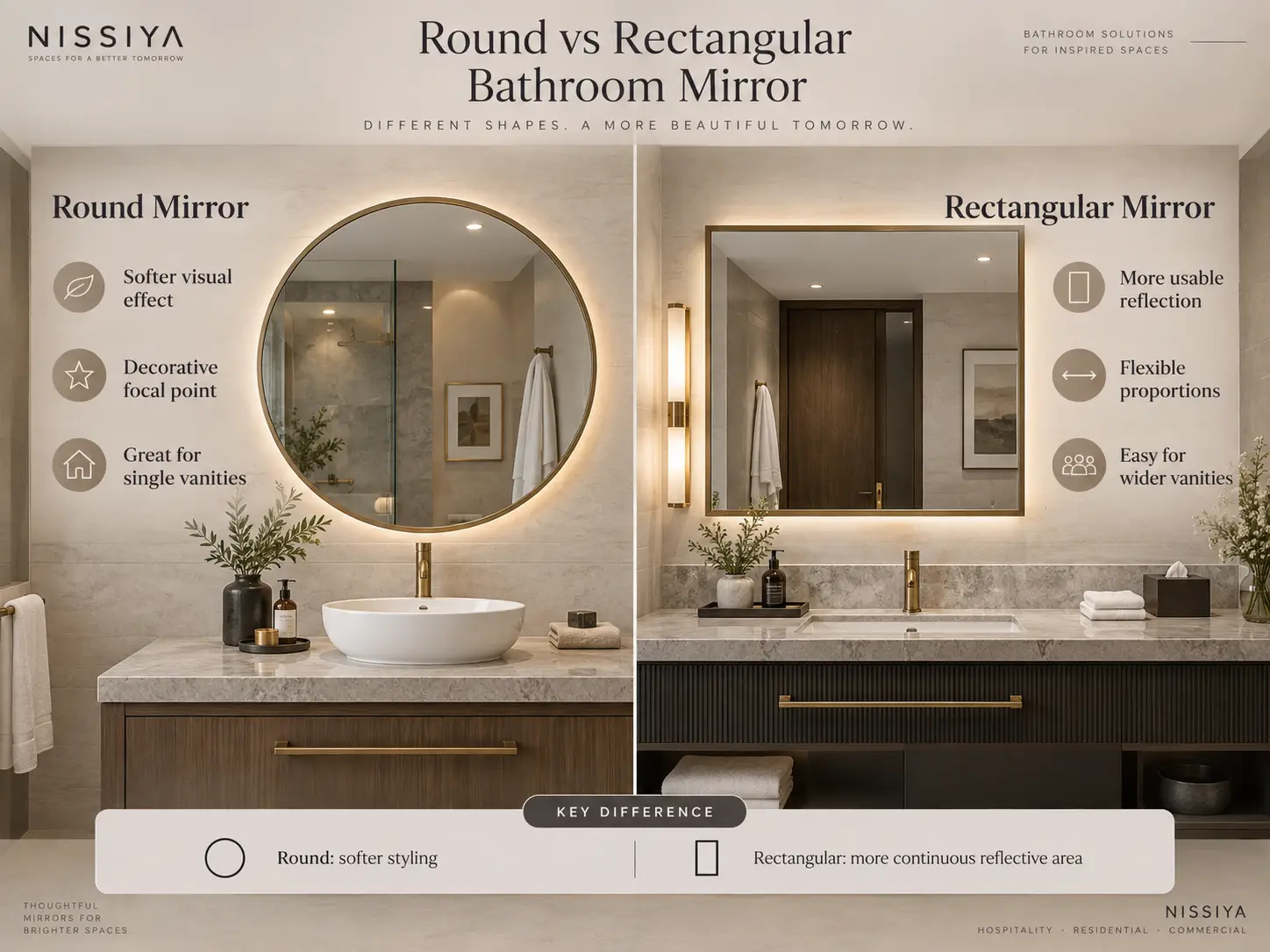
Round mirrors introduce curves into bathrooms that often contain rectangular tiles, cabinets, countertops and shower enclosures. For this reason, they can make a room feel softer and less rigid.
They work particularly well above a single basin, where designers can visually center the mirror with the vanity and faucet. A round shape can also create a decorative focal point in guest bathrooms, boutique hotels and smaller vanity areas.
Advantages of Round Bathroom Mirrors
- Softens bathrooms with many straight architectural lines.
- Creates a clear visual focal point above a single basin.
- Works well with contemporary, transitional and hospitality interiors.
- Visually separates the mirror from rectangular vanity cabinetry.
- Works with framed, backlit and decorative LED mirror designs.
What Buyers Should Watch For
The main limitation of a round mirror comes from its geometry. Its width and height remain equal. Therefore, increasing the width also increases the total height.
This matters when a backsplash, ceiling, vanity light or architectural feature limits wall height. Round mirrors also narrow toward the top and bottom, so buyers should confirm usable viewing area instead of comparing diameter alone.
When Is a Rectangular Bathroom Mirror More Practical?
Rectangular bathroom mirrors let designers choose width and height independently. As a result, they provide more flexibility for wide vanities, restricted wall heights and double-basin layouts.
Straight edges also coordinate naturally with countertops, cabinetry and large-format wall tiles. For hotels, apartments and commercial projects, this predictable geometry can simplify mirror specification across multiple bathroom layouts.
Advantages of Rectangular Bathroom Mirrors
- Maintains continuous reflective width from top to bottom.
- Lets buyers select width and height independently.
- Works well above medium and wide bathroom vanities.
- Supports both vertical and horizontal installation concepts.
- Works naturally with front-lit, backlit and dual-light LED designs.
- Helps hotels standardize mirror specifications across multiple rooms.
What Buyers Should Watch For
A rectangular mirror can appear visually heavy when its dimensions nearly match the entire vanity or wall width. Therefore, designers should leave sufficient spacing around the mirror during layout planning.
Sharp rectangular outlines may also reinforce the straight lines already present in a minimalist bathroom. In this situation, a rounded-corner rectangle can offer a useful compromise between a round mirror and a traditional rectangular design.
Round vs Rectangular Mirror Comparison
| Factor | Round Mirror | Rectangular Mirror |
|---|---|---|
| Visual Effect | Softer and more decorative | Structured and architectural |
| Usable Reflection | Narrows toward top and bottom | Maintains full width throughout its height |
| Dimension Flexibility | Width equals height | Buyers can select width and height independently |
| Single Vanity | Strong option for centered layouts | Works with many vanity proportions |
| Wide Vanity | Requires careful sizing | Usually easier to proportion |
| Integrated LED Lighting | Works well with halo and backlit designs | Supports front-lit, backlit and dual-light designs |
| Hospitality Projects | Strong decorative choice | Flexible for standardized room layouts |
Round vs Rectangular Mirror for Different Vanity Sizes
Buyers should evaluate mirror shape together with the vanity rather than treating the mirror as an independent decorative object.
Small Single Vanities
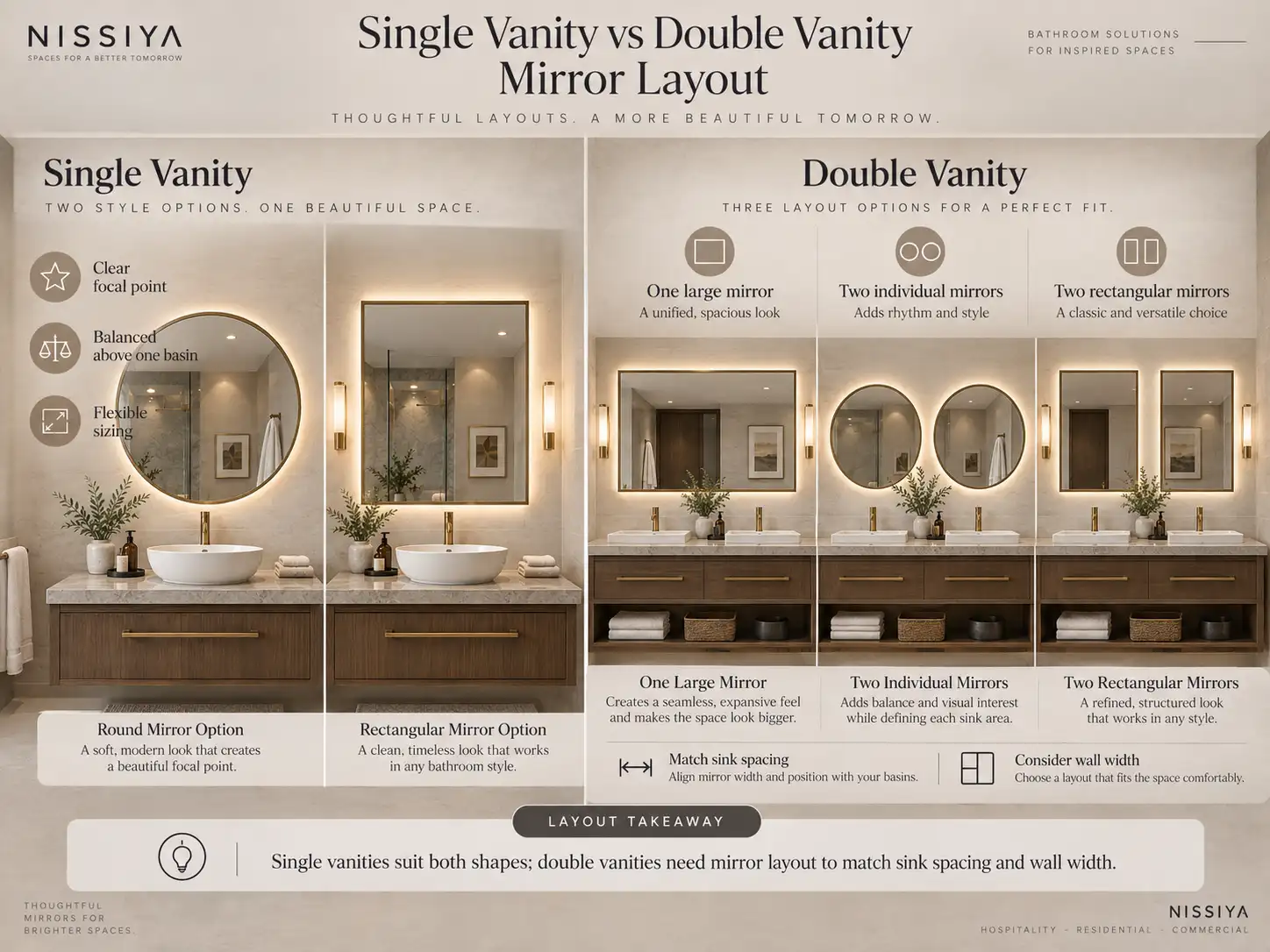
Both round and rectangular mirrors can work well above a compact single vanity. A round mirror creates a clear focal point, while a rectangular mirror may provide more vertical or horizontal reflection within the same wall area.
Wide Single Vanities
As vanity width increases, a rectangular mirror becomes easier to scale because designers can increase width without forcing the mirror to become equally tall.
A large round mirror may still work, but buyers should check ceiling height, wall lighting and surrounding clearances before confirming the diameter.
Double Vanities
Double vanities provide several options: one wide rectangular mirror, two rectangular mirrors or two round mirrors positioned above individual basins.
Sink spacing, lighting, available wall width and the overall interior concept should guide the final arrangement.
How Lighting Changes a Round vs Rectangular Mirror
Lighting remains one of the most overlooked factors when buyers compare a round vs rectangular mirror.
With an external vanity light, designers need to consider the relationship between the fixture and the top edge of the mirror. A rectangular mirror provides a straight horizontal reference, while a round mirror curves away from a linear light fixture.
Integrated LED mirrors reduce this dependency because manufacturers build the lighting directly into the mirror structure. However, buyers should still compare light distribution, color temperature, brightness, CRI and whether the mirror uses front-lit, backlit or dual-light illumination.
Buyers can explore additional models in the NISSIYA bathroom mirror collection .
For broader information about lighting terminology, color and visual performance, buyers can also refer to the International Commission on Illumination (CIE) .
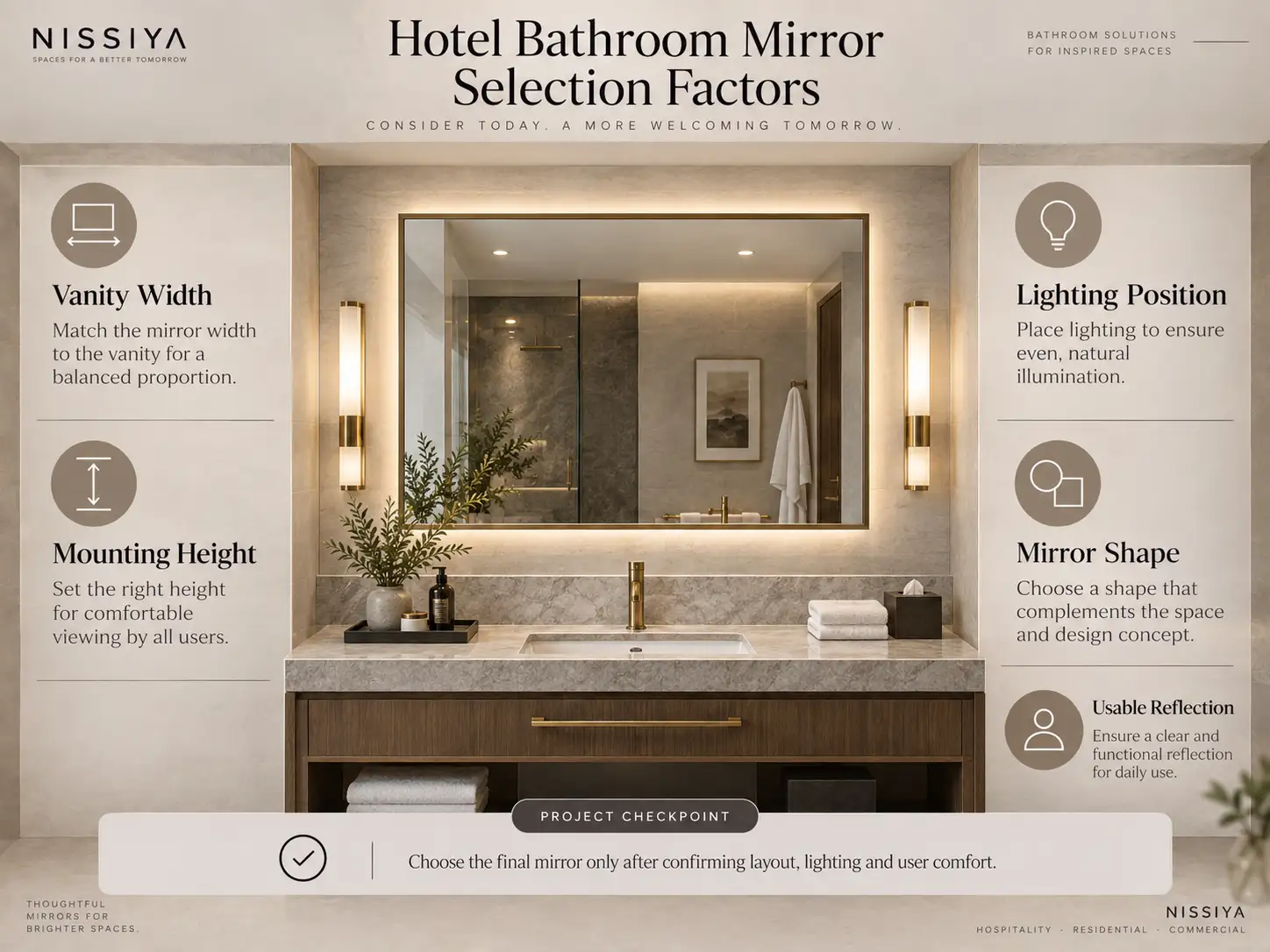
For hotel and commercial projects, NISSIYA recommends confirming wall dimensions, vanity width, mounting height, lighting position and required mirror functions before choosing the final shape. A visually attractive mirror still needs to provide comfortable viewing and practical installation in the finished bathroom.
What Should Hotel and Project Buyers Compare?
For a residential renovation, buyers may select a mirror mainly for one bathroom. Hotel and commercial buyers, however, often need the same mirror concept to work consistently across many rooms.
Therefore, project buyers should evaluate both visual design and technical specifications before confirming the final mirror.
| Factor | What to Compare | Why It Matters |
|---|---|---|
| Mirror Size | Dimensions and usable reflective area | Buyers need comfortable viewing while keeping the mirror proportional to the vanity and wall space. |
| Mirror Quality | Glass thickness, reflection quality and edge finishing | Consistent mirror quality becomes especially important when a hotel uses the same specification across many rooms. |
| Construction | Framed or frameless design | Frame structure affects appearance, installation, durability and coordination with bathroom hardware. |
| LED Structure | Front-lit, backlit or dual-light design | Each lighting structure creates a different visual effect, facial illumination and installation requirement. |
| Light Settings | Color temperature and dimming requirements | Buyers should match lighting specifications to guest comfort, bathroom ambience and project standards. |
| Mirror Functions | Anti-fog, touch control, wall switch or motion sensor | Buyers should choose functions according to hotel standards, user experience and maintenance expectations. |
| Electrical Setup | Hardwired or plug-in configuration | Buyers should confirm the electrical configuration before production so it matches site wiring and installation conditions. |
| Installation | Mounting system and required installation clearance | Correct clearance helps avoid conflicts with faucets, backsplashes, lighting and nearby cabinets. |
| Packaging | Carton protection and breakage control for bulk shipping | Strong packaging helps reduce glass breakage during bulk transport and project delivery. |
Alternatives to a Round vs Rectangular Mirror
A rounded-corner rectangular mirror can provide a useful middle ground. It retains most of the practical reflective area and flexible proportions of a rectangle while softening the visual effect of sharp corners.
Oval, arched and irregular mirrors provide additional options when the interior concept requires a more distinctive shape. However, project buyers should still evaluate usable reflection and installation requirements before choosing a mirror mainly for appearance.
NISSIYA offers multiple bathroom mirror structures, including round, rectangular and custom-shape designs. Buyers can explore our bathroom mirror collection when comparing different project configurations.
Round vs Rectangular Mirror FAQs
Is a round or rectangular mirror better for a bathroom?
Neither shape works best in every bathroom. Round mirrors create a softer decorative appearance, while rectangular mirrors provide flexible dimensions and continuous reflective width. Vanity size, wall space, lighting and user needs should guide the final choice.
Does a rectangular mirror provide more usable reflection?
Compared with a round mirror of similar maximum width, a rectangular mirror can provide more reflection near the corners because its full width continues throughout the mirror height. However, actual usable reflection still depends on dimensions and installation position.
Are round mirrors suitable for hotel bathrooms?
Yes. Round mirrors work well in hotel bathrooms, especially when designers want a decorative focal point above a single vanity. Project buyers should still confirm diameter, wall clearance, lighting and viewing position.
Which mirror shape works better for a double vanity?
A wide rectangular mirror, two rectangular mirrors or two round mirrors can all work above a double vanity. Sink spacing, vanity width, lighting arrangement and interior design should determine the final configuration.
Are rounded-corner mirrors a good alternative?
Yes. Rounded-corner rectangular mirrors combine flexible rectangular proportions with softer visual edges. They work well for buyers who want practical reflective area together with a more contemporary appearance.
Choose the Mirror Shape Around the Bathroom, Not in Isolation
The best bathroom mirror shape depends on more than visual preference. Vanity dimensions, usable reflection, mounting height, lighting position and user needs all influence whether a round or rectangular mirror works better.
Round mirrors introduce softness and create a distinctive focal point. Rectangular mirrors provide flexible proportions and practical reflective coverage. For project buyers, evaluating these factors together before production helps prevent installation compromises later.
From initial design concepts to final product delivery, NISSIYA provides full-scale manufacturing support for hotels, resorts, and commercial developments worldwide. Let our engineering team help you translate your vision into reality with precision-engineered, commercially compliant mirror solutions.