
A makeup mirror arm should move smoothly and hold its position when a guest adjusts it. If the mirror starts drooping, wobbling, or swinging too freely, the cause may be a pivot, a mounting fastener, or the supporting wall. Finding the moving part first can prevent an unnecessary replacement.
For hotels, a single loose mirror may seem like a minor maintenance problem. Across dozens of guestrooms, however, the same fault can increase service calls and affect guest comfort. This guide explains seven possible causes and shows buyers how to evaluate the structure before bulk installation.
It also uses a real NISSIYA double-arm mirror to explain four visible adjustment points. On this design, only points 1 and 4 are intended for adjustment. Points 2 and 3 have already been set and secured during manufacturing.
Quick answer: If the mirror head drops but the arms remain stable, inspect the head adjustment. When the whole arm swings too loosely, check the approved arm-tension control. A wall plate that moves against the wall is a separate mounting problem. Never force a factory-fixed joint.
Makeup Mirror Arm Troubleshooting: Identify the Moving Part
Start with one simple question: which component actually moves? A mirror head that slowly tilts down needs a different check from an arm that turns too easily. Meanwhile, movement of the entire wall plate calls for an inspection of the mounting surface and fixings.
Several joints may look similar from the outside. Yet some are designed for maintenance adjustments, while others are fixed before shipment. The correct approach depends on the model rather than the appearance of a screw head.
NISSIYA's Four-Point Arm Adjustment Reference
The following image shows the back of a NISSIYA 3X lighted wall-mounted mirror. Its double swing arm has two straight sections, a mirror-head connection, and a wall-side mounting base. The numbered positions explain the intended functions of the visible controls.
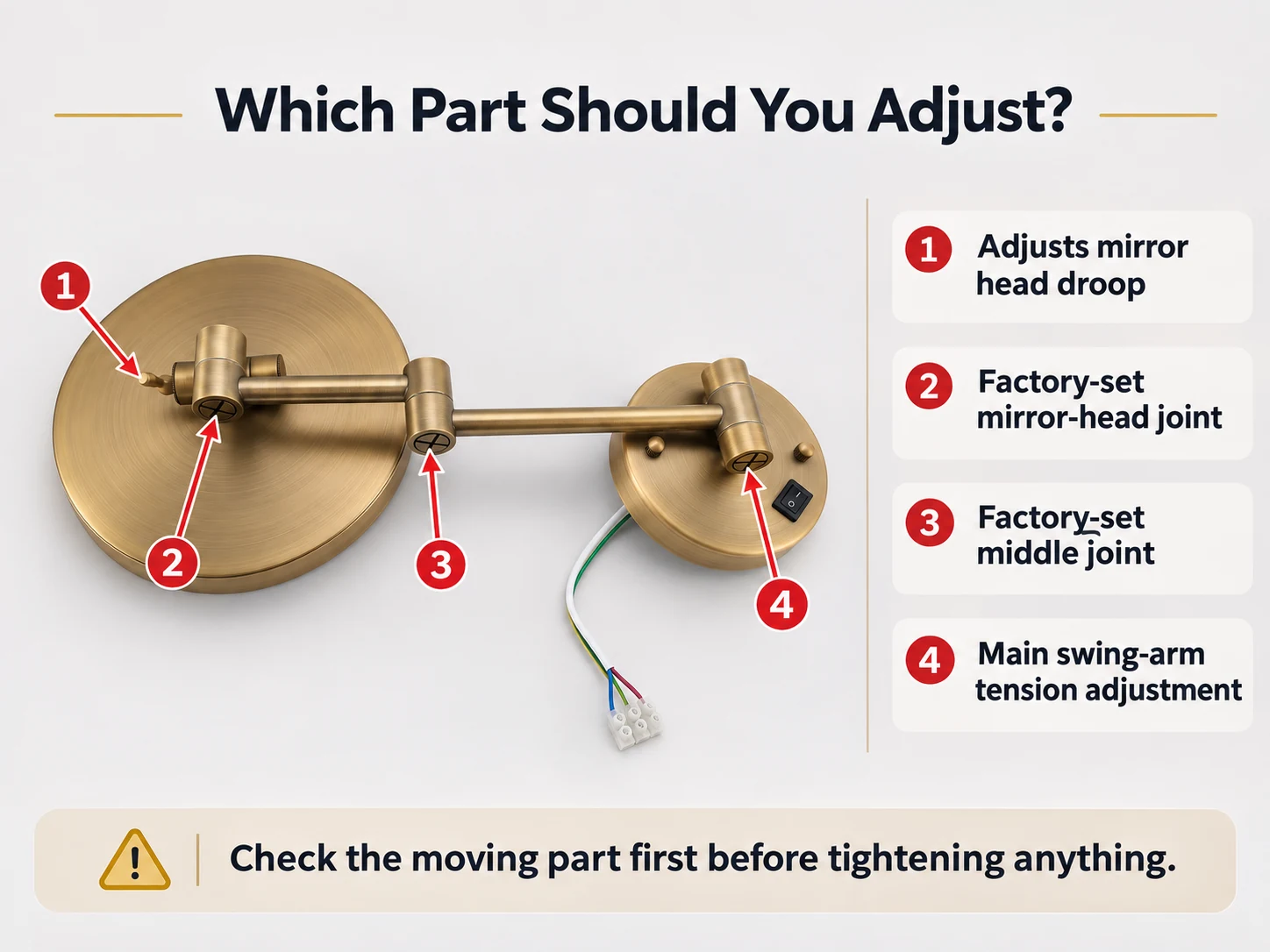
| Point | Component | User Adjustment? | Purpose |
|---|---|---|---|
| 1 | Small handle near the mirror head | Yes | Adjusts head resistance when the mirror frame droops. |
| 2 | Mirror-head connection joint | No | Factory-set and secured with adhesive; users must not turn it. |
| 3 | Middle swing-arm joint | No | Resistance is adjusted and secured with adhesive before shipment. |
| 4 | Wall-side arm tension screw | Yes | Adjusts resistance when the complete swing arm feels too loose or too tight. |
Point 1 is the relevant control if the mirror frame tilts downward. For a swing arm that feels excessively free or stiff, point 4 provides the intended adjustment on this model. Neither control should be confused with a screw that secures the mounting base to the wall.
Do not adjust points 2 and 3. NISSIYA sets their resistance at the factory and applies adhesive to secure the setting. Trying to turn these fasteners can damage the joint or locking compound. Contact the supplier if a factory-fixed joint appears faulty.
These instructions describe the illustrated NISSIYA configuration. Different mirror models may use different mechanisms, so always check the approved manual.
Match the Symptom to the Correct Inspection
| Symptom | Likely Area | Recommended Action |
|---|---|---|
| The entire fixture shifts against the wall | Wall plate, screws, anchors or substrate | Remove from use and arrange a qualified mounting inspection. |
| The mirror frame droops | Mirror-head tilt mechanism | Check the approved head adjustment, such as point 1. |
| The full arm swings too freely | Wall-side swing-arm tension | Check the model's approved tension control, such as point 4. |
| One middle joint seems loose | Factory-set pivot | Ask the supplier to inspect it; do not force a sealed fastener. |
| The arm works when folded but shifts when extended | Joint holding performance under load | Test the approved working range and identify where movement occurs. |
7 Reasons a Makeup Mirror Arm Becomes Loose
1. The Wall Plate Is Not Secure
Every extension of a wall-mounted mirror changes the force applied to its mounting point. Fasteners that do not match the wall structure can gradually loosen, especially with repeated pulling or folding. A stable-looking decorative cover does not prove that the mounting system behind it is sound.
Bathroom tiles are a surface finish, not a substitute for suitable structural support. Contractors need to consider the wall assembly, mirror weight, approved fixing pattern, and normal operating load. If the whole base moves, stop using the product until a qualified installer checks it.
2. A Mounting or Retaining Fastener Has Shifted
Some designs use a concealed chassis behind the wall plate. Others include a separate retaining screw that holds the outer body on its bracket. When a component loosens, the cover may move even if the structural mounting remains secure.
A visual check helps identify the location, but it does not replace the installation drawing. Use the instructions supplied for the actual model to distinguish a decorative cover from a load-bearing fixing.
3. Arm-Joint Resistance Changes Over Time
A makeup mirror arm needs enough friction or controlled resistance to hold its position without making movement difficult. Wear, assembly differences, or damaged moving surfaces can affect that balance. Not every visible pivot, however, is meant to be adjusted by the user.
On the illustrated NISSIYA product, the middle pivot at point 3 is factory-set and secured with adhesive. The nearby point 2 is treated the same way. A technician should not attempt to correct unwanted movement by forcing either of those screws.
Instead, use the approved arm-tension mechanism where the model provides one. Point 4 controls the overall swing-arm resistance on this particular design.
4. The Mirror Head Tilts Downward
The mirror frame can droop even when both arm sections stay in place. This symptom directs attention to the head-tilt mechanism, not necessarily the wall plate or middle pivot.
For the NISSIYA model in the image, the small handle marked point 1 adjusts mirror-head resistance. Make an adjustment only as described in the model's instructions. The screw at point 2 remains factory-fixed and must not be used as an alternative control.
5. Full Extension Increases the Turning Load
An arm may feel stable close to the wall yet move when fully extended. Moving the mirror head farther from the mounting point increases the turning effect on the joints and wall assembly. The head's weight and the arm geometry also influence this behavior.
For that reason, test a loose makeup mirror arm in the actual positions guests use. A sample that works only when folded cannot establish its suitability for close-up grooming. Buyers should inspect stability at a normal viewing position and near the product's approved maximum reach.
6. Moisture or Cleaning Damage Affects the Mechanism
Hotel bathrooms expose metal fittings to humidity, splashes, and cleaning chemicals. Damaged protective coatings may expose susceptible components to corrosion. Cleaning residue or abrasive handling can also affect visible finishes and the movement of joints.
Different materials can look similar after surface treatment. Our brass, stainless steel and iron makeup mirror comparison explains why substrate selection and coating quality matter for different project budgets.
Corrosion should not be assumed to be the cause of every loose arm. Inspect the affected component and its operating conditions before deciding whether a replacement is necessary.
7. Assembly Variation or Transport Damage
Inconsistent assembly, rough handling, or impact during shipment can affect joint resistance before a product reaches the hotel. A mirror may also show finish damage or an unusual gap at a pivot after transport.
Inspect samples when they arrive and compare selected production units with the approved reference. For large purchases, the buyer and supplier should agree on acceptable movement, cosmetic defects, and functional checks before bulk shipment.
How to Inspect a Makeup Mirror Arm Safely
Inspection begins with observing the symptom rather than removing screws. A suitable sequence can help hotel maintenance teams report a clear problem to the supplier or installer.
- Stop if the mounting is unstable. Keep guests away from a mirror whose wall plate shifts or appears at risk of detaching.
- Locate the unwanted movement. Watch the wall plate, main arm, middle joint, and mirror head separately.
- Check the exact model. Match the mirror and its installation drawing before attempting any adjustment.
- Use approved controls only. For the illustrated NISSIYA design, point 1 handles mirror-head droop and point 4 controls overall arm tension.
- Leave sealed joints untouched. Points 2 and 3 were fixed at the factory and are not for customer adjustment.
- Inspect for damage. Look for wall movement, visible gaps, coating damage, missing hardware, or abnormal resistance.
- Retest after authorized service. Verify stable movement at the intended viewing positions without forcing the mechanism.
Electrical and mounting safety: A hardwired LED mirror may contain live connections behind its base. Do not open electrical parts while energized. Qualified personnel should isolate the supply before electrical work, and mounting repairs must suit the actual wall structure. Never solve an unstable wall fixing by tightening an arm pivot.
See the NISSIYA mirror installation guides for product-specific mounting references. Dimensions and hole patterns from one model must not be copied to another without confirmation.
What Reddit Feedback Teaches Us About Mirror-Arm Design
Online discussions often focus on practical convenience rather than material specifications. In one Reddit discussion about choosing a makeup mirror , a commenter described the benefit of pulling a wall-mounted mirror closer and folding it away afterward. That movement is exactly why stable joints and suitable reach deserve attention.
Another Reddit discussion about a mirror coming off its mounting raised questions about loose screws. The example did not involve this NISSIYA model, but it illustrates why secure mounting matters separately from arm tension.
These comments are individual experiences, not a measured defect rate. Still, they suggest useful questions for a hotel buyer: can the mirror be moved easily, does it hold its position, and is the wall connection secure during repeated use?
Hotel Sample-Room Tests for a Makeup Mirror Arm
Before purchasing a large quantity, install the selected mirror in a representative guest bathroom. A sample-room check connects product specifications to real vanity depth, wall construction, and guest movement.
| Check | Practical Method | What to Record |
|---|---|---|
| Wall plate stability | Observe the wall base during permitted arm movement. | Any movement of the fixing or adjacent finish |
| Folded position | Fold the mirror back without forcing its joints. | Clearance and smooth operation |
| Normal viewing position | Extend the mirror to the expected grooming location. | Whether it holds position without drooping |
| Full permitted extension | Test close to the approved maximum reach. | Unexpected swing or joint movement |
| Mirror-head angle | Adjust the head to normal viewing angles. | Whether the face tilts after positioning |
| Joint feel | Repeat a documented number of normal movements. | Sticking, noise, abnormal looseness or finish wear |
| Maintenance reference | Locate user-adjustable and factory-fixed components. | Approved settings and service instructions |
| Production consistency | Compare additional units with the approved sample. | Variation in movement, fit or finish |
Test the mirror at a realistic standing position rather than judging it only in its folded state. Record any shift with a photograph or short video. If a problem appears, identify the specific joint and operating position before requesting corrective work.
A short sample-room review is not a standardized endurance test. For a large hotel or OEM order, ask for the actual test method, load, number of movements, and acceptance criteria. Avoid comparing claimed cycle counts when suppliers use different procedures.
Why Serviceable and Factory-Fixed Joints Must Be Distinguished
Service information is especially important when a hotel maintenance team manages many identical guestrooms. A visible screw may look adjustable without being designed for repeated tightening. Clear instructions help staff avoid turning the wrong component.
The illustrated NISSIYA design separates the functions clearly: point 1 controls mirror-head droop, and point 4 adjusts whole-arm tension. Points 2 and 3 are secured after factory adjustment. This arrangement should be documented in the approved product instructions for the project.
For a related product configuration, see the NISSIYA 8-inch 3X wall-mounted magnifying mirror . Confirm the exact finish, electrical configuration, and joint details of the model selected for your order.
Questions Hotel Buyers Should Ask Before Bulk Ordering
A supplier's technical description should identify how the arm holds its position and which components the buyer may service. General claims such as "heavy duty" cannot replace a defined specification and an approved sample.
| Buyer Question | Why It Matters |
|---|---|
| Which joints are factory-fixed? | Prevents inappropriate adjustment during maintenance. |
| Which controls can the user or installer adjust? | Clarifies the permitted maintenance procedure. |
| What is the actual maximum working reach? | Helps test stability where guests will use the mirror. |
| What fixing hardware and wall support are required? | Connects product selection to safe installation. |
| How is arm resistance checked during production? | Links the approved sample to batch quality. |
| Can the supplier provide test conditions and results? | Allows a meaningful evaluation of durability claims. |
| Are replacement parts or service instructions available? | Helps hotels plan long-term maintenance. |
| How are units protected during shipping? | Reduces avoidable damage before installation. |
Document approved answers in the product specification or sample sign-off. For broader procurement planning, explore NISSIYA hospitality mirror project solutions .
How to Prevent a Loose Makeup Mirror Arm in Hotels
Suitable wall backing, correct installation, and a stable joint design form the foundation for dependable operation. Maintenance practices also matter after the project opens.
Guests should move the mirror within its intended range instead of using it as a handle or towel support. Housekeeping teams should follow the finish-care guidance and avoid aggressive cleaning around the pivots.
Scheduled room inspections can include a short movement check. Look for an unstable wall base, a head that slowly tilts, unusual arm resistance, or obvious finish damage. Report recurring issues early so the affected component can be identified.
When the same fault appears in several rooms, review the installation method and the approved sample instead of repeatedly forcing fasteners. The goal is to identify a shared cause before it becomes a larger maintenance problem.
Makeup Mirror Arm FAQs
Why does my makeup mirror arm keep drooping?
The mirror may have insufficient joint resistance, a head-tilt problem, or an unstable wall fixing. Observe which component moves first, then follow the model-specific inspection instructions.
Can I tighten a loose arm myself?
Only use controls that the manufacturer identifies as adjustable. On the illustrated NISSIYA model, point 4 adjusts overall swing-arm resistance. A loose wall mounting or an electrical issue requires qualified attention.
What does the small handle at point 1 do?
Point 1 adjusts mirror-head resistance on the illustrated NISSIYA model. It is the intended control when the mirror frame tilts or droops.
Why should I not turn screws 2 and 3?
These joints have already been adjusted and secured with adhesive during manufacturing. Users should not force them because doing so may damage the fastener or joint.
What should I check if the whole swing arm feels too loose?
First confirm that the wall plate is secure. If only the arm swings too freely, the illustrated model provides a tension adjustment at point 4. Follow the product instructions rather than guessing the turning direction or force.
Why does a mirror become less stable when fully extended?
Extending the mirror increases the distance between the head and its support, which can increase the turning load on the joints and wall fixing. Test performance within the approved extension range.
What should hotels inspect before buying makeup mirrors in bulk?
Approve a sample-room installation. Check the wall plate, folded and extended positions, head tilt, joint movement, finish quality, and available maintenance instructions. Agree on any additional testing with the supplier.
Final Recommendation for Hotel and OEM Buyers
A makeup mirror arm that does not hold position may have more than one possible cause. The problem could originate in the wall mounting, a moving joint, the mirror-head pivot, or the operating load. Accurate troubleshooting starts by finding which part moves.
On the NISSIYA reference design, only point 1 and point 4 provide the described adjustments. Points 2 and 3 are factory-set and secured with adhesive. These details help maintenance teams avoid damage from turning a joint that was never meant for user adjustment.
Before ordering mirrors for multiple hotel rooms, evaluate a physical sample at realistic viewing positions. Clear instructions, suitable wall support, and agreed quality checks support consistent operation and reduce avoidable maintenance.
Ready to Start Your Next Hospitality Project?
From initial design concepts to final product delivery, NISSIYA provides full-scale manufacturing support for hotels, resorts, and commercial developments worldwide. Let our engineering team help you translate your vision into reality with precision-engineered, commercially compliant mirror solutions.