
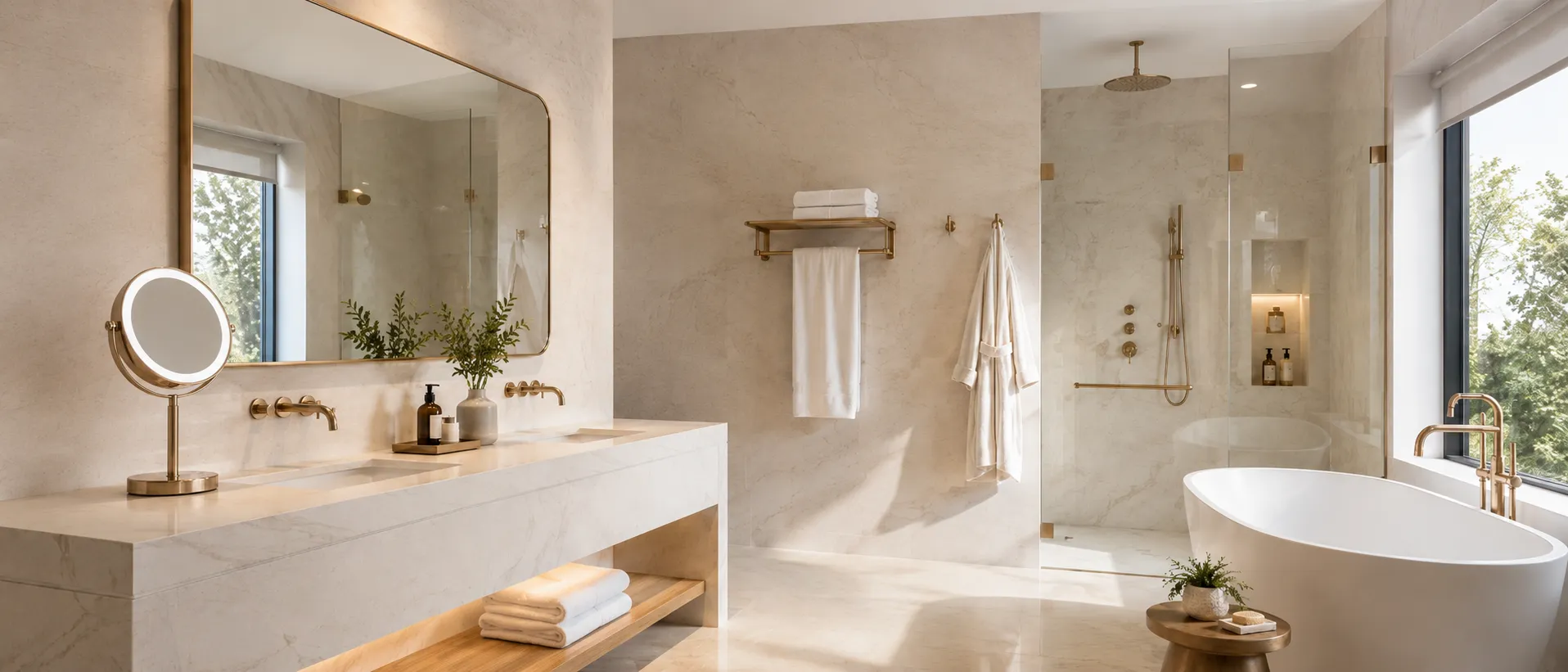
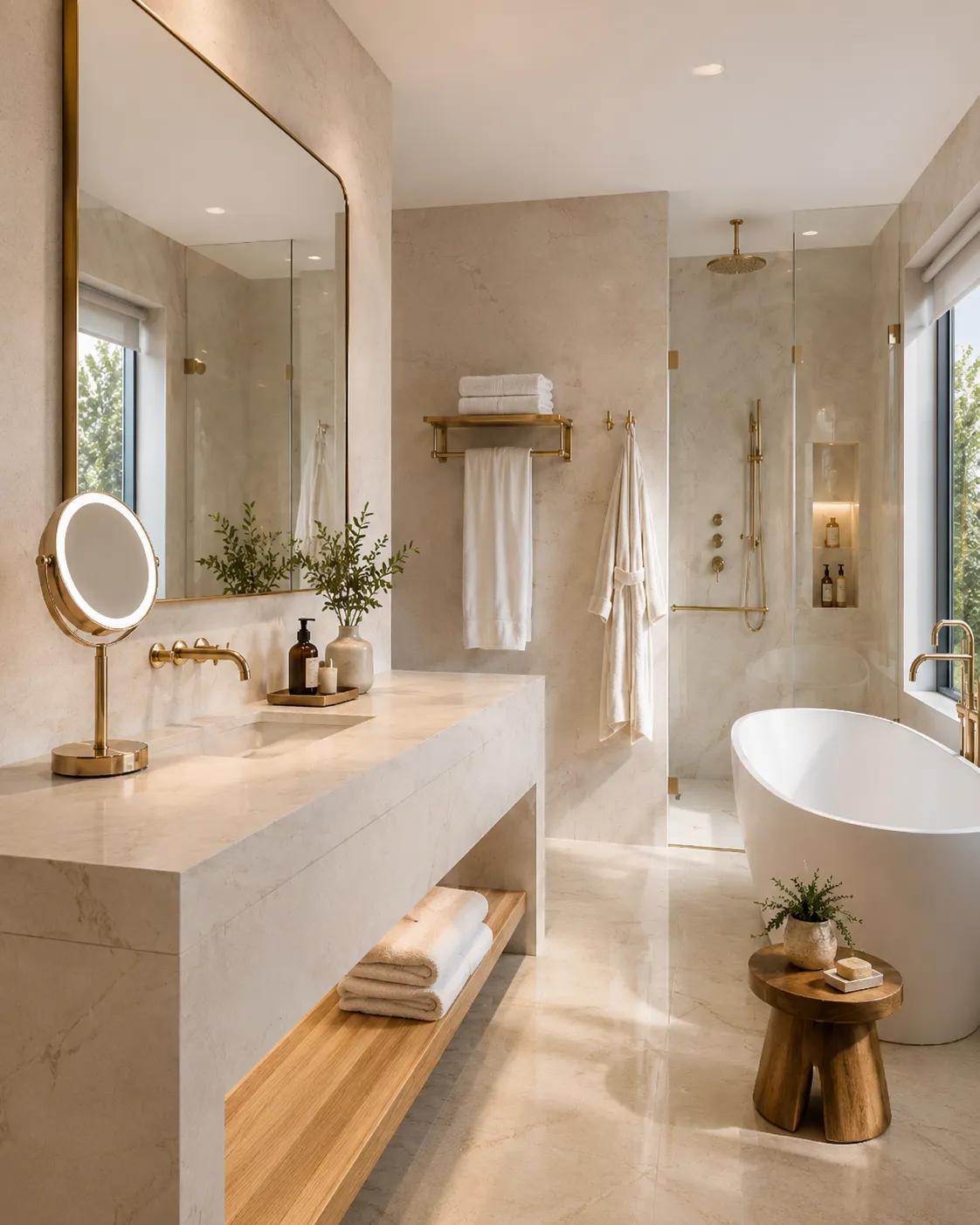
Why is my 10X mirror blurry? In many cases, the problem is viewing distance rather than a defective mirror. A 10X magnifying mirror uses a curved reflective surface and requires a much closer viewing position than a regular mirror.
If you stand too far away, your reflection may look blurry, stretched or even upside down. However, incorrect positioning is not the only possible cause. Poor lighting, fingerprints, mirror angle and optical defects can also affect the viewing experience.
This guide explains seven common causes of blurry 10X magnifying mirrors. It also shows how users, hotel operators and makeup mirror buyers can identify normal optical behavior and potential product quality problems.
Quick Answer: Move closer to the center of your 10X mirror and adjust your position slowly until you find a clear reflection. If the image remains uneven or distorted at a suitable distance, check the mirror surface, lighting and optical quality.
Why Is My 10X Mirror Blurry? Understanding the Optics
A standard 1X mirror has a flat reflective surface. It shows a familiar reflection at a wide range of normal viewing distances.
A 10X magnifying mirror works differently. Its concave reflective surface changes the direction of reflected light and produces a larger image when the user moves into the appropriate viewing range.
The curved surface also creates a focal length. When you move outside the useful close-up range, the reflected image changes significantly.
In basic optics, a concave mirror forms an upright, enlarged virtual image when the user is closer than the mirror's focal point. At greater distances, the mirror can produce an inverted image instead.
For a technical explanation, see OpenStax's guide to image formation by mirrors .
This optical behavior explains why a 10X mirror cannot provide the same comfortable full-face viewing experience as a normal bathroom mirror.
7 Common Causes of a Blurry 10X Mirror
1. You Are Standing Too Far Away
Incorrect viewing distance is one of the most common reasons a 10X mirror appears blurry.
A high-magnification mirror requires a closer position than a 3X or 5X model. If you use a 10X mirror from the same distance as your main bathroom mirror, you may not see a useful reflection.
Some 10X makeup mirrors work comfortably at approximately 4 to 6 inches (10 to 15 cm) from the face. However, this range is only a general reference. The actual viewing distance depends on the mirror's optical design and the user.
How to fix it: Start close to the mirror and move your face gradually. Stop when the central reflection becomes sharp and comfortable to view.
Avoid treating one distance as a universal specification. Always follow the manufacturer's guidance for the actual model.
2. Your Face Is Not Centered in the Mirror
A curved magnifying mirror does not provide exactly the same viewing experience across its entire surface.
When you look toward the outer edge, facial features may appear stretched or less natural than they do in the center.
The viewing angle also matters. If you approach the mirror from one side, you may notice an uneven reflection.
How to fix it: Position the area you want to inspect near the center of the mirror. Adjust the mirror head until your viewing direction feels natural.
For eyeliner or eyebrow grooming, move the mirror or your face slightly instead of relying on the extreme edge of the reflection.
3. You Expect a Full-Face Reflection
A 10X magnifying mirror is primarily a precision grooming tool. It enlarges a small area of your face rather than providing a complete overall reflection.
Users sometimes interpret the limited viewing area as a problem with optical quality.
However, seeing only one eye or a small facial area can be normal when using strong magnification.
How to fix it: Use the 10X surface for close-up tasks such as eyebrow grooming, eyeliner and tweezing. Switch to a normal 1X mirror when you need to check your complete makeup.
Double-sided mirrors can make this process convenient because users can rotate between normal and magnified viewing surfaces.
4. Fingerprints or Residue Cover the Mirror Surface
Fingerprints, dried water spots, cosmetic residue and dust can reduce reflection clarity.
These marks become especially noticeable when users inspect small details with a high-magnification mirror.
Some new mirrors may also have protective packaging materials or film that users must remove according to the product instructions.
How to fix it: Inspect the surface under good lighting. Use a clean, soft microfiber cloth and follow the manufacturer's cleaning instructions.
Avoid abrasive cleaning tools. Do not spray excess cleaning liquid into the frame, LED components or electrical openings.
Clean the surface gently and check whether the reflection improves.
5. Poor Lighting Makes Details Hard to See
Lighting does not change the mirror's focal length. However, poor illumination can make the reflected image harder to use.
Dark areas around the eyes, uneven shadows and glare can reduce the visibility of fine details.
For example, a user may struggle to see eyebrow hairs clearly even after finding the correct viewing distance.
How to fix it: Improve the facial lighting and reduce direct glare. If the mirror has an LED light, check whether the lighting works correctly.
Even illumination can improve practical visibility, but it cannot repair optical distortion caused by an irregular reflective surface.
6. The Wall-Mounted Mirror Cannot Reach the Right Position
For wall-mounted makeup mirrors, installation position can create a practical viewing problem. The wall mounting height and extension-arm length determine how comfortably users can reach the mirror.
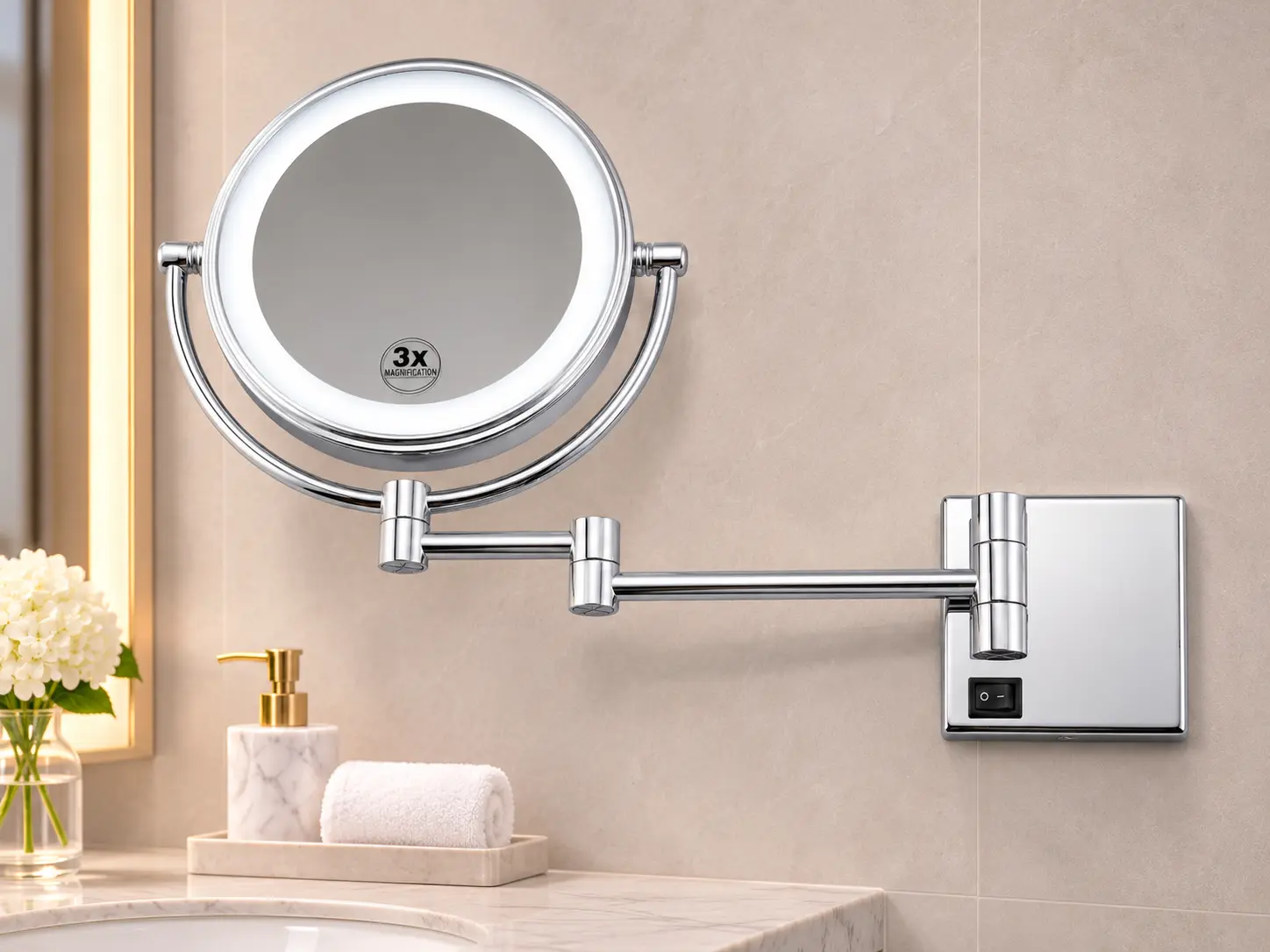
The NISSIYA wall-mounted magnifying mirror shown above features an adjustable double-arm structure. This 3X model illustrates how the extension arm helps users move the mirror into a comfortable position. Higher-magnification models may require a closer viewing distance.
An extension arm may not reach far enough toward the user. The mirror may also sit too high, too low or too close to another bathroom fixture.
As a result, guests may struggle to reach a comfortable viewing distance even when the mirror itself works correctly.
How to fix it: Check the mounting height, arm extension, mirror rotation and clearance around the vanity.
A suitable adjustable arm can help users move the mirror closer without leaning over the basin.
For hotels, contractors should evaluate these dimensions before approving the installation position for every guest room.
7. The Mirror Has an Optical or Surface Defect
Sometimes the problem comes from the mirror itself rather than the viewing position.
Uneven curvature, surface irregularities, coating defects or physical damage can affect reflection quality.
For example, an area of the mirror may produce noticeable waves or asymmetric stretching even when the user views the center at an appropriate distance.
How to fix it: Clean the mirror, test several viewing positions and compare the result with a known-good sample of the same model.
If the distortion remains unusually strong or inconsistent, ask the supplier to inspect the product.
Do not assume that every curved reflection indicates a manufacturing defect. Some peripheral distortion is an expected characteristic of magnifying optics.
How to Find the Correct 10X Mirror Viewing Distance
You can perform a simple viewing check before deciding whether your 10X mirror has a problem.
- Clean the mirror. Remove visible fingerprints or residue with an appropriate soft cloth.
- Choose good lighting. Use even facial illumination without strong glare.
- Face the center. Position one eye near the central viewing axis of the mirror.
- Adjust the distance. Move slowly closer or farther away until your reflection becomes clear.
- Check the result. Keep the same viewing position and inspect whether the central reflection stays consistent.
If you are asking, "Why is my 10X mirror blurry?", understanding how magnification affects viewing distance is a useful first step.
Watch our NISSIYA 3X vs 5X Magnifying Mirror Viewing Distance Demonstration on YouTube. This video demonstrates the viewing differences between 3X and 5X magnifying mirrors. Higher magnification generally requires closer positioning, although the ideal distance depends on the mirror's optical design.
If the mirror becomes clear at a close distance, its earlier blurriness may simply reflect normal high-magnification behavior.
If the image remains unclear, repeat the check with another user or compare the mirror with an approved sample of the same model.
Blurry, Distorted or Upside Down: What Is Normal?
Users often describe several different optical effects with the word "blurry." Identifying the actual symptom helps explain the problem.
| What You See | Possible Explanation | Recommended Action |
|---|---|---|
| Blurry image from a distance | The face may sit outside the useful viewing range. | Move closer and adjust slowly. |
| Upside-down reflection | Concave mirrors can form inverted images beyond their focal point. | Move into the close-up viewing range. |
| Clear center, stretched edges | Curvature and off-axis viewing can affect the outer reflection. | Use the central viewing area. |
| Unclear details in dim lighting | Insufficient light or glare may reduce visibility. | Improve facial illumination. |
| Visible smudges or cloudy spots | Residue, surface damage or coating problems may be present. | Clean and inspect the surface. |
| Persistent uneven waves in the center | The mirror may have optical irregularities. | Compare with an approved sample and contact the supplier. |
Normal magnification effects usually change when the viewing position changes. Persistent irregular distortion deserves closer inspection.
For more information about curved mirror optics, see The Physics Classroom's concave mirror explanation .
How Mirror Curvature Affects 10X Magnification Quality
The curved reflective surface is a key part of magnifying mirror performance.
Its radius of curvature influences the focal length and the way the mirror enlarges a reflection.
Higher magnification generally requires users to work closer to the reflective surface. This creates a more demanding viewing experience than lower magnification.
However, strong magnification does not automatically mean poor optical quality.
A well-made mirror should provide a useful and reasonably consistent central reflection within its intended operating range.
Buyers should pay attention to unusual waviness, local distortion, visible defects and differences between samples of the same specification.
Lighting and surface finishes also matter for the overall product experience, but neither can compensate for significant errors in the mirror's optical shape.
How Hotel Buyers Can Check 10X Makeup Mirror Quality
Hotel purchasing teams and distributors should test magnifying mirrors before approving large orders.
This matters because users may confuse normal focal-distance limitations with actual product problems.
A practical sample inspection should separate optical performance from installation and lighting conditions.
| Inspection Item | What to Check |
|---|---|
| Viewing Distance | Find a clear and usable central viewing position. |
| Central Clarity | Check whether fine facial details remain reasonably sharp at the selected distance. |
| Image Consistency | Look for unexpected waves or asymmetric distortion. |
| Mirror Surface | Inspect scratches, stains, coating marks and other visible defects. |
| Lighting | Check LED illumination separately from optical clarity. |
| Arm Adjustment | Confirm that users can reach the intended viewing position. |
| Sample Consistency | Compare products under the same lighting and viewing conditions. |
For consistent comparison, buyers should use the same test setup for each sample. They should also agree on acceptance criteria with their supplier before bulk production.
A printed grid or reference pattern may help reveal local irregularities when testers compare products under controlled conditions. However, curved mirrors naturally change the appearance of straight lines. Buyers should not treat every curved grid reflection as a defect.
For a hotel project, sample approval should also include mounting height, mirror arm movement and guest usability.
Should Hotels Choose 10X Magnifying Mirrors?
A 10X makeup mirror can provide useful detail for specific grooming tasks. However, it is not always the best magnification for every hotel guest.
Many hotels prefer a more moderate magnification because it offers a larger practical viewing area and easier positioning.
A 10X model may be appropriate when the project specifically requires high-detail viewing. In that case, the hotel should evaluate the actual mirror sample with its planned installation.
Hotel buyers can explore NISSIYA's makeup mirror magnification guide for hotels for a broader comparison of 3X, 5X and 10X.
For retail and private-label programs, stronger magnification may appeal to customers who prefer precision grooming.
NISSIYA's retail makeup mirror solutions include selected double-sided 1X/10X models for different retail applications.
Regardless of the market, buyers should match magnification to user needs rather than select the highest number automatically.
Frequently Asked Questions About Blurry 10X Mirrors
Why is my 10X mirror blurry unless I get very close?
A 10X mirror uses a concave reflective surface and normally requires close positioning for a useful enlarged reflection. Start near the mirror and adjust the distance until the center becomes clear.
How far should my face be from a 10X magnifying mirror?
Some 10X makeup mirrors work at approximately 4 to 6 inches (10 to 15 cm). However, exact viewing distances vary by model and optical design. Follow the manufacturer's instructions and test the actual mirror.
Why does my 10X magnifying mirror look upside down?
A concave mirror can produce an inverted image when your face moves beyond its focal point. This effect can be normal. Move closer until you reach the useful upright viewing range.
Is distortion around the edge of a 10X mirror normal?
Some edge distortion can occur because of the curved reflective surface and viewing angle. However, strong irregular distortion in the central viewing area may require product inspection.
Can better LED lighting fix a blurry magnifying mirror?
Better lighting can improve visibility and reduce shadows. However, LED lighting cannot correct optical irregularities or change the mirror's focal length.
Why Is My 10X Mirror Blurry Even at the Correct Distance?
If the central reflection remains unclear after cleaning the mirror and adjusting your viewing distance, check the lighting and mirror surface. Persistent distortion under controlled conditions may indicate an optical defect that requires supplier inspection.
Is 10X better than 5X for makeup?
10X provides stronger close-up magnification for precision tasks, while 5X generally offers easier positioning and a broader viewing area. The better choice depends on the user and intended application.
Final Thoughts: How to Fix a Blurry Magnifying Mirror
If your 10X mirror looks blurry, check the viewing distance first. Strong magnification requires careful positioning, and a clear central reflection may appear only when you move close enough.
Next, check the mirror angle, cleanliness and lighting. These simple adjustments can solve many common viewing problems.
If unusual distortion remains under controlled viewing conditions, inspect the optical surface and compare the product with an approved sample.
For hotel and commercial projects, mirror quality involves more than the magnification label. Buyers should consider central image clarity, mounting position, arm reach and consistency between products.
NISSIYA supplies lighted and non-lighted makeup mirrors for hospitality, retail, distribution and OEM/ODM projects. Available magnification levels depend on the selected model. Buyers can explore our lighted makeup mirror collection or read our magnifying mirror magnification guide for additional product selection information.
If you are still asking, "Why is my 10X mirror blurry?" after adjusting the viewing distance, check the mirror surface, lighting conditions, and optical quality. Persistent distortion may require further product inspection.
Ready to Start Your Next Hospitality Project?
From initial design concepts to final product delivery, NISSIYA provides full-scale manufacturing support for hotels, resorts, and commercial developments worldwide. Let our engineering team help you translate your vision into reality with precision-engineered, commercially compliant mirror solutions.