


Should you choose a hardwired LED bathroom mirror or a plug-in model? Both options can provide excellent bathroom lighting. However, the electrical connection affects installation planning, cable visibility, maintenance access, and project costs.
A plug-in mirror connects to a suitable electrical receptacle through an approved power cord. By contrast, a hardwired model uses a fixed electrical connection according to the manufacturer's installation requirements.
For homeowners, the main concern may be whether an existing bathroom outlet can power the mirror. Hotel developers face additional decisions. They must coordinate electrical rough-ins, wall finishes, room controls, and installation schedules across multiple guestrooms.
The connection method also differs from the lighting control system. For example, hardwired and plug-in mirrors may both support touch switching or dimming, depending on their approved designs.
This guide compares installation methods, safety considerations, costs, and hotel procurement requirements. It also explains how to avoid common specification mistakes before ordering LED bathroom mirrors.
Quick Answer: Hardwired or Plug-In LED Bathroom Mirror?
A hardwired LED bathroom mirror is often a practical choice for new hotel construction and major bathroom renovations. It allows the electrical contractor to plan a concealed connection before completing the wall finishes.
Meanwhile, a plug-in mirror may suit a finished bathroom with an existing, appropriately located and protected receptacle. This option can reduce the need for new fixed wiring when the selected product and local rules permit it.
Neither connection method is automatically safer or more energy-efficient. The correct choice depends on product certification, electrical protection, installation location, and the manufacturer's approved instructions.
For hotels, confirm the mirror's connection type before approving the electrical layout or releasing bulk production.
Hardwired vs Plug-In LED Bathroom Mirrors: Key Differences
The most important difference is how the mirror receives electrical power. However, this choice can also affect project preparation and the finished bathroom appearance.
A hardwired LED bathroom mirror usually offers a concealed electrical arrangement. A plug-in model requires an appropriate receptacle and a suitable route for its factory-approved power cord.
| Comparison | Hardwired LED Mirror | Plug-In LED Mirror |
|---|---|---|
| Power Connection | Approved fixed electrical connection | Factory-approved cord and plug |
| Typical Appearance | Electrical connection normally concealed | Cord may remain visible unless the approved layout conceals it |
| Installation Planning | Coordinate fixed supply location and connection details | Confirm receptacle location, access, and cord route |
| Electrical Work | Qualified electrician handles the fixed connection | Existing suitable outlet may simplify setup; new outlets require qualified work |
| Touch Controls | Available on suitable models | Available on suitable models |
| Wall Switch Control | Depends on product and wiring design | Depends on receptacle supply and product design |
| Dimming | Requires a compatible approved control arrangement | Requires a compatible approved control arrangement |
| Bathroom Safety | Follow installation instructions and applicable electrical rules | Use an approved receptacle and required electrical protection |
| Maintenance | Provide the required service and electrical access | Plug access may help service, depending on installation |
| Common Project Fit | Planned permanent installations and hotel renovations | Selected retrofits with a suitable existing receptacle |
These comparisons describe common arrangements rather than universal rules. The final installation must match the specific mirror's technical documents.
For example, some commercial lighted mirrors include manufacturer-approved connection methods that differ from a conventional household junction box.
Therefore, the project electrician should use the actual model drawing rather than assume every LED mirror has identical electrical requirements.
What Is a Hardwired LED Bathroom Mirror?
A hardwired LED bathroom mirror receives electricity through an approved fixed electrical connection instead of a removable power plug.
The installation method depends on the product. For instance, some fixtures require a suitable junction enclosure behind the mirror. Others use a manufacturer-approved wiring connection or supply lead arrangement.
As a result, the electrical drawings must identify the connection location and the required access before installation begins.
Why Do Hotels Often Choose Hardwired Mirrors?
Hotels typically plan electrical circuits while contractors prepare the walls. At this stage, the project team can coordinate the mirror position with the electrical supply and mounting hardware.
Consequently, a hardwired arrangement can support a clean appearance without an exposed power cord. This is particularly useful when many guestrooms share a consistent bathroom design.
It can also reduce the likelihood of guests accidentally unplugging a mirror. However, service access and electrical isolation still require appropriate planning.
What Are the Main Tradeoffs?
Fixed connections require qualified electrical work and suitable site preparation. If the supply point conflicts with the mirror's rear structure, installation may need additional coordination.
Furthermore, changing the mirror position after wall finishes are complete can be more complicated.
For this reason, buyers should confirm the finished mirror dimensions, electrical entry position, and installation drawings before approving the bulk order.
NISSIYA provides additional technical context in its LED Bathroom Mirror Electrical Requirements Guide.
How Does a Plug-In LED Bathroom Mirror Work?
A plug-in LED bathroom mirror receives power through an approved cord connected to a suitable electrical receptacle.
This arrangement can be convenient when an existing outlet already meets the product's electrical and location requirements.
For example, a homeowner may want to replace a standard wall mirror without opening the entire bathroom wall. A compatible plug-in LED mirror can offer one possible solution.
However, the outlet must be suitable for the bathroom environment. The cord also needs adequate clearance and protection from damage.
Can the Power Cord Be Hidden?
In certain approved installations, the receptacle may sit within the mirror's footprint. Nevertheless, access and electrical protection requirements still apply.
The installer must also confirm that the mirror's rear frame provides enough space for the plug and cord without pinching them.
A cord should never be routed through a wall simply to hide it. Instead, a qualified electrician should plan an appropriate permanent electrical arrangement when concealed wiring is required.
Is Plug-In Always Easier?
Not necessarily. A plug-in model may save electrical work when a suitable receptacle already exists. However, adding a new outlet can require substantial installation work.
Likewise, an accessible cord may be less desirable in high-traffic public spaces or projects that require a fully concealed appearance.
Therefore, buyers should evaluate the actual bathroom layout before assuming a plug-in model will always cost less to install.
Hardwired LED Bathroom Mirror vs Plug-In: Installation Planning
The following illustration summarizes the two electrical connection approaches. It also highlights the decisions that should happen before construction or installation.
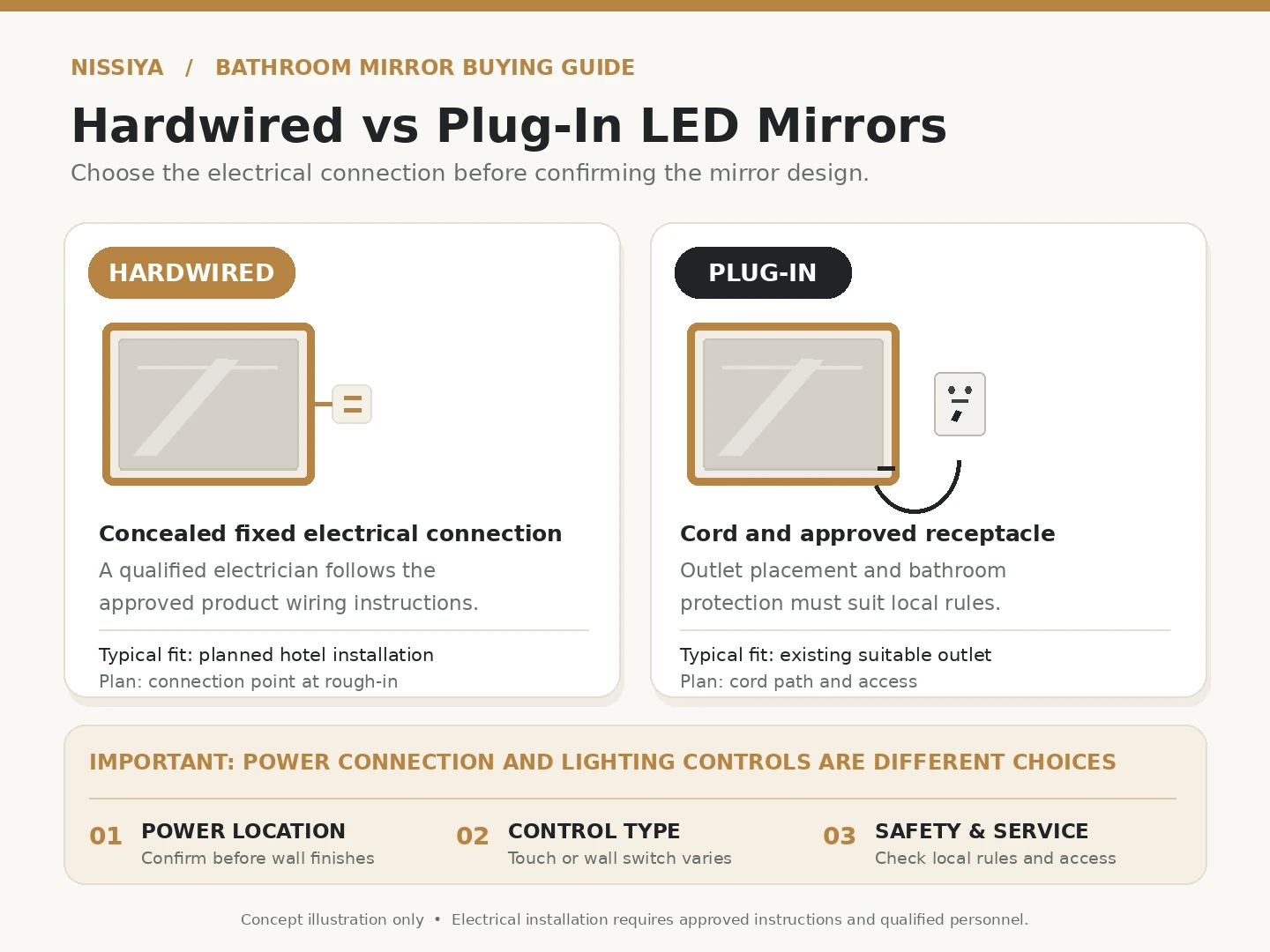
The diagram shows connection concepts only. It is not an electrical wiring schematic or a substitute for the manufacturer's installation instructions.
Importantly, the power connection does not determine the type of touch sensor, wall switch, dimming function, or anti-fog control.
Is a Hardwired LED Bathroom Mirror Safer Than Plug-In?
Neither connection method automatically guarantees greater electrical safety. A safe installation depends on the product's approved construction, protective devices, and local electrical rules.
A hardwired LED bathroom mirror must use the correct fixed wiring arrangement. Meanwhile, a plug-in model needs a suitable receptacle and an approved cord.
Both products must also suit their bathroom installation environment.
Check Ground-Fault Protection
In the United States, bathroom receptacles generally require ground-fault circuit-interrupter protection under applicable electrical rules.
The Electrical Safety Foundation International explains how GFCI devices help protect users against electrical shock.
However, protection requirements can differ between locations and electrical systems. For example, other countries may apply RCD protection and bathroom-zone rules.
Therefore, project electricians must confirm the requirements for the actual installation location.
Never Route an Ordinary Power Cord Through a Wall
A common mistake involves passing a plug-in mirror's flexible power cord through a hole in the bathroom wall to conceal it.
For ordinary permanent installations, this is generally not an acceptable substitute for fixed wiring under US electrical rules.
The US Occupational Safety and Health Administration explains restrictions on using flexible cords through or concealed behind building walls.
Instead, use a manufacturer-approved wiring method and ask a qualified electrician to review the design.
Electrical safety notice: Do not cut a factory plug, connect exposed conductors, modify the driver, or conceal a flexible cord inside a wall unless the manufacturer expressly authorizes the proposed configuration and qualified personnel confirm compliance.
Always follow the product instructions and the electrical rules that apply to the installation.
Does a Hotel Have to Use Hardwired Mirrors?
Not in every circumstance. Local electrical requirements, product approvals, and the installation environment determine which methods are acceptable.
A hardwired design often suits permanent hotel construction, but an appropriately approved plug-in product may be suitable in other applications.
Consequently, procurement teams should avoid treating either method as universally mandatory.
Hardwired LED Bathroom Mirror: Wall Switch or Touch Sensor?
The electrical connection and the user control system serve different functions.
A hardwired LED bathroom mirror may use a wall switch, an integrated touch sensor, or another approved control arrangement. Likewise, a plug-in model can have a touch switch on the mirror surface.
Therefore, the phrase "hardwired mirror" does not tell the buyer whether the mirror supports dimming or color-temperature adjustment.
External On/Off Operation
Some products use a conventional wall switch to control the lighting supply.
However, an ordinary external switch does not automatically provide electronic dimming. A compatible dimming design requires the manufacturer's approval.
On/Off and Dimming
Some LED bathroom mirrors integrate lighting on/off and brightness adjustment into a single touch switch.
For example, a short touch may switch the lighting state, while a long touch changes brightness. The actual operation follows the approved controller design.
What Happens When a Wall Switch Cuts Power?
If a wall switch disconnects the mirror's supply, the touch sensor may receive no power until someone restores the circuit.
Furthermore, different control modules may respond differently after power returns. Some retain the previous setting, while others follow another programmed startup sequence.
Hotels should therefore confirm the intended guestroom operation before finalizing the wiring.
How Does Anti-Fog Control Work?
A heated defogger may operate independently or together with the lighting, depending on the selected model.
Similarly, some controls include timers or other automatic functions.
Before approving an order, request the actual control sequence. This helps avoid confusion after installation.
For a separate guide to control faults, see LED Bathroom Mirror Touch Sensor Not Working?.
Hardwired vs Plug-In LED Mirrors: Which Costs Less to Install?
Installation costs depend mainly on the existing electrical infrastructure and the work required at the site.
A plug-in mirror may involve less electrical work when the bathroom already has a suitable receptacle. However, this advantage can disappear if an electrician must install a new outlet or modify the electrical circuit.
Conversely, a hardwired LED bathroom mirror may fit efficiently into a new construction project that already includes the correct electrical rough-in.
The cost comparison should also consider mounting labor, finishing work, product access, and possible changes to the project schedule.
| Project Condition | Hardwired Option | Plug-In Option |
|---|---|---|
| New Construction | Electrical connection can be coordinated during rough-in | Requires planned and suitable receptacle location |
| Existing Suitable Outlet | May need additional fixed wiring | May reduce new electrical work |
| Finished Tile Wall | Changes may require more coordination | Can help when the approved outlet already exists |
| Fully Concealed Appearance | Often easier to achieve in planned construction | Depends on approved receptacle and cord arrangement |
| Large Hotel Installation | Supports standardized planned electrical connections | Requires review of outlet location and access in every room |
| Future Maintenance | Needs suitable isolation and service access | Needs accessible approved power connection and service clearance |
For example, a hotel renovating 200 bathrooms should not compare installation costs based only on the mirror purchase price.
Instead, the project team should review how many rooms already have suitable electrical connections. It should also identify whether the selected mirrors require new wiring locations.
Ultimately, the lower-cost method depends on the building conditions and approved product design.
Which LED Bathroom Mirror Connection Is Best for Hotels?
For planned guestroom construction, a hardwired LED bathroom mirror often offers a practical balance of appearance and installation coordination.
The electrical contractor can plan the connection position alongside the mirror's dimensions and mounting structure. As a result, the finished bathroom can avoid exposed power cords.
However, different project types may justify another approach.
Plan the Fixed Connection Early
The design team can confirm the mirror dimensions and power entry position before completing the wall finishes.
Therefore, a suitable hardwired model may simplify repeated installations across guestrooms.
Evaluate Existing Electrical Points
A property may already have wiring or receptacles in different locations.
Consequently, the best approach depends on whether those connections meet the new mirror's requirements.
Confirm Each Installation Location
Larger custom mirrors may use different mounting structures or electrical configurations.
Furthermore, public bathrooms can have different maintenance and access requirements from guestrooms.
Standardize the Approved Specification
Consistent electrical details help contractors repeat the same installation method.
However, any room-type differences should appear in the approved drawings before production.
Why Early Coordination Matters
Suppose the contractor prepares 200 bathroom walls for one electrical connection method. Later, the purchasing team selects a mirror requiring another connection arrangement.
That mismatch may lead to additional electrical work or adjustments to the wall finishes.
Therefore, hotel buyers should approve the mirror's connection type, rear structure, and installation drawing before the contractor completes the rough-in.
The same principle applies when choosing a custom LED bathroom mirror for a hospitality project.
How Power Connections Affect LED Mirror Mounting
The electrical connection is only one part of installing a wall-mounted LED bathroom mirror.
The mounting system must also support the complete assembly. Depending on the model, this can include rear aluminum structures, brackets, lighting components, and protective glass backing.
NISSIYA bathroom mirrors may use Z-bar, keyhole, dovetail-hook, or split-type mounting arrangements.
However, these systems have different installation geometries and should follow their approved drawings.
Check the Rear Clearance
A plug-in configuration needs enough space for the approved plug and cord. Meanwhile, a hardwired design needs the specified electrical entry and connection clearance.
Therefore, buyers should confirm the installed wall projection rather than rely on glass thickness alone.
Coordinate Electrical and Mounting Positions
The power connection should not conflict with mounting brackets or rear support components.
In addition, the installation plan must account for service access and any required electrical protection.
For mechanical installation information, review NISSIYA's Bathroom Mirror Mounting Systems Guide.
The Mirror Installation Guides page also provides product-specific installation illustrations.
Can You Convert a Plug-In LED Mirror to Hardwired?
Some manufacturers offer products with more than one approved connection method. However, this does not mean every plug-in mirror can safely become a hardwired model.
For example, a manufacturer may supply separate electrical configurations or a specifically approved installation procedure.
By contrast, cutting the plug from an unsuitable product can affect its electrical safety, product approval, and warranty.
Therefore, buyers should review the model's installation manual before requesting any conversion.
If the documentation does not authorize a different connection method, contact the manufacturer rather than modifying the product on site.
Never assume conversion is permitted: A qualified electrician must follow the manufacturer's approved method and applicable local rules. Do not treat removing a plug as a universal installation solution.
For large hotel orders, the preferred approach is to confirm the electrical configuration during product selection rather than rely on field modifications.
Hardwired LED Bathroom Mirror: What Buyers Should Verify
A clear purchasing specification helps prevent disagreements between the mirror supplier, electrical contractor, and hotel project team.
Before purchasing a hardwired LED bathroom mirror or a plug-in alternative, confirm the following details.
Confirm the Electrical Connection Type
Specify whether the mirror requires an approved fixed connection or a factory-supplied plug and cord.
If the product supports both, request the instructions for the selected configuration.
Verify the Input Voltage and Electrical Rating
Confirm the intended country, voltage, frequency, and relevant product electrical specifications.
In addition, check the complete mirror's input-power requirements rather than relying only on the LED driver's rated capacity.
Review the Connection Position
Ask for the approved drawing showing the mirror dimensions, electrical entry, and rear structure.
Then compare those details with the site electrical layout.
Confirm the Lighting Control Method
Document whether the product uses a wall switch, an integrated touch sensor, or another approved control.
Also confirm the operating sequence for dimming and color-temperature adjustment when those functions apply.
Check the Anti-Fog Control Arrangement
If the mirror includes a defogger, determine whether heating operates independently or with the lighting.
Consequently, the electrical contractor and hotel maintenance team can understand the intended behavior.
Verify Bathroom Safety Requirements
Confirm the relevant product approvals, bathroom location requirements, and electrical protection.
A qualified local professional should also review the electrical installation method.
Approve the Physical Sample
Test the mirror's actual operating functions and inspect its rear structure, mounting parts, and connection details.
However, do not assume a successful sample test replaces required electrical compliance documentation.
Plan Maintenance Access
Determine how authorized personnel can inspect or replace approved service components.
In addition, confirm the service access requirements for the installed electrical connection.
Keep the Approved Documents Together
Maintain the electrical diagram, product specifications, installation instructions, and approved sample records.
This documentation can help the project team handle future maintenance and replacement orders.
For a broader purchasing checklist, see NISSIYA's Hotel Bathroom Mirror Specifications for Projects.
Does Hardwired or Plug-In Use More Electricity?
The electrical connection method does not, by itself, determine the mirror's energy consumption.
If two LED mirrors have identical electrical components and operating conditions, the choice between an approved fixed connection and an approved plug does not inherently change their lighting load.
Instead, electricity use depends on factors such as LED power, driver efficiency, dimming settings, anti-fog heating, and operating time.
For example, a mirror with an active heated defogger may consume more electricity than a lighting-only model, regardless of whether either uses a plug.
Therefore, buyers should compare verified electrical input values rather than assume a hardwired LED bathroom mirror is automatically more energy-efficient.
NISSIYA explains the calculations in LED Bathroom Mirror Power Consumption: Watts and Hotel Costs.
Four Mistakes When Selecting LED Mirror Power Connections
Assuming Every LED Mirror Is Hardwired
Some products use plugs, while others require fixed connections. Therefore, verify the actual model before planning the electrical supply.
Confusing Power and Touch Controls
A hardwired mirror can still have integrated touch switching. Similarly, a plug-in model may support dimming.
Hiding a Cord Inside the Wall
An ordinary flexible power cord should not replace approved fixed building wiring. Instead, ask an electrician to design a compliant connection.
Approving the Mirror Too Late
The electrical connection may conflict with the finished wall or mounting structure. Consequently, late changes can disrupt hotel installation schedules.
Hardwired LED Bathroom Mirror: Frequently Asked Questions
What is a hardwired LED bathroom mirror?
A hardwired LED bathroom mirror uses an approved fixed electrical connection rather than a removable plug. The connection method must follow the manufacturer's instructions, and qualified personnel should complete the electrical work.
Is a hardwired LED mirror better than plug-in?
Hardwired mirrors often suit new construction and permanent hotel installations because they allow concealed electrical connections. However, plug-in mirrors can be practical when a suitable receptacle already exists. The best choice depends on the product and installation.
Can you plug an LED bathroom mirror into an outlet?
Yes, if the mirror has an approved plug-in configuration and the outlet meets the applicable electrical requirements. The receptacle location, protection, and cord arrangement must also suit the bathroom environment.
Does a hardwired LED bathroom mirror need a wall switch?
Not every model uses the same control method. Some hardwired mirrors use a wall switch, while others include an integrated touch sensor. Confirm the approved control arrangement before installation.
Can a hardwired LED bathroom mirror have touch dimming?
Yes. The electrical connection and dimming control are separate design choices. A compatible hardwired model may offer touch dimming, but the actual features depend on its controller and approved electrical configuration.
Can I cut the plug off an LED mirror and hardwire it?
Do not modify the plug or wiring unless the manufacturer expressly approves the conversion. A qualified electrician must follow the authorized installation method and applicable local rules.
Can a plug-in mirror cord run through the wall?
Ordinary flexible power cords generally cannot pass through or remain concealed inside building walls as a substitute for fixed wiring under US electrical rules. Ask a qualified electrician to plan an approved connection.
Is a hardwired LED bathroom mirror safer?
Neither connection type is automatically safer. Electrical safety depends on product construction, appropriate circuit protection, correct installation, and compliance with applicable requirements.
Which LED mirror connection is best for hotel projects?
Hardwired connections often suit planned hotel construction because contractors can coordinate concealed electrical supplies before wall finishes. However, the final decision should follow the approved product design, site conditions, and local electrical requirements.
Choose the Connection Before Finalizing the Mirror Order
The choice between hardwired and plug-in LED bathroom mirrors affects more than the visible power cord.
For new hotel construction, a hardwired LED bathroom mirror often provides a practical approach to concealed electrical connections and standardized installation.
Meanwhile, an approved plug-in mirror can suit selected renovation projects with an appropriate existing receptacle.
However, buyers should not assume that one connection method automatically offers better electrical safety, dimming performance, or energy efficiency.
Instead, the final decision should consider the product's electrical specifications, control functions, mounting structure, local requirements, and maintenance access.
For NISSIYA hotel and OEM/ODM projects, the selected connection arrangement should match the approved mirror design and project electrical requirements.
The best LED bathroom mirror connection is the one that fits the building, supports safe installation, and matches the approved product specification.
Ready to Start Your Next Hospitality Project?
From initial design concepts to final product delivery, NISSIYA provides full-scale manufacturing support for hotels, resorts, and commercial developments worldwide. Let our engineering team help you translate your vision into reality with precision-engineered, commercially compliant mirror solutions.