

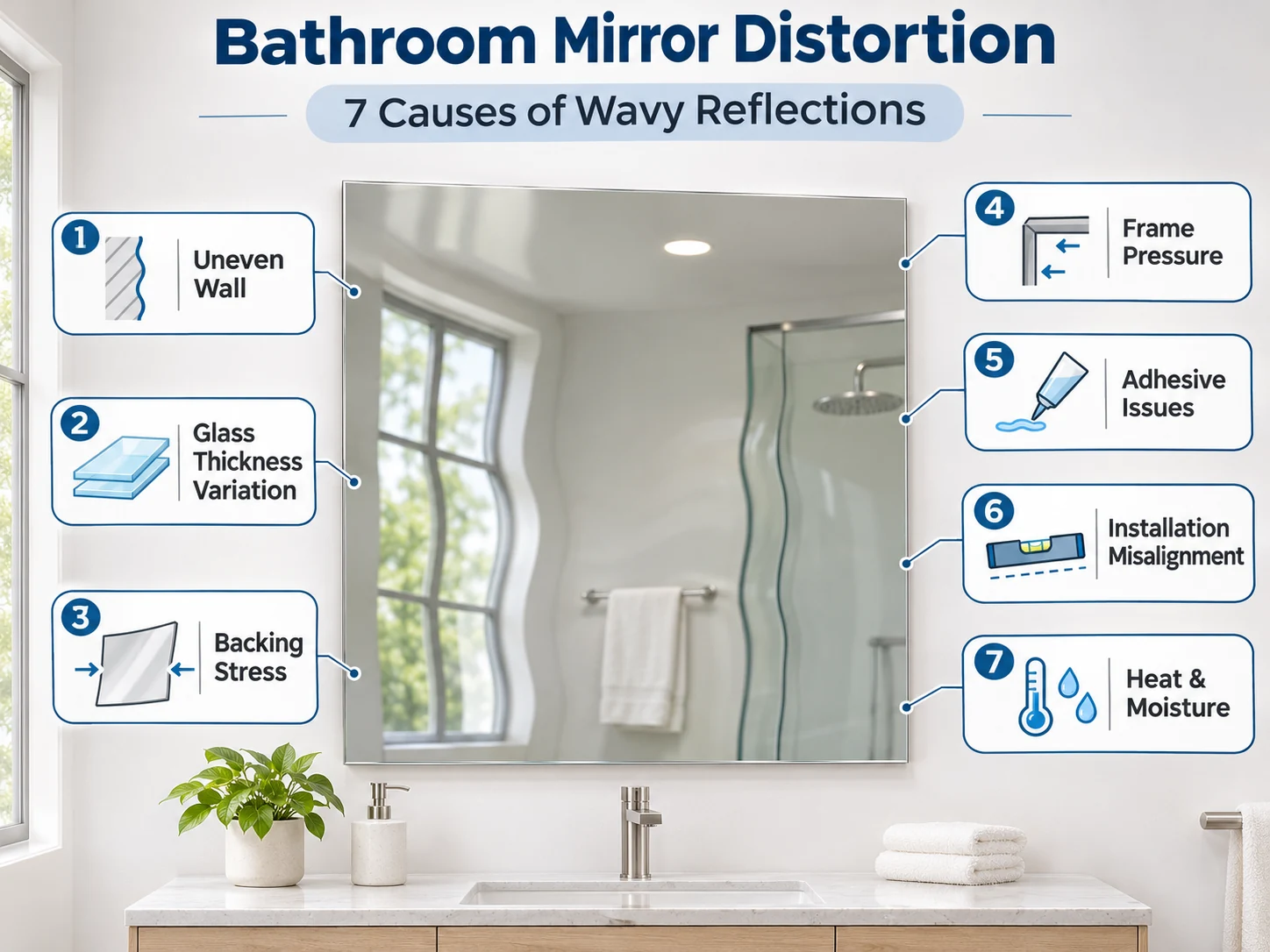
Why does a bathroom mirror make straight lines look bent, stretched, or wavy? Bathroom mirror distortion can come from the glass itself or from stress introduced during installation. A mirror may look acceptable from one position but show curved door frames, uneven tile lines, or an unusual reflection when viewed from farther away.
Before replacing the mirror, check where the distortion appears and whether the mounting system is placing pressure on the glass. The seven possible causes below explain what to inspect, which problems are repairable, and when a replacement makes more sense.
Common causes include an uneven wall, inherent glass flatness variation, pressure from the rear support, a tight frame, unsuitable adhesive, or mounting hardware that bends the glass. Heat and humidity can also damage a mirror over time, although moisture-related coating deterioration is not usually the direct cause of a wavy reflection.
Is Your Bathroom Mirror Reflection Actually Distorted?
Start with what you see. A bent window frame, distortion near a clip, and a cloudy edge can have very different causes. Use this comparison before deciding whether a mirror must be replaced.
| What you see | Possible explanation | Next step |
|---|---|---|
| Straight lines curve across the whole mirror | Glass flatness variation or broad mounting stress | Compare pre- and post-installation appearance |
| Waviness near an edge or corner | Tight clips, frame pressure, or a local support point | Have mounting pressure reviewed |
| Reflection changes after installation | Uneven wall or bracket-induced bending | Check wall and support plane against the drawing |
| Reflection looks worse from the side | Viewing angle makes existing distortion more visible | Repeat the check straight on |
| Dark edges or cloudy spots, without bent lines | Reflective-coating or backing deterioration | Investigate moisture and coating damage |
A cloudy or darkened mirror edge is usually a different problem from a geometrically wavy reflection. Inspect the pattern carefully before choosing a repair.
7 Causes of Bathroom Mirror Distortion
A distorted reflection can originate in the glass or in the mounting system. The causes below explain what changes the reflecting surface, what to inspect, and when the problem involves a different kind of mirror damage.
An Uneven Wall Pushes the Mirror Out of Plane
A mirror should be supported without being forced to follow bumps or hollows in the wall. If the installer presses a large sheet against an uneven surface, the glass may bend slightly. That change in flatness can turn a straight reflected line into a curve.
This problem is especially relevant to large frameless mirrors and installations that use several fixed contact points. A wall does not cause distortion simply because it looks uneven. The problem develops when the mounting arrangement transfers that unevenness into the mirror.
What to check: Look along the wall with a suitable straightedge and compare the mirror's reflection near different mounting points. Where necessary, an installer can correct the support plane or use approved spacers and mounting details rather than pulling the glass tightly against the wall.
Glass Flatness or Thickness Variation
Flat glass is not optically perfect. Small changes in surface flatness, curvature, or thickness can affect the reflected image. These variations may originate in the glass manufacturing process and become easier to notice when the mirror faces windows, tile joints, or other straight architectural lines.
The National Glass Association's technical guidance on reflective distortion explains that some inherent distortion is permitted in flat-glass mirrors under relevant standards. It also describes why viewing angle and distance affect what people see.
What to check: Examine the reflection before installation where practical, then compare it with the installed result. Consistent waviness that remains when the mirror is free of mounting stress may point to the glass rather than the wall. Choosing a thicker glass alone does not guarantee a distortion-free image.
Stress from the Rear Backing or Support Structure
Many bathroom mirrors include a rear frame, reinforcement, safety film, chassis, or mounting plate. These parts help support the glass, but a poorly aligned or unevenly bonded structure may introduce stress. A local high point behind the mirror can become a pressure point after installation.
For LED bathroom mirrors, the rear structure also carries electrical components and mounting hardware. Its design should support the glass without creating unnecessary bending loads.
What to check: Inspect the approved rear construction and the contact points rather than assuming the visible mirror surface is defective. If the structure appears loose, bowed, or damaged, ask the supplier or qualified installer to assess it before attempting any adjustment.
Excessive Pressure from a Frame or Mirror Clips
A frame or retention clip should hold a mirror securely, not squeeze it into a curved shape. Over-tightened clips, rigid packing, or an incorrectly sized frame may create localized pressure around the edges. The reflected image may then appear distorted near a corner or along one side.
According to Pilkington's mirror installation guidance, installers should avoid excessive stress on glass and compensate appropriately for uneven walls.
What to check: Look for pinched edges, uneven frame gaps, or distorted reflections concentrated around clips. A qualified installer should review the specified clearances and fastening method. Never loosen a heavy wall mirror without first securing it against falling.
Unsuitable Adhesive or Uneven Bonding
Adhesive mounting can work when the product, wall surface, adhesive, and installation method are compatible. However, irregular adhesive build-up or unsupported areas can create uneven contact. If a mirror is forced flat against hard, raised adhesive points, localized bending may result.
Adhesive chemistry matters for a separate reason. Some unsuitable products can harm the mirror's protective backing or reflective coating, even when the glass remains flat. Always follow the mirror manufacturer's approved adhesive specification and curing instructions.
What to check: Review the approved bonding pattern, wall condition, and adhesive compatibility. Do not try to pry off a bonded mirror to diagnose a minor visual issue; removal can break the glass and should be handled by a professional.
Installation Misalignment or Incorrect Mounting Hardware
An installation can look level while still placing uneven loads on the mirror. Mispositioned brackets, rails fitted at different heights, or mounting points that do not share the same plane may twist the assembly. The resulting stress can be visible as wavy reflections.
It is useful to distinguish simple tilt from actual distortion. A mirror that hangs slightly crooked does not automatically bend straight reflected lines. Waviness becomes more likely when the mounting system physically curves or twists the glass.
Hotel contractors can review NISSIYA's bathroom mirror mounting system comparison and installation drawings and guides before selecting a fixing method.
What to check: Confirm bracket spacing, wall fixings, rail alignment, and support points against the approved drawing. A Z-bar, keyhole, dovetail hook, or split bracket must be installed according to the actual mirror structure; they are not interchangeable without design approval.
Heat, Humidity, and Long-Term Mirror Deterioration
Bathrooms repeatedly experience warm air, steam, condensation, and cleaning chemicals. Over time, these conditions can affect mirror edges, adhesives, backing materials, and some surrounding components. Excessive localized heat or thermal stress can also create a separate glass safety concern.
Important distinction: Ordinary bathroom humidity does not normally cause a sound flat-glass mirror to develop optical waves. Dark edges, cloudiness, patches, and peeling are more typical signs of moisture-related coating damage. If a mirror looks cloudy rather than geometrically wavy, the diagnosis is different.
For this separate issue, read NISSIYA's guide to delaying black edge corrosion on hotel mirrors.
What to check: Inspect the mirror perimeter, rear ventilation conditions, and proximity to heat sources. Persistent discoloration or coating failure generally requires different action from correcting mounting pressure.
How to Test Whether Your Bathroom Mirror Is Distorted
You can carry out a simple visual check without touching the glass or removing the mirror.
Choose a Straight Reference
Use a reflected door frame, tile joint, vertical cabinet edge, or a straight object placed safely in front of the mirror.
Stand Directly in Front
Start about one meter from the mirror under even lighting, with your line of sight roughly perpendicular to the glass.
Look for Repeatable Bends
Note whether the line curves at the same place each time or only looks unusual from one angle.
Move Slightly Left and Right
Reflected distortion may become more noticeable as the viewing angle changes.
Compare Different Areas
Waviness mainly near clips or mounting points may suggest installation stress. A pattern across the entire surface may require a glass-quality review.
Document the Result
Take photos from consistent positions and record the viewing distance, mirror size, and installation details.
Safety note: Do not press, flex, pry, or partially detach a mounted glass mirror as a home test. If the glass is cracked or the installation feels unstable, keep clear and contact a qualified installer.
Can a Wavy Bathroom Mirror Be Fixed?
The solution depends on what is making the reflection wavy. Some installation-related problems are correctable, whereas inherent glass distortion usually cannot be removed in place.
Installation-Induced Pressure
Sometimes. If the glass is being bent by clips, uneven mounting points, or a poorly supported wall installation, a qualified installer may be able to correct the source of stress. The mirror must first be made safe, and the solution must follow the approved product design.
Inherent Optical Distortion
By contrast, a mirror with unacceptable inherent optical distortion generally cannot be repaired by polishing or adjusting its position. Replacement may be the practical option after the supplier and buyer agree on the inspection standard.
Cleaning can remove streaks, deposits, and surface haze, but it cannot correct bent reflections caused by glass shape. Likewise, a defogger treats condensation on the face of a mirror; it does not straighten an optically distorted image.
How Hotel Buyers Can Reduce Distortion Before Bulk Installation
For a homeowner, one distorted mirror is frustrating. In a hotel project, the same problem can repeat across many rooms. A simple acceptance process helps buyers separate manufacturing variation from site conditions before large-scale installation begins.
Approve a Representative Sample
Check reflection quality under the lighting and viewing positions expected in the finished bathroom.
Confirm Glass Specifications
Record mirror type, nominal thickness, size, edge finish, and relevant visual requirements. NISSIYA commonly works with 5 mm eco silver mirror glass for applicable bathroom mirror designs; final specifications depend on the product and project.
Review the Mounting Drawing
Verify bracket locations, wall clearance, support structure, and fixing method before site installation.
Check the Installation Surface
Confirm wall flatness and the positions of fixing points before a contractor mounts the sample.
Compare Room-to-Room Results
Inspect mirrors from a consistent position and distance, rather than judging one mirror from a steep viewing angle.
Keep a Defect Record
Note the room number, mirror size, batch, viewing position, photo, and whether the concern existed before installation.
For related purchasing checks, see NISSIYA's bathroom mirror manufacturing process guide and hospitality mirror project information. Neither factory inspection nor correct installation can eliminate every permitted optical variation, so buyers should agree on realistic acceptance criteria in advance.
Project recommendation: Approve the mirror sample and inspection conditions before bulk installation. Document the glass specification, wall support, and mounting system so the same acceptance standard can be applied to every guestroom.
Bathroom Mirror Distortion: Frequently Asked Questions
Why does my bathroom mirror make straight lines look curved?
The glass may have slight inherent optical distortion, or mounting pressure may be bending it. An uneven wall, tight clips, or misaligned supports can make the effect worse. Test the reflection from directly in front before deciding on the cause.
Is some distortion normal in a flat bathroom mirror?
Yes. Industry guidance recognizes that limited optical distortion can be inherent in flat glass. The acceptable amount depends on the applicable specification and inspection conditions. Strong or localized waviness still deserves investigation.
Does a thicker mirror always give a better reflection?
No. Glass thickness is only one design factor. Flatness, manufacturing quality, size, mounting pressure, and installation conditions all affect the visible result. A thicker mirror is not automatically free from distortion.
Can an uneven bathroom wall cause a wavy mirror reflection?
Yes, if the mounting system forces the mirror to follow the wall's uneven shape. A properly designed support system should avoid transferring unnecessary wall irregularities into the glass.
Can bathroom humidity make a mirror wavy?
Normal humidity more commonly leads to condensation or gradual coating and edge damage, not optical waviness in sound flat glass. If reflections actually bend, inspect glass flatness and mounting stress first.
Should I replace a mirror with wavy reflections?
Not necessarily. First have the installation and support conditions checked. If the glass itself has unacceptable permanent distortion, replacement may be more appropriate than attempting to correct it on site.
Check the Glass and the Installation Before Replacing the Mirror
Bathroom mirror distortion is not always a glass defect. The wall, mounting hardware, rear structure, and installation method can all change how a mirror reflects straight lines. Meanwhile, some mild optical variation may be inherent in flat glass and becomes more visible at certain distances or angles.
The best approach is to examine the reflection consistently, check for mounting stress, and distinguish true waviness from moisture damage. For hotel and commercial projects, approved samples and clear installation drawings provide a more reliable basis for assessing mirror quality across multiple rooms.
Ready to Start Your Next Hospitality Project?
From initial design concepts to final product delivery, NISSIYA provides full-scale manufacturing support for hotels, resorts, and commercial developments worldwide. Let our engineering team help you translate your vision into reality with precision-engineered, commercially compliant mirror solutions.