
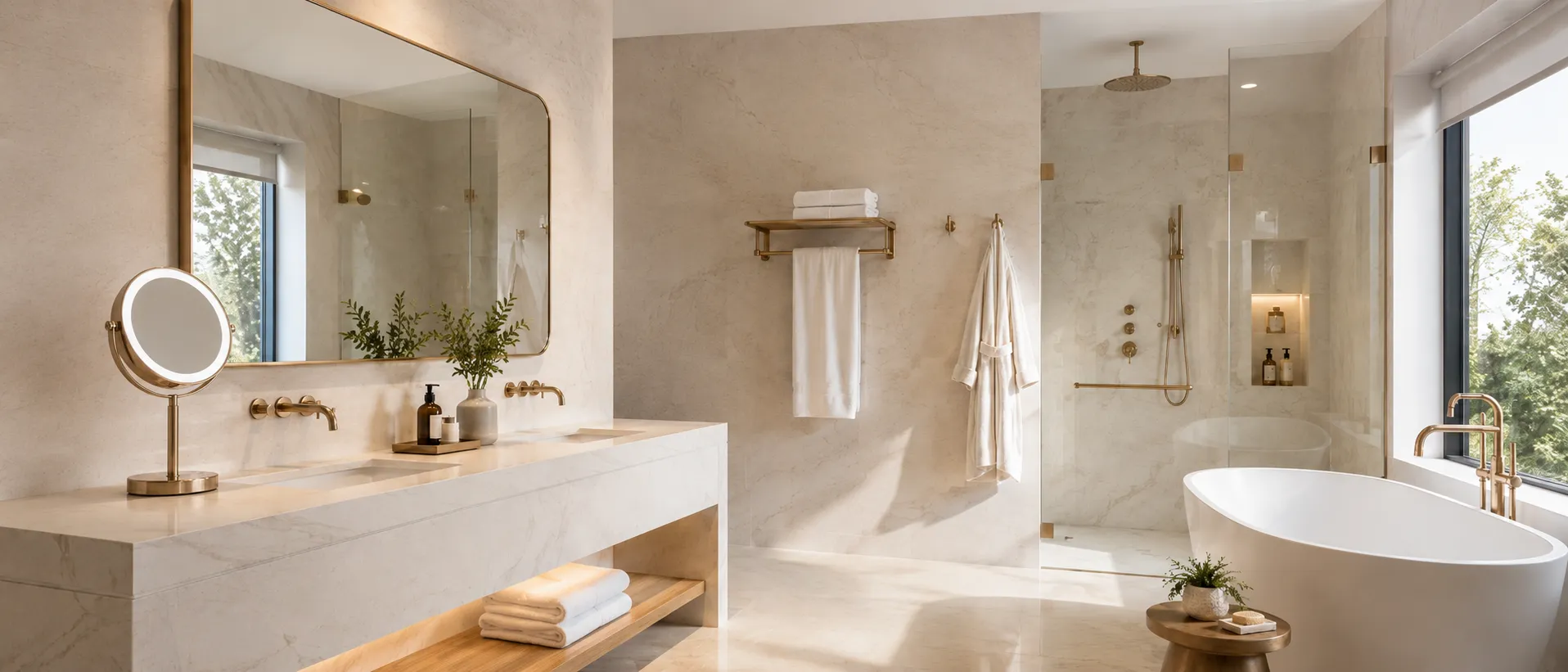
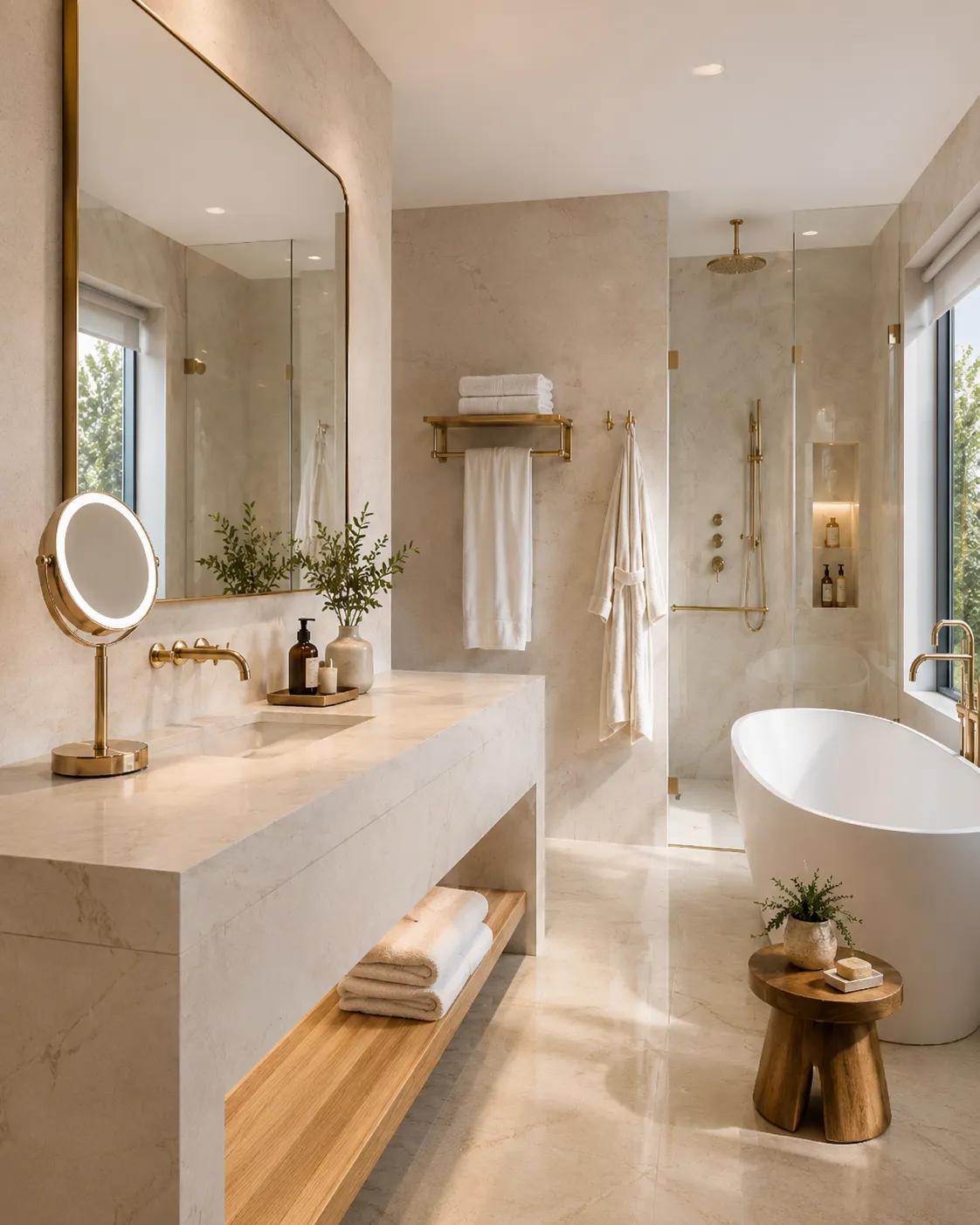
Have you ever finished your makeup in front of a lighted mirror, only to notice that your foundation looks different near a window? Makeup mirror lighting can change the appearance of skin tone, concealer, blush and fine detail. A bright mirror is not necessarily an accurate one.
Warm white LEDs, neutral white light and cooler daylight-style settings create different visual impressions. The result also depends on color rendering, where the light falls on your face and the other fixtures in the room. Looking only at the Kelvin number leaves out important information.
This guide compares warm, neutral and daylight-style illumination for everyday makeup. It also explains what hotel procurement teams should test when selecting wall-mounted LED magnifying mirrors for guest bathrooms.
Why Does Makeup Look Different in Natural Daylight?
Imagine applying foundation in a warm hotel bathroom and checking your face again beside a bright window. The same foundation may appear more yellow, more visible or less evenly blended. A change in illumination can reveal contrasts that were hard to notice earlier.
Light sources do not all contain the same balance of wavelengths. Their color appearance, spectral characteristics and direction influence the colors and shadows you see. Daylight also changes with weather, time of day and location, so it is not one fixed lighting condition.
Room lighting can introduce another variable. A warm ceiling fixture beside a cool LED mirror may illuminate different parts of the face with different-looking light. That mixture makes it harder to judge a subtle foundation match.
Better makeup mirror lighting should make facial detail easier to assess rather than simply creating the brightest possible reflection. Neutral light is a helpful starting point, although checking the result in a second environment remains worthwhile.
Makeup Mirror Lighting: Warm vs Neutral vs Daylight
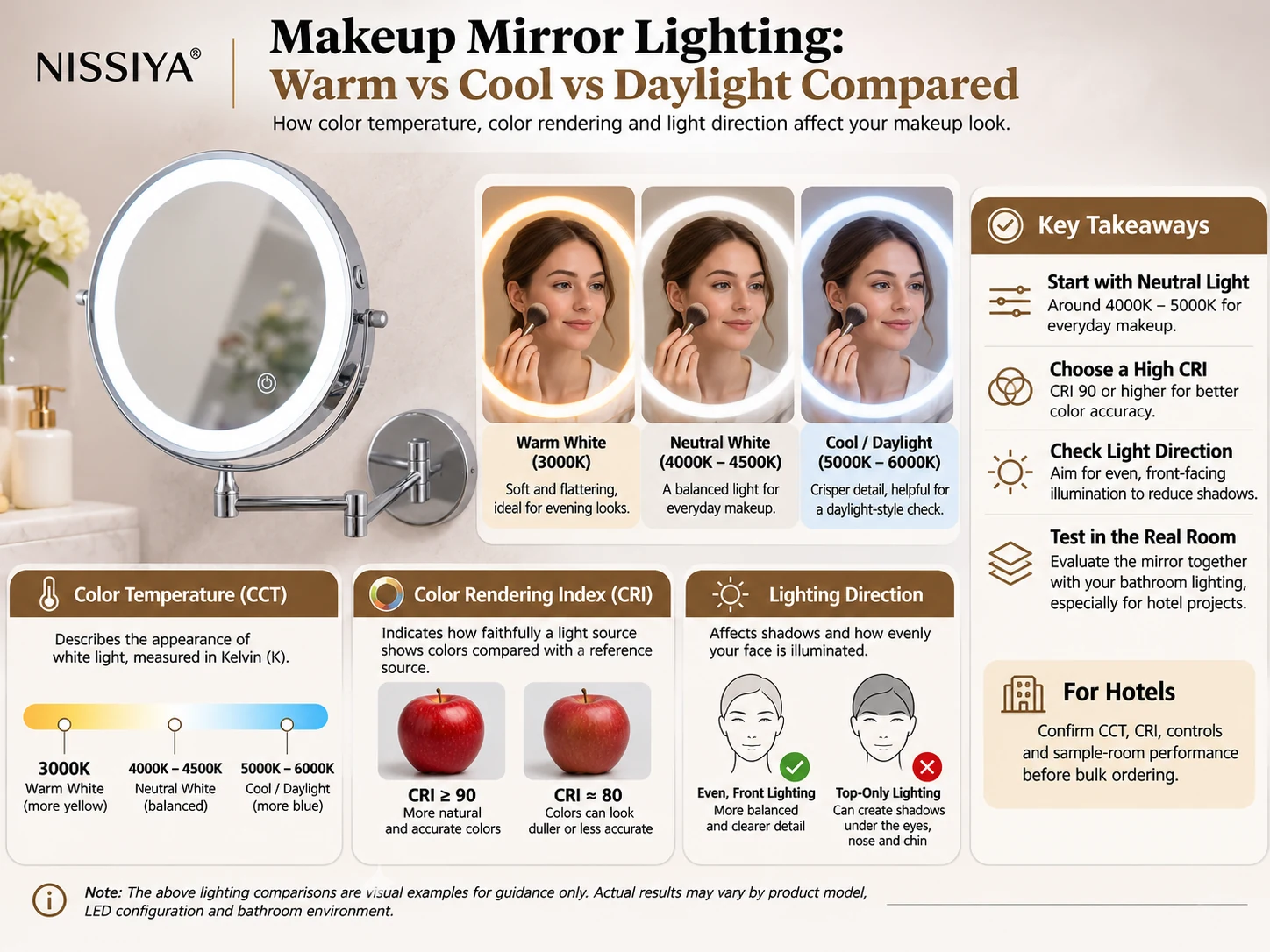
Color temperature describes whether white light appears warm, neutral or cool. The number is measured in Kelvin (K). A lower Kelvin value looks warmer; a higher value generally looks cooler. It does not measure the physical heat of the mirror or its brightness.
| Light Setting | Typical Appearance | Useful Makeup Check | Possible Limitation |
|---|---|---|---|
| 3000K Warm White | Soft, yellow-warm light | Reviewing a look for warm evening interiors | May make color differences harder to judge for daylight use |
| 4000K–4500K Neutral White | Balanced white with less warm or cool tint | Practical starting point for everyday application | Still depends on CRI, diffusion and room lighting |
| 5000K–6000K Cool / Daylight Style | Crisper, cooler-looking white | Comparing details under a daylight-like setting | Can feel harsh if overly bright or poorly directed |
These ranges are useful descriptions, not guaranteed results. Two lamps with the same Kelvin rating can still render skin color differently because their spectra and color-rendering properties differ.
3000K: Warm Lighting for Evening Environments
Warm white often complements beige stone, timber and warm-toned hotel interiors. It can also be pleasant when getting ready for dinner in a softly lit room. However, warm illumination alone may hide color differences that become obvious under a cooler source.
When applying makeup for daytime use, consider checking your finished look under neutral light or indirect daylight. Warm light still has a role; it simply answers a different question about how the makeup will appear in an evening setting.
4000K–4500K: Neutral Light for Everyday Application
Neutral white offers a practical middle ground between yellow-warm and cool-blue appearances. For many users, it is a useful baseline when choosing foundation, blending concealer or reviewing blush placement. The face should still receive even illumination.
A high-quality neutral LED can support accurate color judgments, but Kelvin alone is not a quality rating. Ask about CRI, light distribution and glare before concluding that any 4000K product is suitable.
5000K–6000K: A Cooler Daylight-Style Check
Cooler white can make fine facial detail easier to notice in some settings. It may be useful when someone expects to spend time in bright daylight or cooler indoor lighting. Nevertheless, daylight varies significantly, and a fixed 6000K LED does not reproduce every outdoor condition.
Very bright cool light may also feel uncomfortable at close viewing distance. Instead of assuming higher Kelvin means better visibility, compare the actual product at the user's normal position.
Which Light Color Is Best for Applying Foundation?
If you use one makeup mirror every morning, start by testing a neutral-white setting with good color rendering. Around 4000K–5000K is a useful range to evaluate for general makeup application. Then check the look under the type of light you will encounter later.
Foundation matching deserves particular attention because subtle differences near the jawline can become visible when the lighting changes. Use a 1X reflection for the overall appearance and a magnifying surface for detailed areas when appropriate. Magnification and color temperature perform different jobs.
For an evening event, a warmer final check may be more relevant than a cool daylight-style setting. Someone who works near bright windows may prefer to compare the finished makeup with indirect daylight instead.
There is no single Kelvin setting that guarantees a perfect match in every room. The goal is to reduce surprises by considering the lighting where the makeup will actually be seen.
Color Temperature vs CRI: Why Both Matter
Color temperature and color rendering are often confused. Kelvin describes the apparent whiteness of the light. The Color Rendering Index, usually written as CRI or Ra, describes how faithfully a source renders a set of colors compared with a reference source.
The U.S. Department of Energy's LED guidance explains that CRI 90 or higher indicates excellent color fidelity. It also notes that CRI does not describe every aspect of color quality, particularly some saturated reds.
For makeup mirror lighting, CRI 90+ is therefore a sensible comparison point. A higher figure can be valuable for distinguishing skin tones and cosmetic shades, although illumination direction and surrounding light still affect what users see.
Does CRI Above 95 Make a Difference?
A manufacturer may specify a high-CRI LED configuration above 95 for a particular model. That is a useful product characteristic, but it should be supported by the approved specifications or test data. It should not be assumed across an entire product catalog.
For example, NISSIYA lists CRI above 95 for its ELITE Polished Chrome 1X/3X LED makeup mirror and HALO-9 wall-mounted LED makeup mirror. Both products have their own configurations, which must be checked before a project order.
Specialized projects may also request additional color-quality information, such as red-rendering performance, when the supplier can provide it. A marketing claim about natural light is not a substitute for a documented specification.
Brightness and Kelvin Are Not the Same Measurement
A 6000K mirror is not automatically brighter than a 3000K mirror. Color temperature describes appearance, while brightness depends on the amount of light delivered and how it is distributed. Electrical wattage alone cannot tell a hotel buyer how well a guest's face will be illuminated.
When reviewing a sample, observe the face at the intended viewing distance. Check whether the eyes, nose and jawline remain visible without uncomfortable glare. If dimming is part of the approved design, test several brightness levels instead of evaluating only the maximum setting.
Why Light Direction Can Matter as Much as Color
Even a high-CRI LED can produce an inconvenient reflection when the light falls in the wrong place. A fixture mounted only above the face may cast shadows beneath the brow, nose and chin. Strong light coming from one side can make the opposite side look darker.
For detailed grooming, illumination that reaches the face from the front and sides is often more useful than decorative light aimed primarily at the wall. An integrated LED ring may help distribute light around a magnifying mirror, depending on its optical design and viewing distance.
However, a glowing ring does not automatically guarantee completely shadow-free facial lighting. The mirror's diffusion, LED output, adjustment angle and surrounding fixtures all influence the result.
LED Makeup Mirror vs Main Bathroom Mirror
A large bathroom mirror serves general viewing, while a smaller magnifying mirror supports close-up tasks. Their lighting roles can complement each other. A backlit main mirror may contribute ambient light, yet a separate illuminated makeup mirror can bring task light closer to the face.
For the difference between general vanity illumination and separate fixtures, see NISSIYA's LED Mirror vs Vanity Lights guide. Lighting performance should be judged on the complete bathroom arrangement rather than the appearance of one glowing product.
Distance and Magnification Change the Viewing Position
A 3X mirror invites the user to stand or lean closer than they might with a conventional 1X reflection. Higher magnification can require an even shorter viewing distance. That change also affects where the face sits relative to the LED lighting.
Check the mirror from the position a guest will actually use. Our 3X vs 5X vs 7X vs 10X magnification guide explains the optical differences, while the makeup mirror size guide covers head dimensions and usable glass area.
What Real Users Say About Makeup in Different Lighting
The concern is not limited to product specifications. In a September 2026 Reddit discussion, a makeup user described looking good under a bright vanity LED but noticing a different result outdoors and in other lighting. Other participants suggested testing multiple light settings and considering the environment where the makeup would be seen.
Those comments are personal experiences rather than controlled optical tests. Still, they illustrate a search problem that shoppers recognize immediately: the same makeup can appear different when illumination changes.
Useful makeup mirror lighting advice should therefore explain more than the warm and cool buttons. A good setup helps users compare color, see detail and understand the limits of any one lighting condition.
Makeup Mirror Lighting for Different Daily Routines
| Daily Situation | Useful Starting Point | Final Check |
|---|---|---|
| Morning makeup before work | Neutral white with good color rendering | Check near indirect daylight if available |
| Evening event | Neutral light for application | Review the look under warm interior lighting |
| Close-up eyeliner or brow work | Even facial illumination and appropriate magnification | Step back to check the whole face at 1X |
| Hotel bathroom with mixed fixtures | Test the makeup mirror together with room lighting | Observe color casts and shadows from the actual guest position |
| Travel between different lighting environments | Use a repeatable neutral starting condition | Compare the finished result in the destination lighting when possible |
A color-adjustable mirror can make these comparisons convenient, but a fixed-CCT product can still perform well when its light quality and placement suit the task. Confirm the functions of the exact model rather than assuming every LED mirror has three color settings or brightness memory.
Hotel Makeup Mirror Lighting: What Buyers Should Test
For hotel procurement teams, the main challenge is consistency. A sample that looks attractive in a showroom may behave differently beside a warm ceiling fixture in a finished guest bathroom. The approved makeup mirror lighting specification should therefore reflect the actual installation environment.
Before committing to bulk production, evaluate a representative sample room under normal operating conditions. Include the model's intended switch, power supply, mounting position and surrounding lights in the review.
| Inspection Item | What to Check | Why It Matters |
|---|---|---|
| Specified CCT | Confirm the Kelvin value or approved adjustable range | Prevents confusion between a fixed light and a multi-color model |
| Color Rendering | Request the CRI rating for the exact LED configuration | Supports consistent skin and cosmetic color evaluation |
| Facial Illumination | Observe shadows at a normal grooming distance | Tests function rather than LED ring appearance alone |
| Glare and Comfort | Check the mirror at different angles and brightness levels, if available | Reduces discomfort during close-up viewing |
| Room-Light Interaction | Turn on typical ceiling and vanity fixtures during the test | Reveals conflicting warm and cool light sources |
| Controls | Verify the approved rocker, touch or other switching behavior | Helps guests operate the mirror without confusion |
| Batch Consistency | Compare approved samples with the agreed lighting specification | Supports repeatable results across multiple guestrooms |
| Service Documentation | Confirm the electrical configuration and approved maintenance procedure | Supports safe installation and later service |
Why Color Consistency Matters Across Hotel Rooms
If a hotel purchases mirrors for numerous guestrooms, small differences in light appearance can become noticeable when neighboring rooms use different batches. Buyers should agree on the required CCT, acceptable tolerances and any relevant quality checks before production.
A project team should not diagnose a color difference by eye alone when specifications are disputed. NISSIYA's LED mirror color mismatch guide discusses the broader quality-control topic for hotel mirror installations.
Confirm Available Functions, Not Just the Marketing Name
Terms such as natural light, daylight mode and smart mirror are not precise electrical specifications. A product may offer a fixed LED color, several selectable CCT settings or dimming, depending on its design. None of those options should be inferred solely from a photograph.
For example, the NISSIYA ELITE series uses an acrylic LED light guide and has model-specific touch or mechanical control options. The HALO-9 lists a three-minute auto-off timer for its standard configuration. Neither detail should be confused with a promise of adjustable color temperature on every unit.
Hotel buyers should verify final functions, connection requirements and destination-market specifications against the approved sample and order documents. Our makeup mirror switch comparison explains how different control arrangements affect operation.
Common Mistakes When Choosing Makeup Mirror Lighting
Choosing the Highest Kelvin Number
Higher Kelvin values create cooler-looking light; they do not guarantee better color accuracy or greater brightness. Evaluate CCT together with CRI and actual facial illumination.
Assuming a Bright LED Ring Means Even Lighting
A ring can look impressive while leaving parts of the face in shadow. Check the light at the intended viewing distance rather than judging a product only from a front-facing photograph.
Ignoring Other Bathroom Lights
Warm ceiling lights and a cool mirror can create a mixed lighting environment. Compare the complete room setup before selecting the final color temperature.
Confusing CRI With Adjustable Color Temperature
CRI describes color-rendering performance; tunable CCT describes a control feature. A high-CRI fixed-color mirror and a color-adjustable mirror are not automatically the same product.
Approving a Sample Without Testing Guest Controls
Even suitable makeup mirror lighting becomes less useful when guests cannot operate the switch comfortably. Confirm the actual control method and electrical connection in the sample room.
Makeup Mirror Lighting: Frequently Asked Questions
What is the best lighting for a makeup mirror?
Neutral white around 4000K–5000K is a useful starting point for many people. Look for good color rendering, ideally CRI 90 or higher, and even illumination of the face. Compare the finished makeup in the lighting where it will be seen.
Is warm or cool light better for applying makeup?
Neither extreme is best for every situation. Neutral light often provides a practical baseline. Warm light helps assess an evening look, while cooler daylight-style light can provide a different comparison.
Is 3000K too yellow for makeup?
3000K has a warm appearance and can be pleasant indoors. For makeup intended to be viewed in daylight, a neutral-light or daylight check is helpful because colors may appear different under warmer illumination.
Is 6000K better than 4000K for a makeup mirror?
Not automatically. 6000K looks cooler, but the Kelvin number does not measure brightness or color fidelity. A well-designed 4000K light with high CRI and even facial illumination may be more comfortable for everyday use.
What does CRI mean on an LED makeup mirror?
CRI stands for Color Rendering Index. It describes how closely a light source renders a set of colors compared with a reference. A value of 90 or higher indicates excellent color fidelity, although CRI does not describe every aspect of light quality.
Why does my makeup look different outside?
Outdoor daylight can differ from bathroom LEDs in color appearance, spectrum, brightness and direction. Mixed room lighting and shadows can also change how foundation or concealer looks in the mirror.
Does an LED ring make makeup lighting shadow-free?
Not necessarily. An LED ring may provide helpful facial illumination, but the result depends on diffusion, light output, mirror angle, viewing distance and surrounding fixtures. Check the actual product rather than relying on the ring shape alone.
Can hotels order makeup mirrors with adjustable color temperature?
Adjustable color temperature may be available for suitable models or custom projects. Hotels should confirm the exact Kelvin range, controls and electrical configuration with the supplier before sample approval and bulk ordering.
Final Advice: Light the Face, Then Check the Color
Good makeup mirror lighting is not simply the warmest, coolest or brightest option. A suitable mirror helps users see skin tone and facial details with comfortable, consistent illumination. Neutral white, high color rendering and careful light placement offer a practical starting point.
For hotel and wholesale projects, NISSIYA recommends assessing the complete mirror and room-lighting arrangement. Confirm the actual model's CCT, CRI, controls, mounting position and sample-room performance before approving production. A carefully tested configuration is more valuable than an unsupported promise of perfect daylight.
Ready to Start Your Next Hospitality Project?
From initial design concepts to final product delivery, NISSIYA provides full-scale manufacturing support for hotels, resorts, and commercial developments worldwide. Let our engineering team help you translate your vision into reality with precision-engineered, commercially compliant mirror solutions.