
Choosing the right makeup mirror size involves more than comparing numbers on a product page. A 6-inch mirror looks compact, while a 9-inch head appears noticeably larger. Yet neither measurement tells you exactly how much reflective glass is available for daily grooming.
Some manufacturers specify the outside diameter of the entire mirror head. Others highlight the clear viewing area inside the frame. An LED light ring can further reduce the usable glass diameter, even when two mirrors share the same advertised size.
This guide compares 6, 7, 8 and 9-inch makeup mirrors. You will learn how to read the dimensions, assess viewing comfort and choose a suitable design for a home bathroom or hotel project. We also explain what wholesale buyers should confirm before approving a sample.
What Does Makeup Mirror Size Actually Mean?
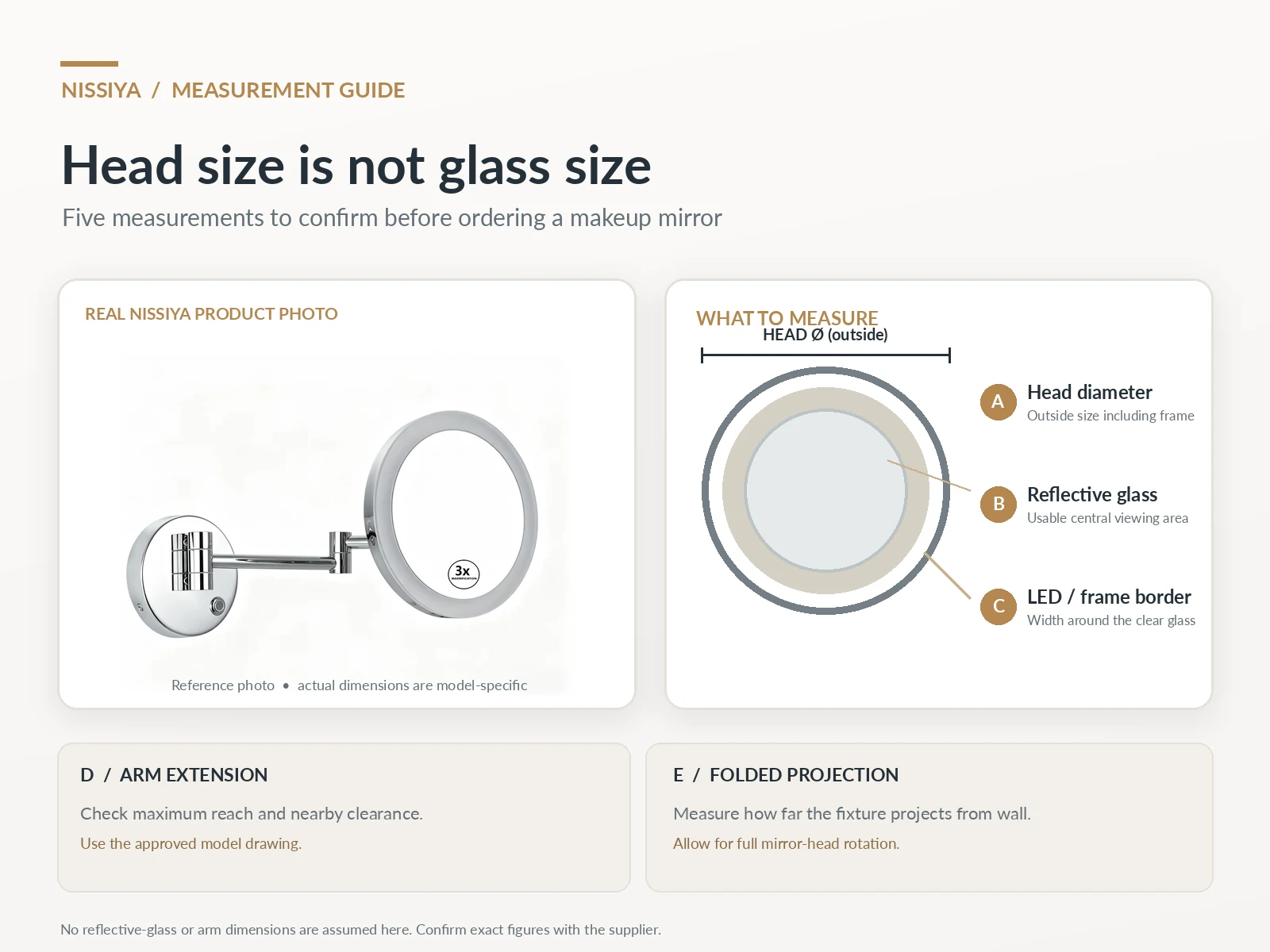
The advertised size may describe several different dimensions. To compare products fairly, identify what each measurement includes. A clear specification drawing is more reliable than a single number beside a product photograph.
Overall Mirror Head Diameter
For a round model, the overall diameter runs from the outer edge of the head to the opposite edge. An 8-inch circular head measures approximately 203mm across. This dimension helps you evaluate visual proportions and available installation space.
However, the outside diameter may include a metal frame, LED diffuser and supporting housing. It should not be confused with the reflective surface.
Clear Reflective Glass Diameter
The reflective diameter is the width of the area that actually produces a usable image. A narrow border generally leaves more room for glass than a wide border on a similarly sized head. Consequently, two products described as 8-inch mirrors can feel different in daily use.
For example, a Zadro wall-mounted mirror listing distinguishes an 8-inch head from a 7-inch reflective surface. It illustrates why buyers should ask for both dimensions instead of assuming they match.
LED Light Ring Width
Lighted designs often use an acrylic diffuser or LED border around the glass. That lighting assembly forms part of the head but does not necessarily increase the reflective area. When comparing a lighted model with a non-lighted design, note the width of the surrounding ring.
The lighting ring can also influence the appearance of the product. Still, its visual style and its usable glass area are separate considerations.
Arm Reach and Folded Projection
Wall-mounted makeup mirrors need additional measurements beyond the head diameter. Maximum arm extension indicates how far the mirror can reach from the wall. Folded projection describes how much space it occupies when stored close to the mounting surface.
Check both positions during a room mock-up. Nearby faucets, wall lights, cabinets and doors can restrict movement even when the mirror head itself fits the wall.
Measurement tip: Ask suppliers to identify the overall head diameter, clear reflective glass diameter, maximum arm extension and folded projection separately. The infographic above shows the measurement locations, not verified dimensions for every NISSIYA model.
Makeup Mirror Size Comparison: 6, 7, 8 and 9 Inches
The following table compares nominal round-head sizes. Metric figures are approximate inch conversions rather than exact specifications for every manufacturer. Real product drawings may use slightly different measurements.
| Nominal Size | Approx. Diameter | Typical Consideration | What to Verify |
|---|---|---|---|
| 6 Inch | 152mm | Compact head for limited wall or vanity space | Usable glass size and viewing distance |
| 7 Inch | 178mm | Intermediate size with a modest visual footprint | Frame width and reflection area |
| 8 Inch | 203mm | Versatile starting option for many bathrooms | LED border, arm reach and clear glass |
| 9 Inch | 229mm | Larger head where installation space permits | Head weight, support and folded clearance |
6-Inch Makeup Mirrors: Compact by Design
A 6-inch head can work well beside a narrow vanity or at a secondary grooming station. Its smaller profile may be desirable when surrounding fixtures leave little room. Nevertheless, the available reflection can be limited by a thick frame or lighting border.
Before selecting this size, test the actual mirror at the intended viewing distance. Comfort matters more than the label on the packaging.
7-Inch Makeup Mirrors: A Middle Ground
The 7-inch category sits between a compact 6-inch product and a larger 8-inch design. It can be useful when a project needs a moderate head diameter without committing to a bulkier appearance.
Yet frame proportions vary considerably. Compare the reflective opening, not only the outside dimension. A well-positioned mirror with a clear viewing area may be more useful than a bigger model with limited reach.
8-Inch Makeup Mirrors: A Versatile Starting Point
Many hotel bathroom projects can begin with an 8-inch sample. The size offers a reasonable reference for evaluating guest comfort, visual balance and wall clearance. It is a starting point for testing, not a universal requirement.
NISSIYA's ELITE Polished Chrome Makeup Mirror has an approximately 203mm round head, double-sided 1X/3X viewing and an acrylic LED light-guiding ring. Its adjustable arm helps the user position the reflection closer to the face.
The product's clear glass diameter and installed reach should still be confirmed using the relevant drawing. An outside measurement alone cannot establish either value.
9-Inch Makeup Mirrors: More Head Space
A 9-inch round head measures approximately 229mm in nominal terms. With similar frame proportions, it can accommodate a larger reflective area than an 8-inch design. However, a wide lighting border can change that comparison.
The NISSIYA HALO-9 is listed with an approximately 230mm head, standard 3X magnification and integrated LED lighting. Its larger format may suit guestrooms that offer sufficient wall space.
For installation planning, consider the total assembly rather than the head size alone. Verify the arm, mounting plate and project-specific electrical configuration before approving the order.
Does a Larger Makeup Mirror Provide a Better View?
A larger head can create more room for glass, but viewing comfort depends on several factors. Magnification, viewing distance, lighting and mirror position all affect the user experience. The nominal makeup mirror size cannot explain those differences on its own.
Mirror Diameter Is Not Magnification
A mirror's diameter describes its physical dimensions. Magnification describes how large the reflected image appears. These specifications answer different questions.
For instance, a 6-inch 10X mirror offers higher magnification than a 9-inch 3X mirror. The larger head does not change the optical power. Higher magnification also tends to require a shorter viewing distance for a clear image.
See our 3X vs 5X vs 7X vs 10X magnifying mirror guide for more detail on those optical differences.
Why the Clear Glass Opening Matters
Imagine two round mirrors with an 8-inch outer diameter. One has a broad illuminated border, while the other uses a narrower frame. The second could leave more space for reflective glass even though the advertised head size is identical.
When requesting samples, compare the effective viewing area side by side. This simple check can reveal differences that product thumbnails hide.
Viewing Distance Changes the Experience
An adjustable arm allows the user to move a wall-mounted mirror toward a comfortable position. Its range can be especially helpful for magnifying glass that requires close viewing. Yet extra reach does not alter the mirror's magnification.
If the reflection looks blurry, first check whether the viewing distance suits the optical power. Our article Why Is My 10X Mirror Blurry? explains that issue separately from physical head dimensions.
Round vs Square Makeup Mirrors: Does Shape Change the Size?
A round mirror is usually described by diameter. Square models are commonly listed by width and height. An 8-inch circle and an 8-inch square therefore do not have the same total surface area.
The frame can further change the usable reflection. For a fair comparison, request the clear glass dimensions of each shape. Also check the head's path of movement if it rotates on a wall-mounted arm.
Neither shape automatically provides a better grooming experience. The preferred design depends on viewing comfort, bathroom style and the available installation space.
What Makeup Mirror Shoppers Actually Look For
Consumers often ask whether a compact mirror will show enough of the face. Others prioritize a larger viewing area, even when their preferred product uses a higher magnification. Those preferences help explain why nominal head size can be a misleading buying shortcut.
A Reddit discussion about replacing a lighted magnifying mirror illustrates consumer interest in larger heads and the practical reflection they provide. Individual comments are not engineering tests, so buyers should still assess the actual product.
For hotel procurement, a sample-room evaluation is more dependable than assuming all guests prefer the same diameter. A larger size may appeal to some users, while a compact, well-positioned design may suit others.
Which Makeup Mirror Size Works Best in Hotel Bathrooms?
Hotel bathrooms differ in layout, fixture spacing and guest expectations. A compact room may need a smaller head to avoid conflicts with nearby hardware. Larger suites can offer additional wall clearance, but that does not automatically make the largest model the best choice.
Use the following scenarios to shortlist samples. Final approval should depend on measurements taken in the actual guestroom or a representative mock-up.
| Hotel Application | Size to Evaluate | Main Check |
|---|---|---|
| Compact Guest Bathroom | 6–8 Inch | Usable glass versus available wall and arm clearance |
| Standard Guestroom | 8 Inch Starting Sample | Comfortable reach, viewing and folded position |
| Spacious Suite | 8–9 Inch | Head movement, wall support and visual proportion |
| Dressing Desk | Model Dependent | Tabletop footprint, seated eye level and stability |
| Renovation Project | Match Approved Installation | Existing fixing points and electrical requirements |
| Multi-Room Project | Approve Representative Samples | Consistency in operation and mounting conditions |
Start With the Available Wall Space
Measure the space beside the main bathroom mirror or vanity. Nearby faucets, light fixtures, towels and doors can affect the usable installation area. Consider how the head moves, not just where it rests when folded.
An 8-inch model may fit one room but interfere with a nearby feature in another. Checking the real layout helps avoid expensive changes after bulk delivery.
Review Reach and Mounting Height Together
The mirror should be comfortable for guests to approach and adjust. Arm reach, mounting height and magnification all affect that experience. Test these factors together rather than approving each dimension independently.
For further guidance, see NISSIYA's wall-mounted makeup mirror height guide. Projects considering a desktop alternative can also review our wall-mounted vs tabletop comparison.
Evaluate Comfort in a Sample Room
Let the project team inspect the mirror in both folded and extended positions. Check whether guests can see their reflection without leaning awkwardly or stretching around the vanity. Observe any conflicts with the room's other fixtures.
If more than one room type will use the same mirror, test representative layouts. A consistent product specification is useful only when it also suits the installation conditions.
NISSIYA Makeup Mirror Sizes: Product Examples
NISSIYA offers different designs for hospitality, distribution and OEM/ODM applications. The models below illustrate actual listed options. Custom variations should always be confirmed against the approved quotation and sample.
| Product | Listed Head Size | Design Notes |
|---|---|---|
| HERITAGE-V | 8 Inch Standard; 6 and 7 Inch Options | Non-lighted, double-sided 1X/5X wall-mounted design |
| ELITE Polished Chrome | 8 Inch / Approx. 203mm | Double-sided 1X/3X, acrylic LED light-guiding ring and adjustable arm |
| GLIDE-S | Approx. 200mm / 8 Inch | Single-sided 3X tabletop design with adjustable joint |
| HALO-9 | 9 Inch / Approx. 230mm | Wall-mounted LED design with standard 3X magnification |
Although several models share similar nominal dimensions, they do not share every feature. Some have double-sided heads; others use single-sided glass. Lighting, arm structure and power configurations must be checked for each approved model.
What Wholesale and OEM Buyers Should Confirm
For bulk purchasing, the makeup mirror size specification should describe the complete assembly. A dimensioned drawing helps prevent misunderstandings between purchasing, engineering and production teams.
- Head dimensions: State the overall diameter or the width and height for a non-round design.
- Reflective glass: Record the clear viewing area separately from the outside head dimension.
- Lighting border: Specify the acrylic diffuser or LED ring arrangement when relevant.
- Head profile: Check the total thickness and the planned rotation range.
- Arm movement: Verify extended reach, folded projection and positioning stability.
- Mounting plate: Match plate dimensions and fixing requirements to the installation drawing.
- Optical details: Confirm the required magnification independently of the head size.
- Export packaging: Review protective materials and carton dimensions against the approved design.
Does a Larger Head Need a Stronger Arm?
A change in head diameter can affect weight and leverage, depending on the mirror materials and construction. The supporting arm must therefore be evaluated with the actual head assembly. Matching the appearance of an existing model is not enough to confirm mechanical compatibility.
For a hotel installation, test whether the mirror stays in its intended position throughout normal movement. Factory approval should cover the complete design rather than the head alone.
What About Retail and Private Label Orders?
Retail customers benefit from clear dimensions that distinguish the head from its reflective glass. Accurate product images also help shoppers understand the size before ordering. On packaging and product pages, identify the measurement method instead of relying on an ambiguous label.
Wholesale buyers should likewise confirm whether a proposed customization changes the head, frame, lighting or carton size. Those details can influence both user experience and logistics.
Common Makeup Mirror Sizing Mistakes
- Buying by the label alone. An 8-inch listing may describe the outside head rather than the reflective glass.
- Confusing diameter with magnification. A larger mirror does not automatically provide a stronger optical effect.
- Ignoring the LED border. A wide illuminated ring can reduce the clear reflection area.
- Measuring only the folded mirror. The extended arm and rotating head also need clearance.
- Comparing round and square heads as equals. Diameter and width describe different shapes and surface areas.
An accurate drawing and a physical sample can resolve most of these questions. For projects involving many guestrooms, resolving sizing details early is preferable to correcting installation problems later.
Makeup Mirror Size: Frequently Asked Questions
What is the best makeup mirror size for everyday use?
An 8-inch mirror is a useful starting option for many bathrooms. The best choice still depends on the clear reflective area, viewing distance, available space and personal preference.
Is a 6-inch makeup mirror too small?
Not necessarily. A 6-inch head can work in compact spaces, provided the reflective surface is comfortable for the intended grooming task. Compare a real sample before deciding.
What is the difference between an 8-inch and a 9-inch makeup mirror?
A nominal 9-inch round head is larger than an 8-inch head. However, the frame and LED border can affect the actual glass area. Check both the outside diameter and clear reflective diameter.
Does an 8-inch makeup mirror have an 8-inch reflective surface?
Not always. Some manufacturers include the frame and lighting ring in the advertised size. Request a separate measurement for the usable reflective glass.
Does a bigger magnifying mirror provide higher magnification?
No. Mirror size and magnification are separate properties. A larger head does not automatically produce a more magnified reflection. Check the stated 3X, 5X or other optical rating.
Which makeup mirror size is suitable for hotel bathrooms?
Hotel teams can begin by testing an 8-inch wall-mounted sample. Compact and spacious rooms may need different sizes, so confirm the head, arm reach and installation clearance in a representative guestroom.
Is a round or square makeup mirror better?
Neither shape is universally better. Compare the clear glass dimensions, lighting, available wall space and viewing comfort of the actual models rather than relying on the nominal size.
Can hotels order custom makeup mirror sizes?
Custom sizes may be available depending on the model and project requirements. NISSIYA can discuss OEM and ODM configurations, with dimensions and functions confirmed before production.
Final Advice: Compare the Glass, Not Just the Number
The best makeup mirror size provides a comfortable reflection without restricting the surrounding bathroom space. Compact 6-inch and 7-inch designs may suit smaller areas, while an 8-inch or 9-inch head can be considered for different installation layouts.
Before choosing, verify the clear glass diameter, optical magnification, lighting border and arm clearance. These details reveal more than the nominal head dimension alone.
For NISSIYA hotel and wholesale projects, a representative sample and approved technical drawing provide the clearest basis for final selection. They help ensure that the specified mirror suits the space, user and installation requirements.
Ready to Start Your Next Hospitality Project?
From initial design concepts to final product delivery, NISSIYA provides full-scale manufacturing support for hotels, resorts, and commercial developments worldwide. Let our engineering team help you translate your vision into reality with precision-engineered, commercially compliant mirror solutions.