


Is your anti-fog mirror not working after a hot shower? The glass may remain cloudy, the demister button may seem unresponsive, or only a small area may stay clear. Although these symptoms look similar, their causes can be very different.
An illuminated bathroom mirror may include a heating pad behind the glass. When activated, this pad helps reduce condensation in its intended coverage area. However, the function does not necessarily keep the entire mirror clear.
For hotels, repeated problems can affect guest satisfaction and maintenance costs. One faulty control may involve a single room, while an unsuitable specification can affect many guestrooms.
This guide explains seven possible causes, safe troubleshooting steps, and practical maintenance decisions. It also shows how hotel buyers can prevent avoidable complaints through better product approval.
If your anti-fog mirror is not working, first check whether the selected model actually includes a defogger. Next, confirm that its heating function is active and has operated for the period specified by the manufacturer.
A small clear area may be normal when the heating pad covers only part of the glass. Persistent condensation can also result from high humidity, interrupted power, faulty controls, or a damaged heating element.
Start with normal user controls and the product manual. Leave electrical testing, mirror removal, internal wiring, and component replacement to qualified personnel.
Anti-Fog Mirror Not Working: Failure or Normal Heating Coverage?
A foggy mirror does not always indicate an electrical failure. The location and timing of the condensation offer useful clues.
Before replacing a component, determine whether the mirror has no clear area, partial clearing, or inconsistent operation. Different symptoms require different responses.
| Observed Symptom | Possible Explanation | First Response |
|---|---|---|
| Entire mirror remains foggy | Inactive defogger, insufficient warm-up, excessive humidity, or a system fault. | Check the approved controls and operating instructions. |
| Center stays clear, edges remain foggy | The heating pad may cover only the main viewing area. | Compare the clear area with the approved coverage design. |
| Mirror clears after several minutes | The heating system needs time to warm the glass. | Confirm the manufacturer's intended operating sequence. |
| Defogger works sometimes | Control behavior, power interruption, or an intermittent fault. | Record the time and conditions when the problem occurs. |
| LED light works, but defogger does not | Lighting and heating may use different controls or circuits. | Check the model-specific functions and service information. |
| Several guestrooms report the same issue | Shared configuration, operating instructions, or installation problem. | Compare room records and the approved project specification. |
This symptom-based approach can reduce unnecessary replacements. It also helps the manufacturer identify whether the problem concerns the product or its operating conditions.
7 Reasons an Anti-Fog Bathroom Mirror Stops Working Properly
A defogger problem can involve user settings, the bathroom environment, or electrical components. Each cause below includes a practical observation and a recommended response.
The Anti-Fog Function Is Not Activated
Some LED bathroom mirrors use a dedicated touch button for defogging. Other designs connect the heater to the lighting control or a separate wall switch.
A guest may turn on the LED illumination without activating the heating function. Consequently, the mirror looks bright but still collects condensation.
The control symbols can also create confusion. For example, an unfamiliar button may operate the demister rather than the lighting brightness.
Recommended check: Review the model's operating instructions. Activate the approved defogger control and verify the indicated operating state, if the product provides one.
Hotel staff should not assume that every NISSIYA mirror uses the same control method. The exact arrangement depends on the approved model.
The Heating Pad Has Not Had Enough Time to Work
A mirror demister does not necessarily clear condensation immediately. Its heating element must transfer warmth through the glass before the surface can resist fogging.
Starting the system only after a long, hot shower may produce a slower result. Preheating can improve performance when the model supports that operating sequence.
However, warm-up time varies with the product and bathroom conditions. Glass thickness, heater design, room temperature, and humidity can influence the result.
Recommended check: Follow the manufacturer's operating instructions. Compare the result after the specified warm-up period rather than expecting instant clearing.
A mirror that eventually clears may be working as designed. Persistent failure after normal operation deserves further assessment.
The Heated Area Is Smaller Than the Mirror
This is one of the most common reasons users misunderstand anti-fog performance. The heating pad may sit behind the central viewing zone instead of covering the entire glass.
As a result, the center can remain clear while the outer edges collect mist. Such a pattern may reflect the approved design rather than a defective heating system.
The WarmlyYours mirror defogger support guide explains that heating concentrates around the element. Additional clearing outside that area depends on environmental conditions.
Recommended check: Compare the visible clear zone with the manufacturer's approved pad dimensions and position.
If the guest cannot see their face in that area, the design may not suit the installation height. A functioning heater can still provide an unsatisfactory user experience.
Bathroom Humidity Is Too High for the Available Heating
Hot showers release moisture into the bathroom air. Condensation develops when a mirror surface remains cooler than the surrounding air's dew point.
A heating pad helps reduce this problem within its effective area. Nevertheless, severe steam, poor ventilation, or unusually cold glass can affect the final result.
Poor ventilation may also leave the bathroom humid long after the guest finishes showering. The mirror heater and exhaust system serve different purposes.
Recommended check: Observe whether the room has unusually persistent steam. Ask the building maintenance team to review ventilation performance where appropriate.
Do not diagnose a heater failure solely because the edges remain cloudy during extremely humid conditions.
The Defogger Is Not Receiving Its Intended Power
An illuminated mirror can contain separate lighting and heating circuits. Therefore, working LED lights do not prove that the defogger receives power.
Depending on the approved design, wall switches, controllers, timers, and electrical supply arrangements may affect heating operation.
For instance, a hotel room control system could interrupt power when the guest leaves. A separate defogger circuit may also behave differently from the mirror light.
Recommended check: Record the operating conditions and report the issue to a qualified electrician. The technician should verify the approved supply and control arrangement.
Staff must not expose internal wiring, bypass switches, or test live electrical parts.
The Touch Controller or Automatic Timer Has a Fault
Some mirror designs use electronic controls to manage heating. Selected products may also include an automatic shutoff or other timed functions.
A controller fault can prevent the heater from starting or cause unexpected shutdowns. However, normal timer operation may look like a fault if guests do not understand the feature.
Repeated button presses may create more confusion when the control has delayed responses. Users should follow the documented operating sequence.
Recommended check: Identify the exact model and its control logic. Ask the supplier to review the timer or touch-controller behavior when it differs from the approved specification.
Avoid assuming a timer is present on every NISSIYA product. Such features depend on the selected configuration.
The Heating Pad or an Internal Connection Has Failed
A damaged heater, defective connection, or failed electrical component can prevent the mirror from warming correctly. The fault may appear after installation or develop during operation.
Unfortunately, the visible symptom alone cannot reveal which internal component failed. Control problems and supply interruptions can produce similar results.
Moisture exposure or mechanical damage may also require inspection. Any sign of overheating, burning odor, or electrical damage warrants immediate attention.
Recommended check: Stop using the affected system when a safety concern exists. Arrange professional diagnosis and contact the manufacturer for approved repair information.
Replacing the entire mirror should not be the automatic first decision. Serviceability depends on the model and the confirmed fault.
These causes explain why an anti-fog mirror not working complaint needs careful investigation. A simple settings problem requires a different response from an internal electrical failure.
Why Is Only the Center of My Anti-Fog Mirror Clear?
The answer often comes down to the size and position of the heating element. A larger mirror does not automatically contain an equally large defogger pad.
Consider an illustrative rectangular mirror measuring 1200 × 800mm. Suppose the approved heating pad measures 600 × 400mm.
In this example, the pad occupies one-quarter of the mirror's nominal surface area. However, this percentage is not a measured fog-free coverage ratio.
Heat can spread beyond the pad, while humidity may reduce the effective clearing area. The actual visible result depends on the complete mirror design and operating conditions.
Important: These dimensions are only a mathematical illustration. They do not describe a specific NISSIYA model, heating-pad option, or mandatory design requirement.
NISSIYA's Anti-Fog Bathroom Mirror Guide explains pad placement and coverage in more detail. Today's article focuses on troubleshooting when the expected performance is not achieved.
How to Fix an Anti-Fog Mirror That Is Not Working
When hotel staff report an anti-fog mirror not working, the first task is to document the symptom. Safe observation can often separate operating errors from problems that need electrical service.
The following sequence is suitable for an initial maintenance report. It does not replace manufacturer instructions or professional diagnosis.
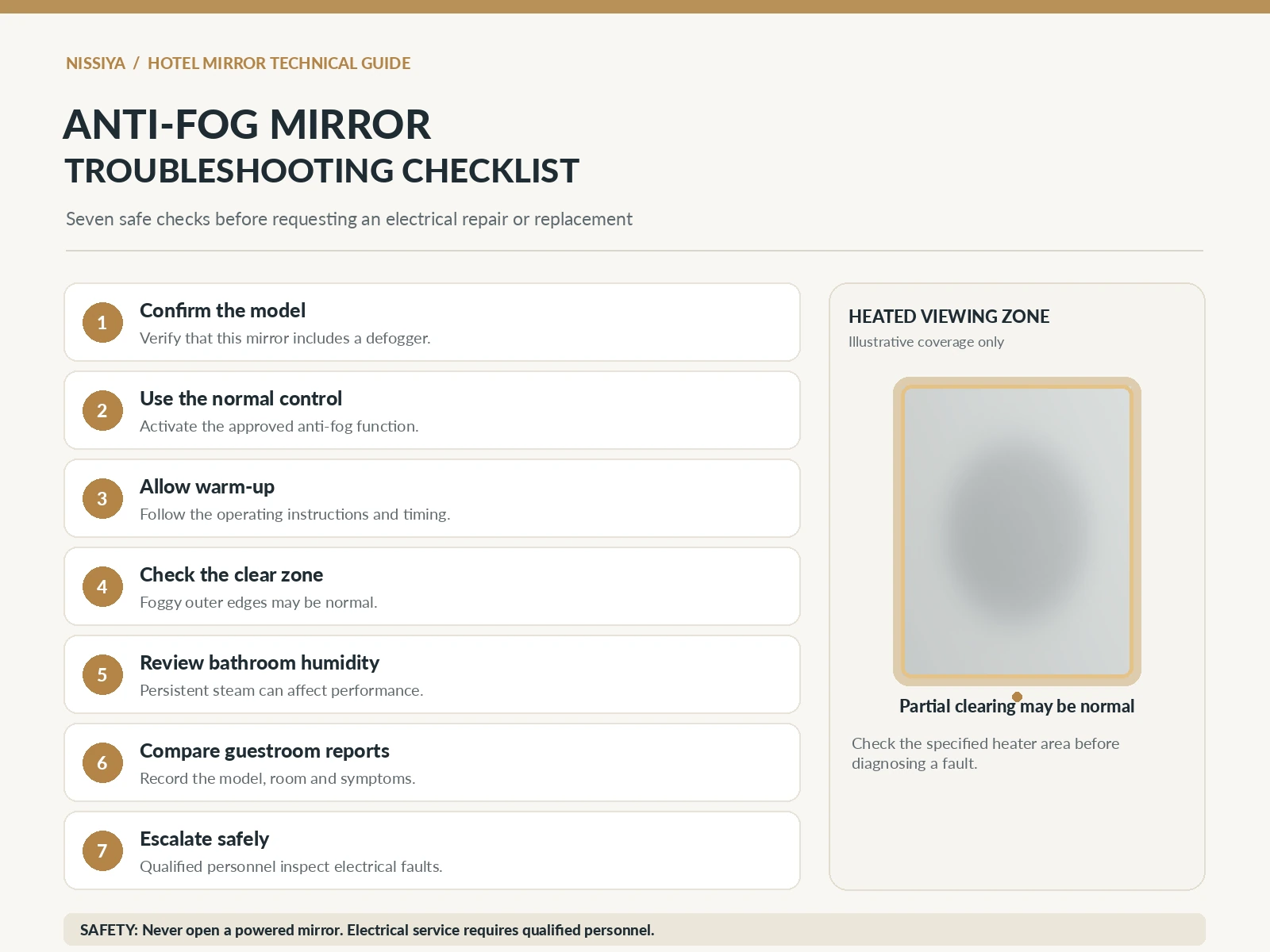
Confirm the Mirror Has a Defogger
Check the exact product model and approved specification. An LED bathroom mirror does not necessarily include an anti-fog function.
Review Normal User Controls
Use the documented switch or touch control. Note whether the indicator confirms activation, if the mirror provides one.
Allow the Approved Warm-Up Period
Operate the defogger according to its manual. Avoid assuming that every model reaches an effective temperature within the same number of minutes.
Observe Where Fog Remains
Record whether the whole mirror stays cloudy or only the outer areas. Compare the pattern with the approved heating-pad coverage.
Check the Room Environment
Look for unusually persistent steam or poor ventilation. Report building-system concerns to the appropriate maintenance team.
Compare Other Mirrors of the Same Model
Identify whether nearby guestrooms have the same behavior under similar conditions. This comparison may reveal a shared operating or specification issue.
Arrange Qualified Diagnosis When Necessary
If the system still fails, consult the manufacturer and a qualified electrician. Provide the model, symptom record, and approved electrical information.
Electrical safety notice: Do not remove a powered mirror, open its electrical housing, test live conductors, or modify heating-pad wiring. Suspected electrical faults require qualified inspection. Stop use immediately if smoke, unusual heat, or burning odor appears.
For additional safety and supply considerations, review NISSIYA's LED Bathroom Mirror Electrical Requirements .
Should You Repair the Defogger or Replace the Entire Mirror?
Not every defogger complaint requires a replacement mirror. The correct decision depends on the confirmed cause, product construction, and availability of approved parts.
For hotel operators, replacement costs include more than the new product. Labor, electrical work, guestroom downtime, freight, and possible wall repairs also deserve consideration.
| Confirmed Situation | Possible Response | Important Condition |
|---|---|---|
| Incorrect user setting | Correct the operation and update guest instructions. | No internal repair should be necessary. |
| Normal limited heating coverage | Compare performance against the original specification. | A different design may be needed to expand the clear area. |
| Bathroom ventilation issue | Review ventilation and environmental conditions. | Do not modify mirror electronics to compensate. |
| Faulty external switch or power arrangement | Arrange qualified electrical service. | Follow approved drawings and local requirements. |
| Defective controller | Ask about approved component replacement. | Service access depends on the exact mirror model. |
| Damaged heating pad | Consult the manufacturer about repair feasibility. | Do not peel, cut, or improvise repairs to an installed heater. |
| Major damage or unavailable parts | Evaluate complete mirror replacement. | Compare total repair cost, warranty, and safety requirements. |
The supplier should confirm whether approved components can be serviced. In some assemblies, replacing the complete product may be safer or more practical than repairing a damaged heater.
Before ordering parts, retain the original model information. An apparently similar heating pad may have different dimensions, ratings, or control requirements.
What Reddit Discussions Reveal About Hotel Anti-Fog Mirrors
Real user discussions provide useful examples of how hotel guests experience mirror defogging. These posts are not controlled product tests, and they cannot establish failure rates.
The Clear Area Is Too High for the Guest
A user in r/mildlyinfuriating described a mirror with a clear area positioned too high for comfortable use.
The discussion focused on the mismatch between the heated zone and the user's viewing position.
Hotel lesson: A functioning defogger may still disappoint guests if the clear area does not serve their actual reflection height.
Only the Center Remains Clear
A user in r/mildlyinteresting shared a hotel bathroom mirror that remained clear in the middle while the surrounding glass collected fog.
The visible result is consistent with a heated central area, although the post alone cannot confirm the product's exact internal construction.
Hotel lesson: Explain the intended heating coverage during sample approval and evaluate whether the clear area is large enough for guests.
Different Mirrors Use Different Defogger Controls
In a separate hotel anti-fog mirror discussion , participants described heating pads behind the glass and noted that some systems operate through the bathroom light switch.
This illustrates why a guest may not immediately understand how the heating function is activated.
Hotel lesson: Confirm the actual defogger control method and provide operating instructions that match the installed model.
A Clear Patch Does Not Prove a Fault
A small clear window can indicate that a heater is operating. Yet the result may not meet the project's usability requirements.
Before declaring an anti-fog mirror not working, compare the visible performance with the approved sample, design, and user expectations.
Hotel lesson: Guest comfort and engineering acceptance both matter.
One Hotel Mirror Fails or Twenty: Why the Pattern Matters
A single guestroom complaint may involve an individual component. However, similar reports across several rooms can indicate shared controls, specifications, or installation conditions.
Maintenance teams should collect comparable information before replacing multiple mirrors.
| Failure Pattern | What to Investigate | Suggested Hotel Action |
|---|---|---|
| Only one guestroom | Individual settings, controls, product, or electrical connection. | Record the model and request targeted inspection. |
| Several rooms on one floor | Shared electrical or building control arrangements. | Ask the electrician to review common factors. |
| Many rooms from the same production batch | Approved component configuration and manufacturing records. | Coordinate a documented supplier investigation. |
| Only newly installed mirrors | Installation, power configuration, and sample approval. | Compare the new installation with approved drawings. |
| All mirrors have a clear center | Normal heating-zone dimensions and position. | Check whether coverage matches the design specification. |
| Only a replacement mirror behaves differently | Updated components or control specifications. | Verify model compatibility and service documentation. |
Avoid replacing every defogger before identifying a common cause. The wrong repair decision can increase project costs without solving the underlying issue.
How Hotels Can Prevent Anti-Fog Mirror Problems Before Bulk Orders
For hotel developers, the most efficient troubleshooting often begins before the mirrors arrive. Product specifications should define what the anti-fog system is expected to do.
A sample room helps the buyer test actual performance under realistic conditions. It also provides an approved reference for later maintenance disputes.
Approve the Intended Clear Viewing Area
The mirror's overall dimensions do not describe its heating coverage. Buyers should request the approved defogger dimensions and position when this information is important to the project.
Check whether the intended clear area matches typical guest viewing needs. Different mirror orientations or vanity layouts may require different coverage considerations.
Confirm the Control Method
Determine whether the heater uses a dedicated touch control, combined switch, or another approved arrangement. The operating instructions should match the delivered model.
For hotel guestrooms, simple control behavior may reduce confusion. Still, the preferred method depends on the project's design requirements.
Coordinate the Electrical Specification
A defogger adds electrical load to the complete mirror system. Therefore, the factory and electrical contractor should agree on the supply and control requirements.
The mirror's destination market also matters. Applicable certifications and installation conditions depend on the exact electrical configuration.
Review Factory Function Tests
Applicable NISSIYA LED mirror orders undergo a 48-hour powered aging process. Such testing can help reveal certain early operational problems.
However, the aging period alone does not prove that every defogger meets a specified heating distribution. Buyers should agree on appropriate functional inspection criteria for the approved model.
See the NISSIYA LED Mirror Aging Test Guide for more information about the company's quality-control process.
Keep Model and Batch Records
A hotel may need replacement mirrors or service parts years after installation. Retaining model numbers, approved drawings, component information, and inspection records simplifies later investigations.
Clear documentation also helps distinguish a manufacturing issue from an operating or installation problem.
Anti-Fog Bathroom Mirror Specifications Buyers Should Confirm
Hotel buyers can use this checklist before approving samples or releasing a bulk order. It focuses on avoiding the kinds of problems that lead to an anti-fog mirror not working complaint after installation.
| Specification Item | What to Confirm |
|---|---|
| Mirror Model | Exact product code and whether the approved version includes a defogger. |
| Mirror Dimensions | Overall width, height, orientation, and reflecting area. |
| Defogger Coverage | Approved heating-pad dimensions and intended clear viewing zone. |
| Heater Position | Placement relative to the guest's normal viewing area. |
| Operating Method | Dedicated touch control, linked switch, or another approved method. |
| Warm-Up Behavior | Expected operation and agreed functional acceptance conditions. |
| Electrical Requirements | Input supply, rated heating load, controls, and applicable market requirements. |
| Optional Auto-Off | Whether a timer is included and how it operates. |
| Safety and Protection | Model-specific electrical protection and supporting compliance documentation. |
| Factory Testing | Agreed functional inspection and applicable aging-test procedures. |
| Sample Approval | Approved heating behavior, guest controls, drawings, and finish. |
| Service Planning | Warranty conditions, authorized repair method, and replacement availability. |
Project recommendation: Describe the required clear viewing area rather than simply requesting an "anti-fog LED mirror." This helps the manufacturer confirm whether the proposed defogger design suits the bathroom.
For a broader sourcing checklist, see Hotel Bathroom Mirror Specifications .
How NISSIYA Anti-Fog LED Mirrors Fit Hotel Projects
NISSIYA manufactures bathroom mirrors for hospitality, commercial, wholesale, and OEM/ODM applications. Selected LED bathroom mirror configurations can include integrated anti-fog functions.
Project buyers can review mirror dimensions, lighting options, controls, and heating coverage together. The approved configuration must also accommodate electrical components and rear mounting structures.
For example, a hotel may prioritize a central clear zone for ordinary guestrooms. Another project could request a different heating-area arrangement for a larger mirror, subject to technical review.
These options depend on the actual model and manufacturing feasibility. NISSIYA should not be assumed to offer every heater size or control function across all products.
To explore compatible mirror designs, visit the NISSIYA Bathroom Mirror Collection .
Before bulk production, the buyer and factory should confirm the sample's defogger behavior. Recording those details supports repeatable manufacturing and future maintenance.
Anti-Fog Mirror Not Working: Frequently Asked Questions
Why is my anti-fog mirror not working after a shower?
Possible causes include inactive controls, insufficient warm-up, limited heating coverage, high humidity, or an electrical fault. Check the model's operating instructions first. Qualified personnel should investigate suspected internal failures.
Why does only the center of my bathroom mirror stay clear?
Many defogger pads heat a central viewing zone rather than the entire mirror. Fog around the edges may be normal for the selected design. Compare the clear area with the approved heating specification.
How long should an anti-fog mirror take to work?
Warm-up time depends on the heater, glass, temperature, and humidity. Some products begin clearing within several minutes, but there is no universal timing for every model. Follow the manufacturer's instructions.
Can the LED light work while the anti-fog system fails?
Yes. Lighting and heating may use different electrical components or controls. Working LED illumination does not guarantee that the defogger is receiving its intended power.
Does an anti-fog mirror need to be switched on before showering?
Preheating may improve performance for certain designs. However, the appropriate sequence depends on the approved model. Guests should follow its operating instructions.
Can poor ventilation cause an anti-fog mirror to stay cloudy?
High humidity can affect the visible result, especially outside the heated area. A defogger does not replace suitable bathroom ventilation. The building system and mirror should be evaluated separately.
Can I replace a damaged mirror heating pad myself?
Do not attempt electrical repairs without the required qualifications. Removing an installed heater may damage the mirror or its electrical system. Ask the manufacturer about approved servicing or replacement.
How can hotels reduce anti-fog mirror complaints?
Approve the heating area, control method, electrical specification, and sample-room performance before ordering. Clear instructions and accurate maintenance records can also reduce avoidable problems.
Find the Cause Before Replacing the Mirror
An anti-fog mirror not working complaint does not always mean the heating pad has failed. Control settings, warm-up time, partial heating coverage, and bathroom humidity can produce similar symptoms.
For hotel maintenance teams, the first step is to document how the mirror behaves. Qualified electricians and approved service personnel should handle internal electrical faults.
For procurement teams, prevention begins with clear specifications. The heating area, control method, electrical requirements, and sample performance should all be approved before bulk production.
NISSIYA hotel mirror projects can benefit from this approach through more accurate product selection, consistent quality checks, and better maintenance planning.
Ready to Start Your Next Hospitality Project?
From initial design concepts to final product delivery, NISSIYA provides full-scale manufacturing support for hotels, resorts, and commercial developments worldwide. Let our engineering team help you translate your vision into reality with precision-engineered, commercially compliant mirror solutions.