


LED bathroom mirror flickering can frustrate hotel guests and increase maintenance work. The symptoms range from occasional flashes to repeated dimming, unstable startup or sudden changes in light output.
However, a flickering mirror does not automatically mean its LED driver has failed. External dimmers, controls, electrical connections and internal components can produce similar symptoms. The correct diagnosis depends on the exact model and installation.
For hotels, the problem deserves extra attention. A single fault may disrupt a guestroom, while repeated problems across several rooms can indicate a shared electrical or specification issue. This guide explains eight possible causes, safe first checks and practical ways to reduce future failures.
Common causes of LED bathroom mirror flickering include incompatible dimmers, unstable power, faulty LED drivers, poor connections, damaged LED components and control-system problems. Heat and moisture may also contribute to certain failures.
First, observe whether the fault appears at low brightness, after several minutes or when another device operates. Then record the mirror model, control type and affected room. A qualified technician can use that information to assess the electrical and product components safely.
Stop using a mirror that shows smoke, a burning smell, unusual heat, exposed wiring or visible water damage. Do not remove the mirror or open powered electrical housings.
LED Bathroom Mirror Flickering: What Does the Pattern Tell You?
A symptom is a clue, not a diagnosis. For example, flickering during low-level dimming suggests a different investigation from automatic switching by a touch sensor.
Before ordering replacement parts, hotel maintenance teams should describe exactly what the light does. They should also note whether the behavior affects one mirror or several guestrooms.
| Visible symptom | Possible area to investigate | Recommended next action |
|---|---|---|
| Flicker only at low brightness | Dimmer and driver compatibility or control settings | Record the dimming level and confirm the approved control method. |
| Flashing at all brightness levels | Supply, driver, connections or LED assembly | Arrange qualified electrical and product assessment. |
| Flashing after several minutes | Temperature-sensitive components or intermittent fault | Stop repeated testing and report the time pattern. |
| Light changes when the fan runs | Control interaction or electrical supply | Report the correlation to a qualified electrician. |
| Light or defogger switches by itself | Touch sensor, infrared sensor or controller | Record which functions change and under what conditions. |
| Several rooms show the same fault | Shared circuit, control specification or production batch | Compare installation records before replacing every mirror. |
| Smoke, odor or unusual heat | Potential safety hazard | Stop use and arrange urgent professional inspection. |
In addition, rapid light modulation may exist even when a person sees a steady light. The U.S. Department of Energy's flicker research explains how drivers, dimmers and lighting waveforms influence temporal light modulation. This is different from a mirror repeatedly switching on and off.
8 Causes of LED Bathroom Mirror Flickering and Their Fixes
The following factors can produce similar symptoms. None should be treated as a confirmed cause without checking the approved product design and actual site conditions.
Incompatible Wall Dimmer or Lighting Control
Some LED bathroom mirrors use internal touch dimming. Others accept specific external control methods. A mirror with a built-in dimming function does not necessarily support a phase-cut wall dimmer.
An incompatible combination can create unstable brightness or flashing. In particular, the problem may become noticeable at the lower end of the dimming range. Lutron's LED dimmer troubleshooting guidance discusses this behavior for its compatible products.
Recommended fix: Have the installer confirm the exact mirror-driver-control combination. Follow the manufacturer's approved configuration rather than adjusting wiring or substituting dimmers without technical review.
Defective or Incompatible LED Driver
The LED driver supplies regulated electrical output to the mirror's lighting system. A fault may cause flashing, unexpected shutdown or unstable output after the mirror warms up.
Nevertheless, these symptoms can also come from other components. Therefore, LED bathroom mirror flickering should not trigger an automatic driver replacement.
Recommended fix: Ask a qualified technician to verify the supply, connected LED load and driver requirements. Use only an approved replacement with the correct output and control characteristics. Matching wattage alone is not enough.
Loose or Damaged Electrical Connections
Intermittent electrical contact can interrupt supply to the mirror or its controls. Loose connections may create a serious safety risk, particularly when a device repeatedly loses and regains power.
Possible locations include the building connection, suitable junction enclosures and approved internal connectors. The visible flicker pattern cannot pinpoint the location of a poor connection.
Recommended fix: Stop using the affected mirror and arrange a qualified electrical inspection. Do not open live enclosures, tighten wires while energized or bypass protective devices.
LED Strip or Internal Lighting Assembly Fault
A mirror may use one or more LED strips or modules arranged behind the reflective glass. Damage to an LED section or internal connector can create local dark areas, flashing or partial light loss.
For example, one section of the illuminated border might behave differently while the rest remains steady. The pattern helps the manufacturer identify a component group, although it does not establish the fault by itself.
Recommended fix: Photograph or describe the affected area. Contact the manufacturer for approved servicing rather than installing an unspecified strip, connector or driver.
Unstable Electrical Supply or Shared-Circuit Problem
Hotel bathrooms may contain exhaust fans, wall lights and controlled electrical loads. Problems elsewhere in a circuit can affect the mirror's operation, even when its internal components are functioning correctly.
If the mirror changes state when another appliance starts, record the timing. However, this correlation does not prove a particular wiring fault or identify the device responsible.
Recommended fix: Ask a qualified electrician to assess the relevant supply and switching arrangement. Compare other affected fixtures before replacing mirror components.
Touch Sensor, Infrared Sensor or Controller Problem
Automatic switching can look like flicker to a guest. A controller may turn the mirror light on and off, while the LED output stays steady whenever the light remains on.
Touch-sensitive and infrared systems also have different operating characteristics. Therefore, the service team should distinguish an unintended control command from continuous light-output modulation.
Recommended fix: Record whether the touch indicator, lighting and defogger change together. Ask the supplier to assess the model's control system using its approved service instructions.
Moisture Exposure or Damaged Electrical Protection
Humidity rises quickly during hotel bathroom use. If moisture enters inadequately protected or damaged electronics, the affected components may malfunction.
Yet humidity alone does not confirm the root cause. The correct assessment depends on the mirror model, installation position, enclosure condition and ventilation.
Recommended fix: Check for visible water exposure without opening the mirror. Have qualified personnel review damaged protection or electronics. Confirm that the specified product suits the installation environment and applicable local requirements.
Heat-Related or Intermittent Component Failure
Drivers and controllers produce heat during operation. Components with an existing defect may become unstable as they warm up, causing the light to flash or shut down after several minutes.
A mirror that operates normally when cool but fails later provides a useful symptom history. Repeated stress testing, however, can worsen an unresolved electrical problem.
Recommended fix: Document the operating time before the fault appears. Then consult the manufacturer or qualified technician about the component and thermal design.
Because these symptoms overlap, there is no universal replacement part that fixes every case of LED bathroom mirror flickering. Accurate troubleshooting begins with documentation and safe diagnosis.
How to Troubleshoot an LED Bathroom Mirror Safely
Begin with observation, not electrical disassembly. Hotel maintenance staff can document basic symptoms, while qualified electricians and approved service personnel handle electrical testing, internal components and repairs.
The following flowchart summarizes a practical response to LED bathroom mirror flickering. It separates early observations from technical assessments that require trained personnel.
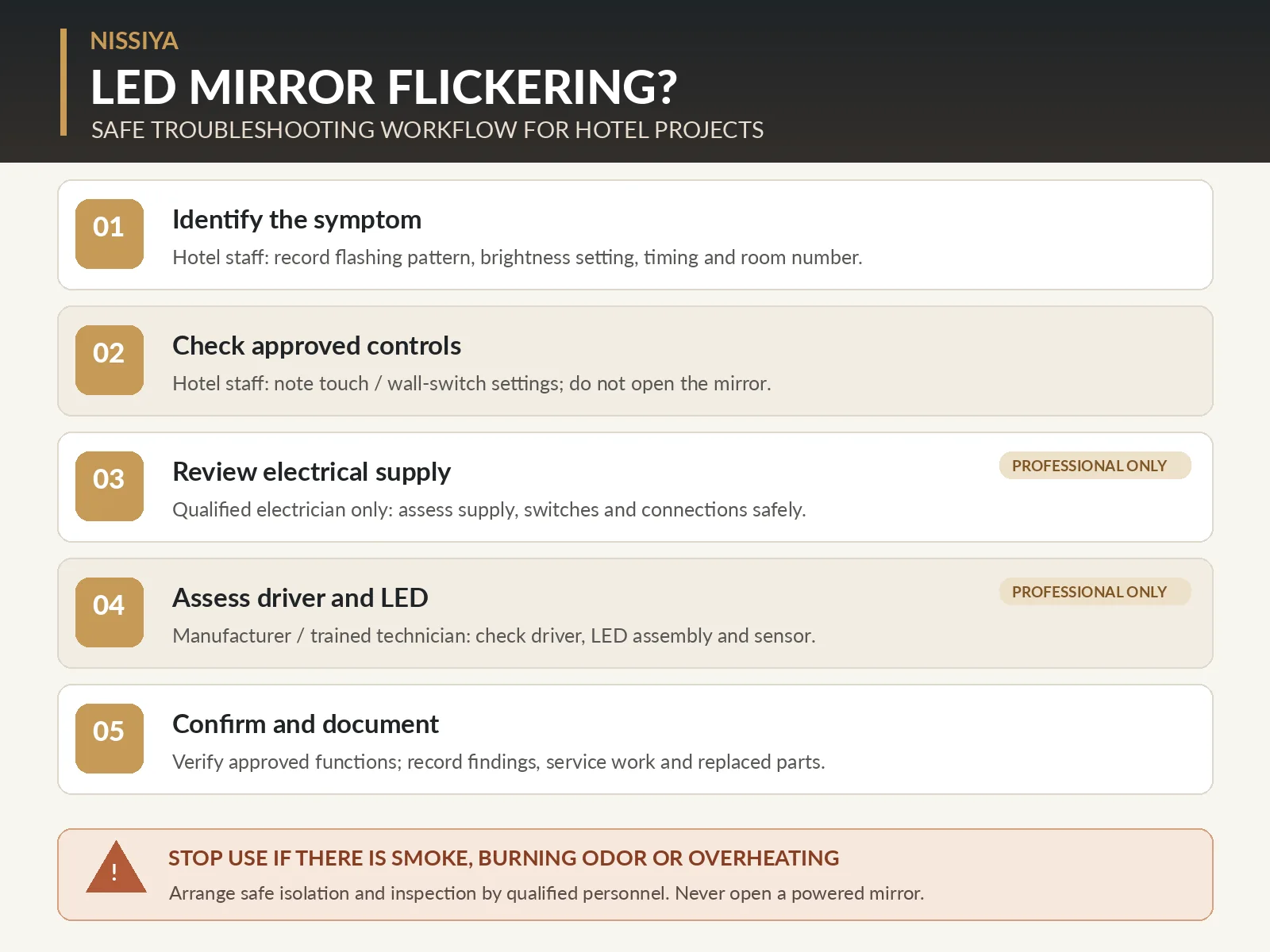
Check for Urgent Warning Signs
Look for smoke, burning odors, abnormal heat, water damage or exposed wiring. If any appear, stop use and request safe isolation and professional inspection.
Identify the Mirror and Its Controls
Record the model number, room location, installation date and available instructions. Note whether the mirror has a touch switch, infrared sensor, external dimmer or defogger.
Describe the Flicker Pattern
Report when the fault starts and whether it affects the whole border or only one area. Observe whether the light dims, flashes or switches completely off.
Review Normal Operating Settings
Check only the user controls described in the manual. Do not alter wiring, open housings or bypass safety devices to test a theory.
Look for Shared Symptoms
Determine whether the fan, nearby light or another guestroom shows similar behavior. Record the connection without intentionally stressing electrical circuits.
Arrange Qualified Electrical Diagnosis
An electrician should assess the supply, switching and connections using approved procedures. Hotel staff should not test live circuits or remove a hardwired mirror.
Coordinate Approved Product Service
When the building supply and controls meet the product requirements, consult the supplier about drivers, LED assemblies or sensors. Retain service records and use approved replacement parts.
Electrical safety: A bathroom mirror can contain hazardous electrical components even when its LED light is off. Never open a powered enclosure, touch internal wiring, bypass grounding or install an unapproved driver. Use a qualified electrician for electrical diagnosis and repairs.
For related specifications, see NISSIYA's LED Bathroom Mirror Electrical Requirements guide. It covers supply voltage, driver output, controls and installation considerations.
What Reddit Discussions Reveal About Flickering Bathroom Mirrors
Real user reports show how similar symptoms can occur under different conditions. However, a Reddit post cannot replace professional fault diagnosis. The examples below are individual reports, not verified failure investigations.
Backlit Mirror Flashes After Installation
A user in r/electricians described a backlit bathroom mirror connected to the same wall switch as an existing vanity light. The mirror later began flashing.
Hotel lesson: Verify the approved electrical connection and switching method before concluding that the mirror driver has failed. The post did not establish a final diagnosis.
Touch Controls Switch Lighting and Defogger
Another user in r/AskElectricians reported a plug-in LED mirror whose lighting and defogger sometimes switched on and off without deliberate input. The user suspected humidity.
Hotel lesson: Separate sensor or controller behavior from LED output flicker. The user's humidity theory was not confirmed.
Exhaust Fan Appears to Affect Mirror Control
A February 2026 report described an infrared-controlled mirror light that sometimes changed state when the bathroom fan started.
Hotel lesson: Test the complete bathroom control arrangement during sample-room approval. Timing alone cannot identify the precise electrical cause.
Observe First, Replace Parts Later
One fault appears during dimming; another involves unwanted switching. A third may follow operation of another electrical device. These patterns need different investigations.
Hotel lesson: Give the technician a precise symptom record before ordering parts or replacing the mirror.
For hospitality projects, these reports reinforce a practical point: LED bathroom mirror flickering is a symptom category, not a single technical defect.
One Flickering Mirror or Several Rooms: How Should Hotels Respond?
Where the failures occur matters as much as how they look. A single mirror may need a model-specific inspection, whereas faults across multiple rooms can point to a common specification or installation condition.
| Failure pattern | What to compare | Recommended response |
|---|---|---|
| One mirror in one room | Individual model, control and connection | Document symptoms and arrange targeted service. |
| Several mirrors on one circuit | Shared supply, switches and control system | Have an electrician assess common infrastructure. |
| Several units from one delivery batch | Approved components, batch records and factory tests | Coordinate a documented supplier investigation. |
| Only mirrors connected to dimmers | Approved dimmer and driver compatibility | Review control specifications before replacing units. |
| Failures begin after a renovation | New controls, wiring changes and installed models | Compare original and revised project drawings. |
| Problems after prolonged operation | Operating time, temperature and component symptoms | Stop repeat stress tests and request qualified assessment. |
For example, replacing every driver in a hotel is unlikely to help if the shared wall dimmer is incompatible. Conversely, a recurring component issue should not be ignored simply because the first guest report came from one room.
When several rooms show LED bathroom mirror flickering, create one record for each affected unit. Include the room number, mirror model, batch reference, symptom pattern and service outcome.
How Can Hotel Buyers Prevent LED Bathroom Mirror Flickering?
Reliable installation starts with a clear technical specification. Before ordering, the buyer should confirm the electrical supply, switching method, LED driver and applicable product requirements.
Approve the Correct Control Combination
Specify whether guests will operate the mirror by wall switch, touch control, infrared sensor or compatible external dimmer. A built-in touch-dimming feature does not mean the mirror accepts an ordinary wall dimmer.
Check the Driver and LED Assembly
Ask the supplier to confirm the driver input, output type, rated load and control compatibility. Where maintenance access is important, clarify how qualified technicians can service approved components.
Review Bathroom Protection and Compliance
Confirm that the exact model suits its intended location. An internal component's protection rating must not be presented as the rating of the complete mirror. Similarly, one model's certification does not automatically cover every customized electrical configuration.
Request Appropriate Factory Testing
For applicable LED mirror orders, NISSIYA uses a 48-hour powered aging test before final inspection and packaging. This process can reveal certain early lighting, driver, wiring or control problems.
Nevertheless, aging tests do not guarantee a product's entire service life or replace market-specific safety certification. The exact inspection scope depends on the confirmed mirror model and functions.
Read NISSIYA's 48-Hour LED Mirror Aging Test and LED Bathroom Mirror Quality Guide for further manufacturing considerations.
Test the Actual Sample Room
Finally, test the approved mirror with the real wall switch, guestroom controls, bathroom fan and selected functions. Record normal startup, dimming, power restoration and switching behavior.
These checks reduce avoidable compatibility mistakes. They cannot guarantee that LED bathroom mirror flickering will never occur, but they help buyers detect specification problems before a full rollout.
LED Bathroom Mirror Flickering Prevention Checklist for Hotel Projects
Use this checklist when reviewing product samples, electrical drawings and bulk production specifications. Keep the approved version with the project documentation.
| Item | What to confirm | Why it matters |
|---|---|---|
| Input supply | Correct rated voltage and frequency for the project. | Prevents an unsuitable electrical configuration. |
| LED driver | Approved input, output, load and control method. | Supports the intended lighting design. |
| Switching | Wall switch or touch control; power-restoration behavior. | Reduces unexpected switching. |
| External dimmer | Whether dimming is supported and which controls are compatible. | Avoids unsupported dimmer-driver combinations. |
| Sensor configuration | Touch or infrared functions, locations and service process. | Helps diagnose control-related problems. |
| Bathroom environment | Approved installation position and applicable protection. | Supports reliable operation in the intended setting. |
| Factory checks | Functional tests, applicable aging tests and acceptance records. | Helps detect certain early defects. |
| Sample-room test | Approved mirror operating with actual room controls. | Checks installation compatibility before scale-up. |
| Service plan | Approved parts, qualified repair method and documentation. | Supports efficient maintenance. |
| Batch tracking | Mirror model, driver specification and production lot records. | Makes multi-room investigations easier. |
The Hotel Bathroom Mirror Specifications Checklist covers broader project decisions, including materials, mounting, lighting and procurement approvals.
Can an LED Mirror Flicker When Its Light Looks Steady?
Yes. Some LED systems produce rapid variations in light output that are difficult to see directly. Engineers call this temporal light modulation, or TLM.
The U.S. Department of Energy's flicker measurement resource explains how instruments capture light-output waveforms for technical evaluation.
However, a phone-camera video cannot provide a reliable flicker specification by itself. The camera's recording settings can create bands or other visual artifacts. Proper assessment needs suitable equipment and stated test conditions.
As a result, buyers should request meaningful measurements whenever a supplier claims unusually low flicker. Marketing terms alone do not establish performance under every dimming level and driver-control combination.
LED Bathroom Mirror Flickering FAQs
Why does my LED bathroom mirror keep flickering?
LED bathroom mirror flickering may result from dimmer incompatibility, a driver fault, unstable supply, poor connections, LED damage or controller problems. A qualified technician must evaluate the actual installation to identify the cause.
Does a flickering mirror always need a new LED driver?
No. Although a defective driver is possible, an incompatible dimmer or supply issue can create similar symptoms. Verify the electrical and control arrangement before replacing any part.
Can an external wall dimmer cause LED mirror flickering?
Yes. Some dimmers do not work correctly with a mirror's driver, particularly at low settings. Always confirm compatibility for the exact model.
Why does the LED mirror flicker only at low brightness?
The dimming method, minimum supported level or driver-control interaction may be responsible. The installer should review the approved control settings and product documentation.
Can bathroom humidity cause the mirror light to malfunction?
Moisture may affect unsuitable or damaged electronics. However, humidity alone does not prove the cause. Review the product's protection design and actual installation environment.
Why does my bathroom mirror light switch on by itself?
An unexpected control signal or sensor problem may cause this behavior. It differs from continuous LED output flicker and requires its own investigation.
Can I replace a mirror driver with any model that has the same wattage?
No. A replacement must match the required electrical output, operating mode, control method and safety requirements. Use approved parts and qualified service.
How can hotels reduce LED mirror complaints?
Hotels can approve compatible controls, confirm electrical specifications, request appropriate factory tests and test a sample room before bulk installation. Maintenance teams should also keep accurate fault records.
Prevent Flickering with Clear Specifications and Safe Diagnosis
LED bathroom mirror flickering does not point to one universal failure. Electrical supply, controls, drivers, LED components and environmental conditions can create similar symptoms.
For hotel maintenance teams, careful observation and qualified diagnosis help avoid unnecessary replacement. Meanwhile, procurement managers can prevent some recurring problems by approving the actual mirror-driver-control combination before bulk production.
Reliable performance comes from coordinated product specifications, appropriate factory testing, professional installation and clear service documentation. A systematic response protects guest experience and supports long-term hotel operations.
Ready to Start Your Next Hospitality Project?
From initial design concepts to final product delivery, NISSIYA provides full-scale manufacturing support for hotels, resorts, and commercial developments worldwide. Let our engineering team help you translate your vision into reality with precision-engineered, commercially compliant mirror solutions.