


Is your magnifying mirror upside down when you step away from it? Seeing an inverted face in a 5X or 10X makeup mirror can be surprising, especially when the reflection looks perfectly normal up close. In many cases, the mirror is behaving exactly as a curved magnifying surface should.
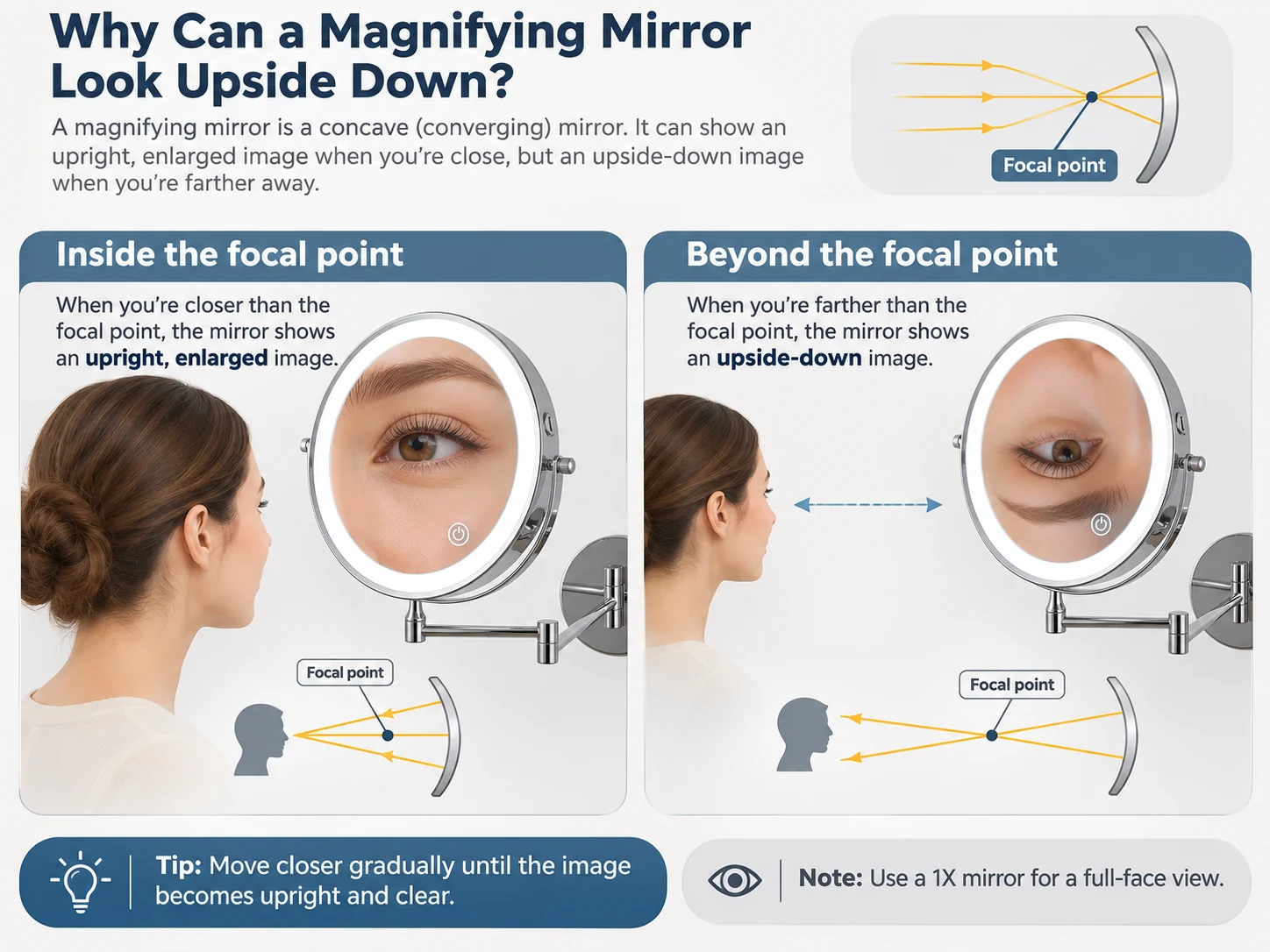
A concave mirror changes its image depending on the distance between your face and the glass. Close to the surface, the reflection can appear upright and enlarged. Move beyond the mirror's focal point, however, and the image can turn upside down. This is a distance-related optical effect, not an LED setting.
Here is how to restore a usable reflection, understand the simple physics and decide when a mirror may need closer inspection. We also explain how NISSIYA hotel buyers can help guests use high-magnification mirrors comfortably without assuming a fixed viewing distance for every model.
Magnifying Mirror Upside Down? Try This 30-Second Check
The quickest way to understand the reflection is to change your viewing position, not the lighting controls. Use a comfortable posture, particularly with a wall-mounted mirror above a bathroom vanity. Never force your face against the glass to obtain a clear image.
- Identify the mirror side. On a double-sided 1X/10X model, rotate to the magnifying surface when you need close-up detail. Use the 1X side for normal, full-face viewing.
- Position the head. Adjust the wall arm or tabletop stand so the glass faces you directly, with your eye area near its center.
- Move closer slowly. Watch for the inverted image to blur, change and become upright as your face approaches the glass.
- Find a comfortable clear view. Make small adjustments until the area you want to inspect looks sharp. Do not assume a distance copied from another brand will fit this mirror.
- Return to 1X when needed. Use the normal side or your main bathroom mirror to check the whole face.
If the image remains upside down or unusable even when you are within the product's intended viewing range, consult its instructions. Check a sample of the same model if one is available, and contact the supplier when the result still seems abnormal.
Why Does a Magnifying Mirror Turn Your Face Upside Down?
The answer comes from the shape of the reflective surface. A standard 1X mirror is essentially flat, while the magnifying side of a cosmetic mirror curves inward. That inward curve is called concave. It redirects reflected light so the image changes as your viewing position changes.
The important boundary is the focal point. In simplified geometric optics, the reflected rays from a distant object converge at a focal point in front of a concave mirror. Your face appears upright and enlarged when it is closer to the mirror than that focal distance.
Once your face moves farther away than the focal point, the mirror can form an inverted real image. The transition can appear as a confusing blur before the upside-down view becomes recognizable. This behavior is explained in OpenStax's lesson on mirror reflection .
Three Viewing Positions Around the Focal Point
| Face Position | Typical Reflection | What It Means |
|---|---|---|
| Closer than the focal point | Upright, enlarged image | The intended magnifying mode for close-up grooming |
| Near the focal point | Very difficult to focus or apparently disappearing | The viewing position is near the optical transition |
| Farther than the focal point | Inverted image; size varies with distance | A normal concave-mirror effect, not automatically a defect |
This explains the common "magnifying mirror upside down" experience: the same curved surface can produce different image orientations without any physical change to the product. It does not mean the mirror has a button that reverses the image.
Why a Spoon Makes a Useful Demonstration
Look at the shiny inside surface of a clean spoon. At a close distance, your eye may appear enlarged and upright. Move the spoon farther away and your face can appear upside down. A cosmetic magnifying mirror uses a more carefully designed concave surface, but the underlying principle is similar.
The National High Magnetic Field Laboratory's microscopy resource describes this spoon experiment. It is a simple way to understand why the image changes as the distance changes.
Does an Upside-Down Image Happen With 3X, 5X and 10X?
Yes. In principle, concave magnifying mirrors can form inverted images when the object is outside the focal point. The difference users notice is the distance at which a useful upright view is obtained. Stronger makeup mirrors commonly require the face to be closer to the glass.
| Mirror Type | Usual Viewing Character | Practical Response |
|---|---|---|
| 1X Flat Mirror | Normal upright reflection across ordinary viewing distances | Use for a full-face view |
| 3X Magnifying Mirror | Moderate enlargement with a more forgiving working position | Move closer if the enlarged image is unclear |
| 5X Magnifying Mirror | Greater detail, generally requiring a closer position | Adjust the mirror arm and center the area being viewed |
| 10X Magnifying Mirror | High-detail close-up with a relatively narrow working range | Approach gradually; use 1X for overall makeup |
Exact distances depend on curvature, optical design and individual viewing comfort. Avoid treating a general distance chart as an official specification for every NISSIYA mirror. For the wider comparison of magnification levels, see our 3X vs 5X vs 7X vs 10X magnifying mirror guide .
Why Is an Inverted 10X Reflection So Noticeable?
Many people expect a makeup mirror to behave like a flat bathroom mirror. They stand at their normal vanity distance, look into the magnified side and find an upside-down face instead. Moving closer may feel unfamiliar, particularly when the mirror is fixed to a wall.
A 10X surface is designed for viewing small details, not the entire face from across the basin. To evaluate a complete makeup look, change to the 1X side or another normal mirror. NISSIYA's existing 10X mirror blurry troubleshooting guide covers additional causes of unclear reflections, including lighting and surface residue.
Magnifying Mirror Upside Down: Normal Optics or a Defect?
An inverted image at a distance is often expected. Persistent distortion under the correct conditions is a different matter. Before deciding that a product is defective, describe what the customer sees and when the problem happens.
| What You See | Likely Explanation | First Check |
|---|---|---|
| Face upright close up, inverted farther back | Normal concave-mirror image formation | Use the closer clear-view position |
| Reflection changes rapidly near one distance | Position near the focal point | Adjust viewing distance gradually |
| 10X side shows only part of the face | Narrow high-magnification field of view | Use 1X for the full-face check |
| Image looks cloudy at all positions | Residue, moisture or other clarity issue may be involved | Inspect and clean according to the care instructions |
| Reflection remains strongly wavy at the intended distance | Possible optical curvature or surface issue | Compare with an approved sample and contact the supplier |
| 1X side appears vertically inverted | Not the normal concave-mirror explanation for a flat 1X side | Confirm the actual side and product construction; request support |
The difference matters in customer service. A "magnifying mirror upside down" complaint may only need a viewing-distance explanation. On the other hand, an image that remains visibly uneven at a suitable position deserves a proper product inspection.
Do Not Confuse Inversion With Edge Distortion
Image inversion changes the apparent top-to-bottom direction of the reflection. Edge distortion is different: parts of the face may look stretched, curved or uneven near the perimeter of a magnifying surface. A cloudy reflection is another separate symptom.
To avoid misdiagnosis, ask whether the whole image flips as the user steps back or whether one area stays irregular at every suitable distance. For a normal concave reflection, moving closer should restore an upright close-up view.
How to Find a Clear View Without Leaning Over the Basin
Distance and mirror position should work together. A magnifying surface may be optically correct but inconvenient when the wall arm cannot reach the user or the mounting height is unsuitable. That problem becomes noticeable in compact bathrooms with deep countertops.
Start by bringing the adjustable mirror toward the face rather than stretching across a sink. Position the head at a comfortable eye level, then adjust the angle and viewing distance. Keep both the mirror and your posture stable during detail work.
For hotels, the usable reach should be checked in a representative guestroom before the product is approved. Our wall-mounted makeup mirror height guide discusses this installation issue in more detail.
Can LED Lighting or Touch Controls Make a Reflection Upside Down?
No. LED illumination can improve facial visibility, but it does not change the concave mirror's focal length or reverse the geometry of the reflected image. A warm/cool light setting may change how skin appears, while a dimmer affects brightness. Neither is an optical inversion switch.
When a customer sees an upside-down reflection, checking the switch is not the first step unless the light itself is malfunctioning. Begin with the correct mirror side and viewing distance. Use NISSIYA's makeup mirror lighting guide if the issue is facial illumination rather than image orientation.
NISSIYA Double-Sided Makeup Mirror Examples
Mirror configuration matters because some products provide a separate normal 1X surface. The actual sides should be verified against each model's approved specification rather than assuming every magnifying mirror supports several selectable magnifications.
| Actual NISSIYA Model | Listed Configuration | What It Means for Viewing |
|---|---|---|
| 8-Inch Rechargeable Wall Mirror | Double-sided 1X/10X, rechargeable LED, touch control, adjustable arm | Use 1X for the full face and 10X close to the glass for fine detail |
| ELITE Polished Chrome | Double-sided 1X/3X, acrylic LED light guide, wall-mounted arm | A moderate magnified side plus a separate normal side |
| 8-Inch Matte Black 5X | Single-sided 5X, integrated LED, double swing arm | Use a separate normal bathroom mirror for overall checks |
The 1X/10X rechargeable product has three selectable lighting colors in its listed configuration. That feature should not be assumed for the ELITE or single-sided 5X model. Regardless of the lighting functions, image inversion is controlled by optical position.
Magnifying Mirror Upside Down? What Hotels Should Explain
In hotels, an inverted reflection can look like a product failure to a guest who has never used a strong magnifying mirror. A short instruction card or an explanation from the maintenance team can prevent unnecessary service calls. The wording should be specific to the installed model.
Use that instruction only when the approved product has both a 1X and magnified side. A single-sided 5X mirror needs a different final sentence, such as "Use the main bathroom mirror for a full-face view."
Hotel Sample-Room and OEM QC Checklist
| Inspection | What to Verify | Why It Matters |
|---|---|---|
| Side Identification | Confirm whether the sample is 1X/3X, 1X/10X or single-sided 5X | Guest instructions must match the actual product |
| Upright Close-Up View | Test the magnified side at its intended working position | Separates normal inversion from possible optical defects |
| Arm Reach and Position | Check height, extension, joints and folded clearance | Guests must reach a comfortable viewing distance |
| Image Consistency | Compare approved sample and production inspection results | Helps identify unwanted waves or uneven clarity |
| Lighting and Control | Confirm only the LED functions specified for this model | Avoids confusion between lighting faults and optics |
| Guest Documentation | Add clear, concise use instructions for the magnified side | Helps first-time users understand the close-up view |
For procurement teams, an inverted reflection is primarily an explanation and usability issue when the image becomes clear at the intended distance. Unusual persistent distortion needs a separate quality check. Document both findings before treating a hotel complaint as a manufacturing defect.
What Real Users Find Confusing About Magnifying Mirrors
In a Reddit conversation about mirrors for glasses wearers , one shopper described seeing an upside-down reflection unless they moved very close. The replies also highlighted the difficulty of getting a useful view when users have different visual needs.
That discussion is anecdotal, not a product test, but it illustrates why clear instructions and adjustable mounting can matter. Shoppers may experience a perfectly normal optical effect as a defect when nobody explains the focal distance.
NISSIYA has a separate makeup mirror guide for glasses wearers covering positioning and practical visibility. This article concentrates on the inverted-image effect itself.
Magnifying Mirror Upside Down: Frequently Asked Questions
Why is my magnifying mirror upside down?
A concave magnifying mirror can form an inverted image when your face is farther from the glass than its focal point. Move closer gradually to find the upright, enlarged reflection. This is often normal optical behavior.
Is an upside-down 10X mirror defective?
Not necessarily. An inverted image at a greater distance is expected for many 10X concave mirrors. If the reflection remains unusable at the intended close-up distance, check the instructions and contact the supplier.
How close should I be to a 10X makeup mirror?
There is no reliable universal distance for every product. High-magnification mirrors usually require a close viewing position. Follow the actual model's guidance and move gradually until the image is upright and clear.
Why does the reflection flip when I move away?
Moving beyond the focal point changes the type of image produced by a concave mirror. The close-up upright image can become difficult to focus and then appear inverted at a greater distance.
Can a 5X or 3X mirror also turn an image upside down?
Yes. This effect follows concave-mirror optics rather than belonging only to 10X products. Working distance varies with the actual mirror design.
Should the regular 1X side show my face upside down?
A standard flat 1X mirror should provide an upright reflection during normal use. If the 1X side appears vertically inverted, verify the mirror side and seek product support rather than assuming ordinary magnification optics.
Does changing LED brightness fix an inverted reflection?
No. Light controls affect illumination, not the geometric image formation of the concave surface. Adjust your viewing distance and mirror angle first.
What should hotels do when guests report an upside-down mirror?
Confirm the installed model and explain that the magnified side is intended for close-up use. Demonstrate a comfortable upright view, then inspect the product if clarity problems remain at the intended position.
Final Advice: Fix the Distance Before Blaming the Mirror
An upside-down reflection in a magnifying mirror usually means the viewer is standing beyond the focal point of a concave surface. The simple remedy is to bring the magnifying side and your face into a comfortable close-up position. Use 1X whenever you need a normal, full-face reflection.
For hotels and wholesale buyers, the lesson is equally practical: verify magnification, viewing comfort and arm reach in a representative room. NISSIYA recommends comparing an approved sample with the ordered specification before concluding that image inversion indicates a product fault.
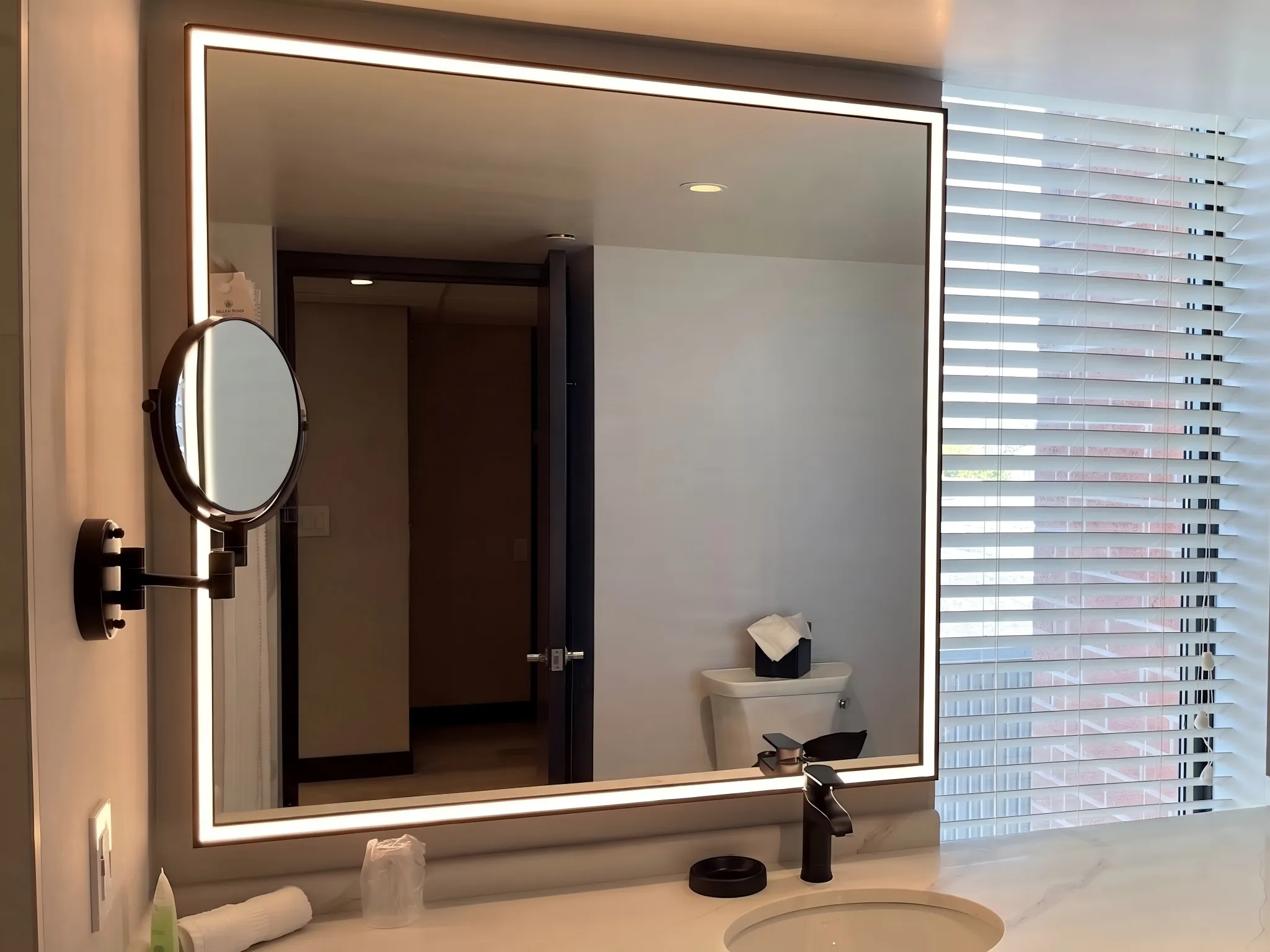
Precision Craftsmanship
Exceptional Quality for Luxury Hospitality
NISSIYA provides turnkey mirror solutions for high-end hotel renovations. Our ETL-certified LED mirrors and precision-engineered wall-mounted makeup mirrors combine sophisticated design with commercial-grade durability
- High Definition Reflection
- Explosion-Proof Film Added
- Eco-Friendly Materials
- ETL/SAA/CE Commercial Certified
- Custom Hospitality Solutions
- Superior Commercial Durability
Ready to Start Your Next Hospitality Project?
From initial design concepts to final product delivery, NISSIYA provides full-scale manufacturing support for hotels, resorts, and commercial developments worldwide. Let our engineering team help you translate your vision into reality with precision-engineered, commercially compliant mirror solutions.